How many signals for 5 methly 3 hexanol ? Can you please show all the steps?...
How many signals for 5 methly 3 hexanol ?
Can you please show all the steps?
Thanks,
Homework Answers

To determine the number of signals for 5-methyl-3-hexanol, we need to consider the different types of hydrogen atoms (protons) present in the molecule. Each unique environment or chemical environment of hydrogen atoms will give rise to a distinct signal in the nuclear magnetic resonance (NMR) spectrum.
Here are the steps to determine the number of signals:
Identify the different types of hydrogen atoms in the molecule: 5-methyl-3-hexanol contains several types of hydrogen atoms. Let's analyze them one by one:
a) Methyl group (CH₃): There is one methyl group attached to the carbon chain. The hydrogen atoms in the methyl group are all equivalent and will contribute to a single signal.
b) Primary alcohol group (-CH₂OH): The hydrogen atom attached to the hydroxyl group (-OH) will be chemically different from the hydrogen atoms in the carbon chain due to its proximity to the polar functional group. It will contribute to a separate signal.
c) Carbon chain (CH₂): The remaining hydrogen atoms in the carbon chain are all equivalent and will contribute to a single signal.
Count the number of unique hydrogen atom environments: Based on the analysis above, we have identified two unique environments for hydrogen atoms: the methyl group and the primary alcohol group.
Determine the number of signals: Each unique environment corresponds to a distinct signal in the NMR spectrum. Therefore, in 5-methyl-3-hexanol, there will be two signals.
To summarize, 5-methyl-3-hexanol exhibits two signals in the NMR spectrum: one signal for the methyl group and another signal for the primary alcohol group.
Add Answer to:
How many signals for 5 methly 3 hexanol ?
Can you please show all the steps?...
CAN YOU SHOW ALL STEPS PLEASE Ch 3, Interest and Equivalence So You Wanna be an...
 CAN YOU SHOW ALL STEPS PLEASE
Ch 3, Interest and Equivalence So You Wanna be an Engineer/CM 3-3 You put $1000 into a savings account at EOYO and EOY1. How much money is in the account EOY3 if interest is paid three times per year? The interest rate is 7.2%
CAN YOU SHOW ALL STEPS PLEASE
Ch 3, Interest and Equivalence So You Wanna be an Engineer/CM 3-3 You put $1000 into a savings account at EOYO and EOY1. How much money is in the account EOY3 if interest is paid three times per year? The interest rate is 7.2%
How many signals would you expect to see in the ' Hedrenes BE 5 3 6...
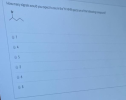 How many signals would you expect to see in the ' Hedrenes BE 5 3 6 8
4. Propose a synthesis to create 3,4-dimethyl-3-hexanol from 1-butene. You only need to show individual steps an...
 4. Propose a synthesis to create 3,4-dimethyl-3-hexanol from 1-butene. You only need to show individual steps and reagents, you do not need to show mechanisms. You must use 1-butene as your ONLY source of carbon atoms. The convergent processes have been outlined for you. for STEP 1: Show how to synthesize butyl magnesium bromide from 1-butene (5 points): BrMg STEP 2: Show how to synthesize 2-butanone from 1-butene (5 points): STEP 3: What intermediate forms below and what reagent(s) will...
3. For the compound dimedone, how many different signals would you see in the proton NMR?...
 3. For the compound dimedone, how many different signals would you see in the proton NMR? (Assume that you can see them all.) A) 2 в) з c) 4 D) 5 E) None of these choices.
Please show all work. Thank You. 5. Determine the Fourier Transforms of the following signals (a)...
 Please show all work. Thank You.
5. Determine the Fourier Transforms of the following signals (a) sinc(Tt/2) (b) 5() (c) sin2(2Tt)
Please show all work. Thank You.
5. Determine the Fourier Transforms of the following signals (a) sinc(Tt/2) (b) 5() (c) sin2(2Tt)
Please show all the steps on how to get the results....!!, really need to understand this...
 Please show all the steps on how to get the results....!!,
really need to understand this for a test!!!!, dont skip steps
please, thanks!!!, Do each question separately
3. A 10 kg block is hanging froma solid cylinder of mass 20 kg (R = 3m). The block is attached by a rope that winds around the cylinder and is 4 m above the ground. M2 = 20 kg R 3 m M1 10 kg 4m a. Calculate the acceleration of...
Please show all the steps on how to get the results....!!,
really need to understand this for a test!!!!, dont skip steps
please, thanks!!!, Do each question separately
3. A 10 kg block is hanging froma solid cylinder of mass 20 kg (R = 3m). The block is attached by a rope that winds around the cylinder and is 4 m above the ground. M2 = 20 kg R 3 m M1 10 kg 4m a. Calculate the acceleration of...
Please be neat and show all work, thank you. 3. Plot the following signals: a) 9.(t)...
 Please be neat and show all work, thank you.
3. Plot the following signals: a) 9.(t) = 11(2t+5) b) 92(t) = sgn(2t) - sgn(t)
Please be neat and show all work, thank you.
3. Plot the following signals: a) 9.(t) = 11(2t+5) b) 92(t) = sgn(2t) - sgn(t)
Please show all steps. Thank you 5. Find all A = A such that A-A. 2x2
 Please show all steps. Thank you
5. Find all A = A such that A-A. 2x2
Please show all steps. Thank you
5. Find all A = A such that A-A. 2x2
Hi there. Could you please show a stepwise mechanism for the following: Please SHOW ALL STEPS...
 Hi there. Could you please show a stepwise mechanism for the
following: Please SHOW ALL STEPS so I can understand. Thanks!
:)
(a) 2-methylcyclohexanol dehydrating via El pathway to form the major product detected by GC (b) cis-2-methylcyclohexanol dehydrating via E2 pathway to form the major product detected by cyclohexanes to illustrate this mechanisms stereochemical requirements.
Hi there. Could you please show a stepwise mechanism for the
following: Please SHOW ALL STEPS so I can understand. Thanks!
:)
(a) 2-methylcyclohexanol dehydrating via El pathway to form the major product detected by GC (b) cis-2-methylcyclohexanol dehydrating via E2 pathway to form the major product detected by cyclohexanes to illustrate this mechanisms stereochemical requirements.
can you please show all the steps (not just this) with every arrow and mechanisms and...
 can you please show all the steps (not just this) with every
arrow and mechanisms and show exactly how to get to these states
please?
thank you so much. I just don't understand how to get actually
get to these products
(neutral form) H* (trace) heat + aos NH2 NaBH3CN or H2, metal cat (Pd/C, Ni, or Raney Ni)
can you please show all the steps (not just this) with every
arrow and mechanisms and show exactly how to get to these states
please?
thank you so much. I just don't understand how to get actually
get to these products
(neutral form) H* (trace) heat + aos NH2 NaBH3CN or H2, metal cat (Pd/C, Ni, or Raney Ni)
 CAN YOU SHOW ALL STEPS PLEASE
Ch 3, Interest and Equivalence So You Wanna be an Engineer/CM 3-3 You put $1000 into a savings account at EOYO and EOY1. How much money is in the account EOY3 if interest is paid three times per year? The interest rate is 7.2%
CAN YOU SHOW ALL STEPS PLEASE
Ch 3, Interest and Equivalence So You Wanna be an Engineer/CM 3-3 You put $1000 into a savings account at EOYO and EOY1. How much money is in the account EOY3 if interest is paid three times per year? The interest rate is 7.2%
 How many signals would you expect to see in the ' Hedrenes BE 5 3 6 8
 4. Propose a synthesis to create 3,4-dimethyl-3-hexanol from 1-butene. You only need to show individual steps and reagents, you do not need to show mechanisms. You must use 1-butene as your ONLY source of carbon atoms. The convergent processes have been outlined for you. for STEP 1: Show how to synthesize butyl magnesium bromide from 1-butene (5 points): BrMg STEP 2: Show how to synthesize 2-butanone from 1-butene (5 points): STEP 3: What intermediate forms below and what reagent(s) will...
 3. For the compound dimedone, how many different signals would you see in the proton NMR? (Assume that you can see them all.) A) 2 в) з c) 4 D) 5 E) None of these choices.
 Please show all work. Thank You.
5. Determine the Fourier Transforms of the following signals (a) sinc(Tt/2) (b) 5() (c) sin2(2Tt)
Please show all work. Thank You.
5. Determine the Fourier Transforms of the following signals (a) sinc(Tt/2) (b) 5() (c) sin2(2Tt)
 Please show all the steps on how to get the results....!!,
really need to understand this for a test!!!!, dont skip steps
please, thanks!!!, Do each question separately
3. A 10 kg block is hanging froma solid cylinder of mass 20 kg (R = 3m). The block is attached by a rope that winds around the cylinder and is 4 m above the ground. M2 = 20 kg R 3 m M1 10 kg 4m a. Calculate the acceleration of...
Please show all the steps on how to get the results....!!,
really need to understand this for a test!!!!, dont skip steps
please, thanks!!!, Do each question separately
3. A 10 kg block is hanging froma solid cylinder of mass 20 kg (R = 3m). The block is attached by a rope that winds around the cylinder and is 4 m above the ground. M2 = 20 kg R 3 m M1 10 kg 4m a. Calculate the acceleration of...
 Please be neat and show all work, thank you.
3. Plot the following signals: a) 9.(t) = 11(2t+5) b) 92(t) = sgn(2t) - sgn(t)
Please be neat and show all work, thank you.
3. Plot the following signals: a) 9.(t) = 11(2t+5) b) 92(t) = sgn(2t) - sgn(t)
 Please show all steps. Thank you
5. Find all A = A such that A-A. 2x2
Please show all steps. Thank you
5. Find all A = A such that A-A. 2x2
 Hi there. Could you please show a stepwise mechanism for the
following: Please SHOW ALL STEPS so I can understand. Thanks!
:)
(a) 2-methylcyclohexanol dehydrating via El pathway to form the major product detected by GC (b) cis-2-methylcyclohexanol dehydrating via E2 pathway to form the major product detected by cyclohexanes to illustrate this mechanisms stereochemical requirements.
Hi there. Could you please show a stepwise mechanism for the
following: Please SHOW ALL STEPS so I can understand. Thanks!
:)
(a) 2-methylcyclohexanol dehydrating via El pathway to form the major product detected by GC (b) cis-2-methylcyclohexanol dehydrating via E2 pathway to form the major product detected by cyclohexanes to illustrate this mechanisms stereochemical requirements.
 can you please show all the steps (not just this) with every
arrow and mechanisms and show exactly how to get to these states
please?
thank you so much. I just don't understand how to get actually
get to these products
(neutral form) H* (trace) heat + aos NH2 NaBH3CN or H2, metal cat (Pd/C, Ni, or Raney Ni)
can you please show all the steps (not just this) with every
arrow and mechanisms and show exactly how to get to these states
please?
thank you so much. I just don't understand how to get actually
get to these products
(neutral form) H* (trace) heat + aos NH2 NaBH3CN or H2, metal cat (Pd/C, Ni, or Raney Ni)
Most questions answered within 3 hours.
-
Where is the error in this code sequence?
String s1 = "Hello";
String s2 = "ello";...
asked 10 months ago -
Financial data for Joel de Paris, Inc., for last year
follow:
Joel de Paris, Inc.
Balance...
asked 10 months ago -
Consider this reaction:
Al2(SO4)3 (aq)+ BaCl3
(aq) Al2Cl6 (aq)- +
3BaSO4(s) . What is the...
asked 10 months ago -
Suppose that Savneet is considering increasing her
recent random sample from 20 car rentals to 40...
asked 10 months ago -
Trucks arrive at an unloading terminal at an average rate of 120
per hour.
Trucks arrive...
asked 10 months ago -
Why are methanol and ethanol completely soluble in water while
octanol is not very little soluble....
asked 10 months ago -
A facilities manager at a university reads in a research report
that the mean amount of...
asked 10 months ago -
When the CuSO4 is rehydrated by adding water to the anhydrous
compound, is this an endothermic...
asked 10 months ago -
A ray of sunlight is passing from diamond into crown glass; the
angle of incidence is...
asked 10 months ago -
A block of mass 0.249 kg is placed on top of a light, vertical
spring of...
asked 10 months ago -
how do the kidneys compensate in the presences of acidosis
a) trigger hyperventilate
b) reserve acid...
asked 10 months ago -
Question 501 pts
The rental rate of capital to the firm increases. Which of the
following...
asked 10 months ago