Explain the effect of the solvent on the reaction kinetics with respect to an SN1 mechanism?...
Explain the effect of the solvent on the reaction kinetics with respect to an SN1 mechanism?
- solvent used was 60/40 acetone/water solution up to 100ml
Homework Answers
Request Answer!
We need at least 10 more requests to produce the answer.
0 / 10 have requested this problem solution
The more requests, the faster the answer.
Add Answer to:
Explain the effect of the solvent on the reaction kinetics with
respect to an SN1 mechanism?...
Explain the effect of the solvent on the reaction kinetics with respect to an SN1 mechanism....
Explain the effect of the solvent on the reaction kinetics with respect to an SN1 mechanism. How to explain 50%/50% acetone/water & 60%/40% acetone/water with reference to the above to the above (from results half life was way less in 50/50) According to the data chart, the Rate constant for the hydrolysis of tertbutylchloride in 50/50 acetone/water (volume) is: k=1.03E-2/min^1 The rate constant for the hydrolysis of tertbutylchloride in 60/40 acetone/water is: K=2.9E-3/min^-1
What is the solvent used in the Sn1 reaction between water and 2-chloro-2-methylpropane... in our experiment...
What is the solvent used in the Sn1 reaction between water and 2-chloro-2-methylpropane... in our experiment we used 2-chloro-2-methylpropane in acetone and NaOH. Would the solvent just be acetone and water? and NaOH acts as the nucleophile?
explain why a polar protic solvent speeds the rate of an SN1 mechanism
explain why a polar protic solvent speeds the rate of an SN1 mechanism
SN2 stepwise mechanism with arrows, the substrate and solvent effect on the reaction, and the stereochemical...
SN2 stepwise mechanism with arrows, the substrate and solvent effect on the reaction, and the stereochemical and regiochemical outcome for the reaction
C. Indicate which is the late-detemning step. d. Is it the same mechanism as in question...
 C. Indicate which is the late-detemning step. d. Is it the same mechanism as in question 1? Why or why not? 3. Explain why El and Sx1 mechanisms follow first order reaction kinetics, whereas E2 and SN2 mechanisms follow second order reaction kinetics. 4. Which is the better nucleophile in a protic solvent: chloride ion or bromide ion? Try to explain this in terms of the nature of the chloride ion and the bromide ion. 5. For the synthesis of...
HCI Choose the correct mechanism and then the solvent that is best for the reaction. CH3OH...
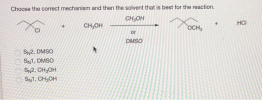 HCI Choose the correct mechanism and then the solvent that is best for the reaction. CH3OH X Сн,он OCH DMSO SN2, DMSO SN1, DMSO SN2, CH3OH Sn1, CH3OH
1.) Determine the mechanism. (Sn1 or Sn2) 2.) Show step by step reaction mechanism of nucleophilic...
 1.) Determine the mechanism. (Sn1 or Sn2)
2.) Show step by step reaction mechanism of nucleophilic
substitution including transition states
3.) Draw the products, including stereochemistry
Br + CN acetone
1.) Determine the mechanism. (Sn1 or Sn2)
2.) Show step by step reaction mechanism of nucleophilic
substitution including transition states
3.) Draw the products, including stereochemistry
Br + CN acetone
3) Write a complete Sn1 mechanism for the following reaction Also, 4) Write a complete Sn2...
 3) Write a complete Sn1 mechanism for the following
reaction
Also,
4) Write a complete Sn2 mechanism for the following.
Please show transition state and list a good solvent as well.
Thank you!
3. Write a complete Sn1 mechanism for the following reaction. Вт + CH3OH CH₃CH2 CH3 4. Write a complete SN2 mechanism for the following. Show the transition state as well. Also list a good solvent. OTS + NaCN H3C 3. Write a complete sul mechanism for the...
3) Write a complete Sn1 mechanism for the following
reaction
Also,
4) Write a complete Sn2 mechanism for the following.
Please show transition state and list a good solvent as well.
Thank you!
3. Write a complete Sn1 mechanism for the following reaction. Вт + CH3OH CH₃CH2 CH3 4. Write a complete SN2 mechanism for the following. Show the transition state as well. Also list a good solvent. OTS + NaCN H3C 3. Write a complete sul mechanism for the...
The follwoign data have been obtained for the effect of solvent composition on the solubility of...
The follwoign data have been obtained for the effect of solvent composition on the solubility of a serine, an amino acid, at 10.0 degrees C: Volume % Methanol 0 10 20 30 40 60 80 100 Solubility (g/100mL solvent) 22.72 18.98 11.58 6.415 4.205 1.805 0.85 0.65 Solution Density (g/mL) 1.00 0.98 0.97 0.95 0.94 0.91 0.88 0.79 The data were obtained by mixing known volumes of methanol and water to obtain the desired solven compositions and then slowly adding...
Sn1 reactions are effected by solvent. Can you just explian what the predicted order will be...
 Sn1 reactions are effected by solvent. Can you just explian what
the predicted order will be and why.
Arrange the four test tubes in the test tube stand. In the first test tube, add 1 mL 1: 1 of methanol: water solvent solution. In the second tube, add 1 mL of a 1: 1 ethanol: water solvent solution. In the third tube, add 1 mL of a 1: 1 1-propanol: water solvent solution. In the fourth and final tube, add...
Sn1 reactions are effected by solvent. Can you just explian what
the predicted order will be and why.
Arrange the four test tubes in the test tube stand. In the first test tube, add 1 mL 1: 1 of methanol: water solvent solution. In the second tube, add 1 mL of a 1: 1 ethanol: water solvent solution. In the third tube, add 1 mL of a 1: 1 1-propanol: water solvent solution. In the fourth and final tube, add...
 C. Indicate which is the late-detemning step. d. Is it the same mechanism as in question 1? Why or why not? 3. Explain why El and Sx1 mechanisms follow first order reaction kinetics, whereas E2 and SN2 mechanisms follow second order reaction kinetics. 4. Which is the better nucleophile in a protic solvent: chloride ion or bromide ion? Try to explain this in terms of the nature of the chloride ion and the bromide ion. 5. For the synthesis of...
 HCI Choose the correct mechanism and then the solvent that is best for the reaction. CH3OH X Сн,он OCH DMSO SN2, DMSO SN1, DMSO SN2, CH3OH Sn1, CH3OH
 1.) Determine the mechanism. (Sn1 or Sn2)
2.) Show step by step reaction mechanism of nucleophilic
substitution including transition states
3.) Draw the products, including stereochemistry
Br + CN acetone
1.) Determine the mechanism. (Sn1 or Sn2)
2.) Show step by step reaction mechanism of nucleophilic
substitution including transition states
3.) Draw the products, including stereochemistry
Br + CN acetone
 3) Write a complete Sn1 mechanism for the following
reaction
Also,
4) Write a complete Sn2 mechanism for the following.
Please show transition state and list a good solvent as well.
Thank you!
3. Write a complete Sn1 mechanism for the following reaction. Вт + CH3OH CH₃CH2 CH3 4. Write a complete SN2 mechanism for the following. Show the transition state as well. Also list a good solvent. OTS + NaCN H3C 3. Write a complete sul mechanism for the...
3) Write a complete Sn1 mechanism for the following
reaction
Also,
4) Write a complete Sn2 mechanism for the following.
Please show transition state and list a good solvent as well.
Thank you!
3. Write a complete Sn1 mechanism for the following reaction. Вт + CH3OH CH₃CH2 CH3 4. Write a complete SN2 mechanism for the following. Show the transition state as well. Also list a good solvent. OTS + NaCN H3C 3. Write a complete sul mechanism for the...
 Sn1 reactions are effected by solvent. Can you just explian what
the predicted order will be and why.
Arrange the four test tubes in the test tube stand. In the first test tube, add 1 mL 1: 1 of methanol: water solvent solution. In the second tube, add 1 mL of a 1: 1 ethanol: water solvent solution. In the third tube, add 1 mL of a 1: 1 1-propanol: water solvent solution. In the fourth and final tube, add...
Sn1 reactions are effected by solvent. Can you just explian what
the predicted order will be and why.
Arrange the four test tubes in the test tube stand. In the first test tube, add 1 mL 1: 1 of methanol: water solvent solution. In the second tube, add 1 mL of a 1: 1 ethanol: water solvent solution. In the third tube, add 1 mL of a 1: 1 1-propanol: water solvent solution. In the fourth and final tube, add...
Most questions answered within 3 hours.
-
Where is the error in this code sequence?
String s1 = "Hello";
String s2 = "ello";...
asked 10 months ago -
Financial data for Joel de Paris, Inc., for last year
follow:
Joel de Paris, Inc.
Balance...
asked 10 months ago -
Consider this reaction:
Al2(SO4)3 (aq)+ BaCl3
(aq) Al2Cl6 (aq)- +
3BaSO4(s) . What is the...
asked 10 months ago -
Suppose that Savneet is considering increasing her
recent random sample from 20 car rentals to 40...
asked 10 months ago -
Trucks arrive at an unloading terminal at an average rate of 120
per hour.
Trucks arrive...
asked 10 months ago -
Why are methanol and ethanol completely soluble in water while
octanol is not very little soluble....
asked 10 months ago -
A facilities manager at a university reads in a research report
that the mean amount of...
asked 10 months ago -
When the CuSO4 is rehydrated by adding water to the anhydrous
compound, is this an endothermic...
asked 10 months ago -
A ray of sunlight is passing from diamond into crown glass; the
angle of incidence is...
asked 10 months ago -
A block of mass 0.249 kg is placed on top of a light, vertical
spring of...
asked 10 months ago -
how do the kidneys compensate in the presences of acidosis
a) trigger hyperventilate
b) reserve acid...
asked 10 months ago -
Question 501 pts
The rental rate of capital to the firm increases. Which of the
following...
asked 10 months ago