choose the right answer. In order for a price ceiling to “bind,” it a.must be set...
choose the right answer.
In order for a price ceiling to “bind,” it
a.must be set above the equilibrium price, and will likely cause a shortage.
b.must be set below the equilibrium price, and will likely cause a shortage.
c.must be set above the equilibrium price, and will likely cause a surplus.
d.must be set below the equilibrium price, and will likely cause a surplus.
Homework Answers
Answer:
b.must be set below the equilibrium price, and will likely cause a shortage.
explanation:
In order for a price ceiling to be binding, it must be below the free-market equilibrium price. If the price ceiling were imposed above the free-market equilibrium price, the market would continue on like nothing has happened. it will create a shortage as there will be excess demand.
Add Answer to:
choose the right answer.
In order for a price ceiling to “bind,” it
a.must be set...
econ hw please help thank you! CLILINGS AND PRICE FLOORS licymakers are more likely to impose...
 econ hw please help thank you!
CLILINGS AND PRICE FLOORS licymakers are more likely to impose a price ceiling: above equilibrium price in order to protect buyers from high prices. above equilibrium price in order to protect sellers from low prices. below equilibrium price in order to protect buyers from high prices. below equilibrium price in order to protect sellers from low prices. b. b. Policymakers are more likely to impose a price floor: above equilibrium price in order to...
econ hw please help thank you!
CLILINGS AND PRICE FLOORS licymakers are more likely to impose a price ceiling: above equilibrium price in order to protect buyers from high prices. above equilibrium price in order to protect sellers from low prices. below equilibrium price in order to protect buyers from high prices. below equilibrium price in order to protect sellers from low prices. b. b. Policymakers are more likely to impose a price floor: above equilibrium price in order to...
A price ceiling that is set below the equilibrium price will cause: an increase in demand....
A price ceiling that is set below the equilibrium price will cause: an increase in demand. quantity supplied to exceed quantity demanded. total economic surplus to rise. producer surplus to fall.
If the equilibrium price of avocados is $4 and the government issues a price ceiling of...
If the equilibrium price of avocados is $4 and the government issues a price ceiling of $4.50, what is likely to happen in the market for avocados? Group of answer choices A) The equilibrium price will remain unchanged from the price ceiling. B) The equilibrium price will rise to $4.50 as a result of the price ceiling. C) A shortage of avocados will result from the price ceiling. D) A surplus of avocados will result from the price ceiling.
1. Recall that total revenue is price times quantity (or P x Q). Which of the...
1. Recall that total revenue is price times quantity (or P x Q). Which of the following will clearly cause a decrease in the total revenue for the entire market? A. Buyers’ income decreases and sellers expect the price to decrease B. Buyers' income increases C. Tastes and preferences for the product decline D. The implementation of an effective price floor on the market E. None of the above 2. If a market is initially in equilibrium, what is the...
1. Recall that total revenue is price times quantity (or P x Q). Which of the...
1. Recall that total revenue is price times quantity (or P x Q). Which of the following will clearly cause a decrease in the total revenue for the entire market? A. Buyers’ income decreases and sellers expect the price to decrease B. Buyers' income increases C. Tastes and preferences for the product decline D. The implementation of an effective price floor on the market E. None of the above 2. If a market is initially in equilibrium, what is the...
Assume that your state government has placed a price ceiling of $.20 per kilowatt hour on...
Assume that your state government has placed a price ceiling of $.20 per kilowatt hour on electricity. The equilibrium price per kilowatt hour for electricity is $.25. The government's action will result in Question 3 options: an increase in producer surplus. a deadweight loss. a surplus of electricity in the electricity market. an increase in the price of electricity to $.25 per kilowatt hour. Question 4 (1 point) A Price Floor set below an equilibrium price is: Question 4 options:...
Beginning with equilibrium in the table above, a government imposed price ceiling at $2 A. means...
 Beginning with equilibrium in the table above, a government
imposed price ceiling at $2
A. means that consumption will be 48
B. cause a surplus of 36.
C. cause a shortage of 48.
D. means that consumption will be 84.
E. will lead to an increase in demand.
Price per Loaf Quantity DemandedQuantity Supplied 30 102 $5 48 84 48 84 102 30
Beginning with equilibrium in the table above, a government
imposed price ceiling at $2
A. means that consumption will be 48
B. cause a surplus of 36.
C. cause a shortage of 48.
D. means that consumption will be 84.
E. will lead to an increase in demand.
Price per Loaf Quantity DemandedQuantity Supplied 30 102 $5 48 84 48 84 102 30
QUESTION 39 In order to have an impact, a must be set below the equilibrium price...
 QUESTION 39 In order to have an impact, a must be set below the equilibrium price and when this occurs, OA. price ceiling; producer surplus decreases O B. price support; total revenue increases O C. price floor; consumer surplus decreases OD. price ceiling: consumer surplus increases
$1.50 $1.25 0.75 In the above figure, a price ceiling of $0.75 would result in a...
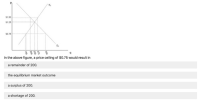 $1.50 $1.25 0.75 In the above figure, a price ceiling of $0.75 would result in a remainder of 200 the equilibrium market outcome a surplus of 200 a shortage of 200
Assume the market is initially in equilibrium at point A. Then assume the city imposes a price ceiling of pz
 Consider the market for apartments in New York City illustrated in the figure below. Assume the market is initially in equilibrium at point A. Then assume the city imposes a price ceiling of pz. How does this affect the market? The price ceiling results in a shortage of apartments The price ceiling results in an equilibrium where supply equals demand. The price ceiling is not binding and has no effect The price ceiling results in a surplus of apartments
 econ hw please help thank you!
CLILINGS AND PRICE FLOORS licymakers are more likely to impose a price ceiling: above equilibrium price in order to protect buyers from high prices. above equilibrium price in order to protect sellers from low prices. below equilibrium price in order to protect buyers from high prices. below equilibrium price in order to protect sellers from low prices. b. b. Policymakers are more likely to impose a price floor: above equilibrium price in order to...
econ hw please help thank you!
CLILINGS AND PRICE FLOORS licymakers are more likely to impose a price ceiling: above equilibrium price in order to protect buyers from high prices. above equilibrium price in order to protect sellers from low prices. below equilibrium price in order to protect buyers from high prices. below equilibrium price in order to protect sellers from low prices. b. b. Policymakers are more likely to impose a price floor: above equilibrium price in order to...
 Beginning with equilibrium in the table above, a government
imposed price ceiling at $2
A. means that consumption will be 48
B. cause a surplus of 36.
C. cause a shortage of 48.
D. means that consumption will be 84.
E. will lead to an increase in demand.
Price per Loaf Quantity DemandedQuantity Supplied 30 102 $5 48 84 48 84 102 30
Beginning with equilibrium in the table above, a government
imposed price ceiling at $2
A. means that consumption will be 48
B. cause a surplus of 36.
C. cause a shortage of 48.
D. means that consumption will be 84.
E. will lead to an increase in demand.
Price per Loaf Quantity DemandedQuantity Supplied 30 102 $5 48 84 48 84 102 30
 QUESTION 39 In order to have an impact, a must be set below the equilibrium price and when this occurs, OA. price ceiling; producer surplus decreases O B. price support; total revenue increases O C. price floor; consumer surplus decreases OD. price ceiling: consumer surplus increases
 $1.50 $1.25 0.75 In the above figure, a price ceiling of $0.75 would result in a remainder of 200 the equilibrium market outcome a surplus of 200 a shortage of 200
Most questions answered within 3 hours.
-
Where is the error in this code sequence?
String s1 = "Hello";
String s2 = "ello";...
asked 10 months ago -
Financial data for Joel de Paris, Inc., for last year
follow:
Joel de Paris, Inc.
Balance...
asked 10 months ago -
Consider this reaction:
Al2(SO4)3 (aq)+ BaCl3
(aq) Al2Cl6 (aq)- +
3BaSO4(s) . What is the...
asked 10 months ago -
Suppose that Savneet is considering increasing her
recent random sample from 20 car rentals to 40...
asked 10 months ago -
Trucks arrive at an unloading terminal at an average rate of 120
per hour.
Trucks arrive...
asked 10 months ago -
Why are methanol and ethanol completely soluble in water while
octanol is not very little soluble....
asked 10 months ago -
A facilities manager at a university reads in a research report
that the mean amount of...
asked 10 months ago -
When the CuSO4 is rehydrated by adding water to the anhydrous
compound, is this an endothermic...
asked 10 months ago -
A ray of sunlight is passing from diamond into crown glass; the
angle of incidence is...
asked 10 months ago -
A block of mass 0.249 kg is placed on top of a light, vertical
spring of...
asked 10 months ago -
how do the kidneys compensate in the presences of acidosis
a) trigger hyperventilate
b) reserve acid...
asked 10 months ago -
Question 501 pts
The rental rate of capital to the firm increases. Which of the
following...
asked 10 months ago