You’re the portfolio manager of a large company. You have an average performance of 13.5% return...
You’re the portfolio manager of a large company. You have an average performance of 13.5% return and risk of 22.5% a year. Your portfolio has beta value of 0.88. The risk free rate is 5% and market return is 12.5%. What is your Alpha, Treynor Ratio and Sharpe Ratio?
Homework Answers
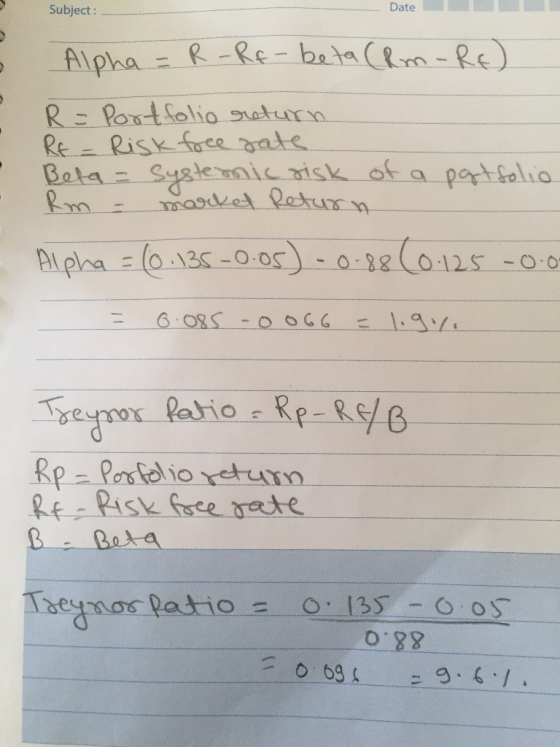
sharpe ratio=Rp-Rf/s
Rp=portfolio return
Rf=risk free rate
s=standard deviation
Add Answer to:
You’re the portfolio manager of a large company. You have an
average performance of 13.5% return...
doud 22. Excess return portfolio performance measures Adjust portfolio risk to match benchmark risk. Compare portfolio...
 doud 22. Excess return portfolio performance measures Adjust portfolio risk to match benchmark risk. Compare portfolio returns to expected returns under CAPM. Evaluate portfolio performance on the basis of return per unit of risk. Indicate historic average differential return per unit of historic variability of differential return. None of the above. 23 An example of a market cap weighted stock market indicator series is the a. Dow Jones Industrial Average. b. Nikkei Dow Jones Average. c. S&P 500 Index. d....
15. Estimate the Sharpe, Treynor and Alpha Jensen's performance analyses fort the three portfolios below. Use...
 15. Estimate the Sharpe, Treynor and Alpha Jensen's performance analyses fort the three portfolios below. Use the data below to complete the table. Portfolio Sharpe Treynor Jensen's Return 0.07 0.085 0.11 SD 0.15 0.12 0.095 Beta 0.8 1.05 1.4 Z 0.075 Market Risk Free 0.075 0.025 a. If you were to choose one portfolio, which one would it be? Why?
You are given the following information concerning three portfolios, the market portfolio, and the risk-free asset:...
 You are given the following information concerning three portfolios, the market portfolio, and the risk-free asset: Portfolio RP 13.0% 12.0 7.0 10.1 5.0 op 30% 25 15 20 Bp 1.30 1.10 0.75 1.00 Market Risk-free 0 What are the Sharpe ratio, Treynor ratio, and Jensen's alpha for each portfolio? (A negative value should be indicated by a minus sign. Leave no cells blank - be certain to enter "O" wherever required. Do not round intermediate calculations. Round your ratio answers...
You are given the following information concerning three portfolios, the market portfolio, and the risk-free asset...
 You are given the following information concerning three portfolios, the market portfolio, and the risk-free asset ВР Portfolio Rp 13.0 Оp 39 1.75 х Y 12.0 34 1.30 7.2 24 0.85 Market 11.0 29 1.00 Risk-free 5.6 0 What are the Sharpe ratio, Treynor ratio, and Jensen's alpha for each portfolio? (A negative value should be indicated by a minus sign. Leave no cells blank - be certain to enter "O" wherever required. Do not round intermediate calculations. Round your...
You are given the following information concerning three portfolios, the market portfolio, and the risk-free asset:...
 You are given the following information concerning three portfolios, the market portfolio, and the risk-free asset: Portfolio RP 15.5% 14.5 7.4 11.7 7.0 Op 36% 31 21 26 0 Bp 1.35 1.15 0.60 1.00 Market Risk-free 0 What are the Sharpe ratio, Treynor ratio, and Jensen's alpha for each portfolio? (A negative value should be indicated by a minus sign. Leave no cells blank - be certain to enter "O" wherever required. Do not round intermediate calculations. Round your ratio...
You have been given the following return information for a mutual fund, the market index, and...
 You have been given the following return information for a mutual fund, the market index, and the risk-free rate. You also know that the return correlation between the fund and the market is 0.97. Risk-Free Year 2011 2012 2013 2014 2015 Fund -17.68 25.1 13.4 6.6 -1.8 Market -34.5% 20.5 12.4 8 .4 -4.2 What are the Sharpe and Treynor ratios for the fund? (Do not round intermediate calculations. Round your answers to 4 decimal places.) Sharpe ratio Treynor ratio
You have been given the following return information for a mutual fund, the market index, and...
 You have been given the following return information for a mutual fund, the market index, and the risk-free rate. You also know that the return correlation between the fund and the market is 0.97 Risk-F Year 2011 2012 2013 2014 Fund -16.4 25.1 13.2 Market -32.5 20.3 2015 -1.68 What are the Sharpe and Treynor ratios for the fund? (Do not round Intermediate calculations. Round your answers to 4 decimal places.) Sharpe ratio Treynor ratio
Please solve question 1 and 2. The following data are available relating to the performance of...
 Please solve question 1 and 2.
The following data are available relating to the performance of High Variance Stock Fund and the market portfolio High Variance Market Portfolio 19% Average Return Standard Deviation of Returns 12% 35% 15% Beta 1.5 1.0 Residual standard deviation 3.0% 0.0% The risk-free return during the sample period was 6%. (1) Evaluate the performance of the High Variance Stock Fund relative to the market portfolio in terms of the Sharpe measure, the Treynor measure, the...
Please solve question 1 and 2.
The following data are available relating to the performance of High Variance Stock Fund and the market portfolio High Variance Market Portfolio 19% Average Return Standard Deviation of Returns 12% 35% 15% Beta 1.5 1.0 Residual standard deviation 3.0% 0.0% The risk-free return during the sample period was 6%. (1) Evaluate the performance of the High Variance Stock Fund relative to the market portfolio in terms of the Sharpe measure, the Treynor measure, the...
Portfolio Average Return Standard Deviation Beta A 14.7% 18.6% 1.47 B 8.8 14.2 .78 C 11.2...
Portfolio Average Return Standard Deviation Beta A 14.7% 18.6% 1.47 B 8.8 14.2 .78 C 11.2 16.0 1.22 The risk-free rate is 4.5 percent and the market risk premium is 7 percent. What is the Treynor ratio of a portfolio comprised of 30 percent portfolio A, 20 percent portfolio B, and 50 percent portfolio C?
15. How does the diversification of a portfolio change its expected returns and expected risks? Is...
 15. How does the diversification of a portfolio change its expected returns and expected risks? Is this in principle any different for internationally diversified portfolios? 16. What types of risk are present in a diversified portfolio? Which type of risk remains after the portfolio has been diversified? 17. If all national markets have market risk, is all market risk the same? 18. If an investor is able to determine a global beta for his portfolio and holds a portfolio that...
 doud 22. Excess return portfolio performance measures Adjust portfolio risk to match benchmark risk. Compare portfolio returns to expected returns under CAPM. Evaluate portfolio performance on the basis of return per unit of risk. Indicate historic average differential return per unit of historic variability of differential return. None of the above. 23 An example of a market cap weighted stock market indicator series is the a. Dow Jones Industrial Average. b. Nikkei Dow Jones Average. c. S&P 500 Index. d....
 15. Estimate the Sharpe, Treynor and Alpha Jensen's performance analyses fort the three portfolios below. Use the data below to complete the table. Portfolio Sharpe Treynor Jensen's Return 0.07 0.085 0.11 SD 0.15 0.12 0.095 Beta 0.8 1.05 1.4 Z 0.075 Market Risk Free 0.075 0.025 a. If you were to choose one portfolio, which one would it be? Why?
 You are given the following information concerning three portfolios, the market portfolio, and the risk-free asset: Portfolio RP 13.0% 12.0 7.0 10.1 5.0 op 30% 25 15 20 Bp 1.30 1.10 0.75 1.00 Market Risk-free 0 What are the Sharpe ratio, Treynor ratio, and Jensen's alpha for each portfolio? (A negative value should be indicated by a minus sign. Leave no cells blank - be certain to enter "O" wherever required. Do not round intermediate calculations. Round your ratio answers...
 You are given the following information concerning three portfolios, the market portfolio, and the risk-free asset ВР Portfolio Rp 13.0 Оp 39 1.75 х Y 12.0 34 1.30 7.2 24 0.85 Market 11.0 29 1.00 Risk-free 5.6 0 What are the Sharpe ratio, Treynor ratio, and Jensen's alpha for each portfolio? (A negative value should be indicated by a minus sign. Leave no cells blank - be certain to enter "O" wherever required. Do not round intermediate calculations. Round your...
 You are given the following information concerning three portfolios, the market portfolio, and the risk-free asset: Portfolio RP 15.5% 14.5 7.4 11.7 7.0 Op 36% 31 21 26 0 Bp 1.35 1.15 0.60 1.00 Market Risk-free 0 What are the Sharpe ratio, Treynor ratio, and Jensen's alpha for each portfolio? (A negative value should be indicated by a minus sign. Leave no cells blank - be certain to enter "O" wherever required. Do not round intermediate calculations. Round your ratio...
 You have been given the following return information for a mutual fund, the market index, and the risk-free rate. You also know that the return correlation between the fund and the market is 0.97. Risk-Free Year 2011 2012 2013 2014 2015 Fund -17.68 25.1 13.4 6.6 -1.8 Market -34.5% 20.5 12.4 8 .4 -4.2 What are the Sharpe and Treynor ratios for the fund? (Do not round intermediate calculations. Round your answers to 4 decimal places.) Sharpe ratio Treynor ratio
 You have been given the following return information for a mutual fund, the market index, and the risk-free rate. You also know that the return correlation between the fund and the market is 0.97 Risk-F Year 2011 2012 2013 2014 Fund -16.4 25.1 13.2 Market -32.5 20.3 2015 -1.68 What are the Sharpe and Treynor ratios for the fund? (Do not round Intermediate calculations. Round your answers to 4 decimal places.) Sharpe ratio Treynor ratio
 Please solve question 1 and 2.
The following data are available relating to the performance of High Variance Stock Fund and the market portfolio High Variance Market Portfolio 19% Average Return Standard Deviation of Returns 12% 35% 15% Beta 1.5 1.0 Residual standard deviation 3.0% 0.0% The risk-free return during the sample period was 6%. (1) Evaluate the performance of the High Variance Stock Fund relative to the market portfolio in terms of the Sharpe measure, the Treynor measure, the...
Please solve question 1 and 2.
The following data are available relating to the performance of High Variance Stock Fund and the market portfolio High Variance Market Portfolio 19% Average Return Standard Deviation of Returns 12% 35% 15% Beta 1.5 1.0 Residual standard deviation 3.0% 0.0% The risk-free return during the sample period was 6%. (1) Evaluate the performance of the High Variance Stock Fund relative to the market portfolio in terms of the Sharpe measure, the Treynor measure, the...
 15. How does the diversification of a portfolio change its expected returns and expected risks? Is this in principle any different for internationally diversified portfolios? 16. What types of risk are present in a diversified portfolio? Which type of risk remains after the portfolio has been diversified? 17. If all national markets have market risk, is all market risk the same? 18. If an investor is able to determine a global beta for his portfolio and holds a portfolio that...
Most questions answered within 3 hours.
-
Where is the error in this code sequence?
String s1 = "Hello";
String s2 = "ello";...
asked 11 months ago -
Financial data for Joel de Paris, Inc., for last year
follow:
Joel de Paris, Inc.
Balance...
asked 11 months ago -
Consider this reaction:
Al2(SO4)3 (aq)+ BaCl3
(aq) Al2Cl6 (aq)- +
3BaSO4(s) . What is the...
asked 11 months ago -
Suppose that Savneet is considering increasing her
recent random sample from 20 car rentals to 40...
asked 11 months ago -
Trucks arrive at an unloading terminal at an average rate of 120
per hour.
Trucks arrive...
asked 11 months ago -
Why are methanol and ethanol completely soluble in water while
octanol is not very little soluble....
asked 11 months ago -
A facilities manager at a university reads in a research report
that the mean amount of...
asked 11 months ago -
When the CuSO4 is rehydrated by adding water to the anhydrous
compound, is this an endothermic...
asked 11 months ago -
A ray of sunlight is passing from diamond into crown glass; the
angle of incidence is...
asked 11 months ago -
A block of mass 0.249 kg is placed on top of a light, vertical
spring of...
asked 11 months ago -
how do the kidneys compensate in the presences of acidosis
a) trigger hyperventilate
b) reserve acid...
asked 11 months ago -
Question 501 pts
The rental rate of capital to the firm increases. Which of the
following...
asked 11 months ago