Calculate the change in internal energy Gas compress by 3.50L by the external pressure of 3.00...
Calculate the change in internal energy Gas compress by 3.50L by the external pressure of 3.00 atm and release 650J of heat.
Homework Answers

Add Answer to:
Calculate the change in internal energy Gas compress by 3.50L by
the external pressure of 3.00...
An external pressure of 2.00 atm causes a gas to compress by 20.0 L. In the...
An external pressure of 2.00 atm causes a gas to compress by 20.0 L. In the process of compression, the gas releases 1200 J of heat to the surroundings. What is the change of the internal energy of this gas? 1 atm = 101325 Pa, 1 L = 0.001 m3 .
An external pressure of 4.00 atm causes a gas to compress by 10.0 L. In the...
An external pressure of 4.00 atm causes a gas to compress by 10.0 L. In the process of compression, the gas releases 1200 J of heat to the surroundings. What is the change of the internal energy of this gas? 1 atm = 101325 Pa, 1 L = 0.001 m . (A) +5253 J (B) +2853 J (C) −1605 J (D) −2853 J (E) −5253 J
Answer . Calculate the internal energy change for each of the following. a. One hundred (100.)...
 Answer . Calculate the internal energy change for each of the following. a. One hundred (100.) joules of work is required to compress a gas. At the same time, the gas releases 23 J of heat. b. A piston is compressed from a volume of 8.30 L to 2.80 L against a constant pressure of 1.90 atm. In the process, there is a heat gain by the system of 350. J. A piston expands against I 1037 J of heat...
5.00 moles of an ideal gas are contained in a cylinder with a constant external pressure...
5.00 moles of an ideal gas are contained in a cylinder with a constant external pressure of 1.00 atm and at a temperature of 523 K by a movable, frictionless piston. This system is cooled to 423 K. A) calculate work done on or by the system, w (J) B. Given that the molar heat capacity for an ideal gas is 20.8 J/mol K, calculate q (J) C. Calculate the change in internal energy for this ideal system,in J
A gas is compressed from an initial volume of 5.75L to a final volume of 1.24 L by an external pressure of 1.00 ATM...
A gas is compressed from an initial volume of 5.75L to a final volume of 1.24 L by an external pressure of 1.00 ATM. During the compression the gas releases 125 J of heat. What is the change in internal energy of the gas?
A gas is compressed from an initial volume of 5.75L to a final volume of 1.24 L by an external pressure of 1.00 ATM...
A gas is compressed from an initial volume of 5.75L to a final volume of 1.24 L by an external pressure of 1.00 ATM. During the compression the gas releases 125 J of heat. What is the change in internal energy of the gas?
The change in internal energy of a system (ΔE) can be described in terms of heat...
The change in internal energy of a system (ΔE) can be described in terms of heat (q) and work (w) according to the equation ΔE = q + w. The conversion of 40 g of liquid H2O to steam at 1.0 atm leads to an increase in its volume. This expansion exerts 4.545 kJ of work on the surroundings. If the increase in internal energy of the H2O is 85.724 kJ, how much heat energy does this vaporization process use?...
A sample of 3.00 moles of O2 at 273 K is heated to 423 K at constant pressure. The change in internal energy of the...
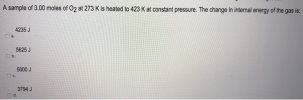 A sample of 3.00 moles of O2 at 273 K is heated to 423 K at constant pressure. The change in internal energy of the gas is: 4235J a 5625J b. 5000 J oc 3794 d.
Calculate the pressure, in atm, required to compress a sample of nitrogen gas from 14.55 L...
Calculate the pressure, in atm, required to compress a sample of nitrogen gas from 14.55 L at 2.10 atm to 5.00 L.
Calculate the w, (in kJ) when gas expards from 15L to you against a constant external...
 Calculate the w, (in kJ) when gas expards from 15L to you against a constant external pressure of 1.5 atm a 2) What is the change in internal energy (in u) of system that releases 605.2J of thermal energy to its surroundings and has 229.9cal of work done on it?
 Answer . Calculate the internal energy change for each of the following. a. One hundred (100.) joules of work is required to compress a gas. At the same time, the gas releases 23 J of heat. b. A piston is compressed from a volume of 8.30 L to 2.80 L against a constant pressure of 1.90 atm. In the process, there is a heat gain by the system of 350. J. A piston expands against I 1037 J of heat...
 A sample of 3.00 moles of O2 at 273 K is heated to 423 K at constant pressure. The change in internal energy of the gas is: 4235J a 5625J b. 5000 J oc 3794 d.
 Calculate the w, (in kJ) when gas expards from 15L to you against a constant external pressure of 1.5 atm a 2) What is the change in internal energy (in u) of system that releases 605.2J of thermal energy to its surroundings and has 229.9cal of work done on it?
Most questions answered within 3 hours.
-
Where is the error in this code sequence?
String s1 = "Hello";
String s2 = "ello";...
asked 10 months ago -
Financial data for Joel de Paris, Inc., for last year
follow:
Joel de Paris, Inc.
Balance...
asked 10 months ago -
Consider this reaction:
Al2(SO4)3 (aq)+ BaCl3
(aq) Al2Cl6 (aq)- +
3BaSO4(s) . What is the...
asked 10 months ago -
Suppose that Savneet is considering increasing her
recent random sample from 20 car rentals to 40...
asked 10 months ago -
Trucks arrive at an unloading terminal at an average rate of 120
per hour.
Trucks arrive...
asked 10 months ago -
Why are methanol and ethanol completely soluble in water while
octanol is not very little soluble....
asked 10 months ago -
A facilities manager at a university reads in a research report
that the mean amount of...
asked 10 months ago -
When the CuSO4 is rehydrated by adding water to the anhydrous
compound, is this an endothermic...
asked 10 months ago -
A ray of sunlight is passing from diamond into crown glass; the
angle of incidence is...
asked 10 months ago -
A block of mass 0.249 kg is placed on top of a light, vertical
spring of...
asked 10 months ago -
how do the kidneys compensate in the presences of acidosis
a) trigger hyperventilate
b) reserve acid...
asked 10 months ago -
Question 501 pts
The rental rate of capital to the firm increases. Which of the
following...
asked 10 months ago