Which of the following is true regarding ᐃG? (mark all that apply) Group of answer choices...
Which of the following is true regarding ᐃG? (mark all that apply) Group of answer choices
When Keq is >> 1, ᐃG is large and negative
When Keq is << 1, ᐃG is large and positive
When Keq is << 1, ᐃG is small and positive
When Keq is << 1, ᐃG is large and negative
When Keq is >> 1, ᐃG is small and positive
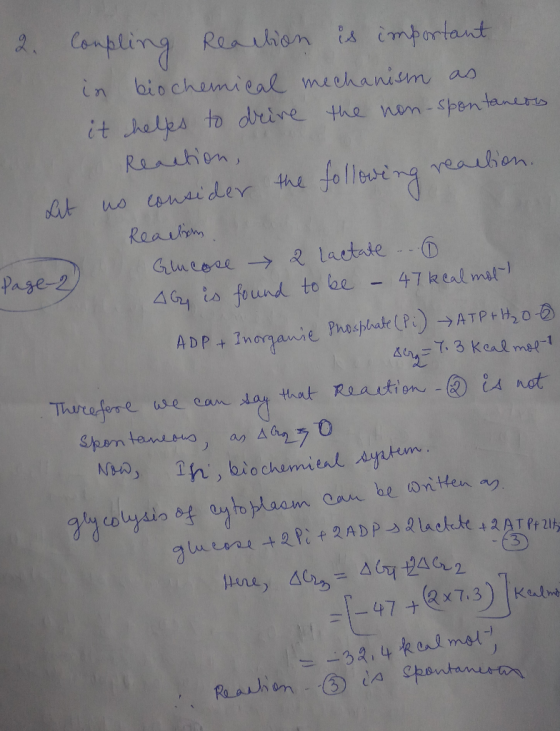
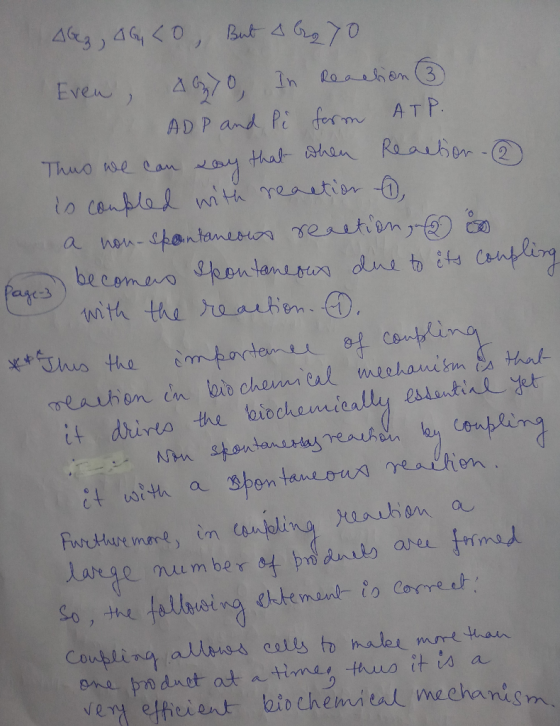
2-Why is coupling of reactions an important biochemical mechanism to allow non-spontaneous reactions to occur (select all that apply)?
Group of answer choices
Coupling reactions allows cells to make more than one product at a time; thus, it is a very efficient biochemical mechanism.
Coupling provides for reactions to occur at a very rapid pace, that is necessary for life.
3-Most organisms can only survive within a relatively narrow temperature range - changing the temperature at which reactions occur is therefore not usually viable.
Consider the reaction shown below:
A + B --> C + D
The ΔG° for the reaction is 14 KCal/mol.
In order to make this reaction proceed spontaneously in the forward direction, we can couple this reaction with which of the following reactions (select all that apply)?
Group of answer choices
Any spontaneous reaction that liberates free energy
No answer text provided.
A reaction whose ΔG° is less than -14KCal/mol
A reaction that involves one of the products or reactants, and which is spontaneous
Homework Answers
- ∆G◦ is related to equilibrium constant Keq. However, ∆G is related to the spontaneity of the reaction.Thus for 1. question ∆G◦ has been considered. The questions are little bit ambiguous. Thus, I made few assumptions to answer them.


Add Answer to:
Which of the following is true regarding ᐃG? (mark all that
apply) Group of answer choices...
Which statements are true regarding reaction rates? [Select all that apply.] 1.Group of answer choices Larger...
Which statements are true regarding reaction rates? [Select all that apply.] 1.Group of answer choices Larger activation energies are associated with faster reaction rates. 2.Higher reactant concentrations are associated with faster reaction rates. 3.Reducing the activation energy for a reaction increases its reaction rate. 4.Reaction rates depend on how likely molecules are to collide in the correct orientation to react. 5.Reactions that give off heat occur rapidly. Reactions that absorb heat occur rapidly. 6.Large changes in enthalpy are associated with...
Which of the following is true concerning exergonic reactions? (Select all that apply) Group of answer...
Which of the following is true concerning exergonic reactions? (Select all that apply) Group of answer choices LaTeX: \Delta Δ G°’ is negative. The reaction proceeds spontaneously. Energy is released. LaTeX: \Delta Δ G°’is positive. The reaction does not proceed spontaneously.
Which of the following is true about selective media? Group of answer choices a) Selective media...
Which of the following is true about selective media? Group of answer choices a) Selective media favors growth of either gram positive or gram negative, while inhibiting the other b) Selective media contains general ingredients that allows the growth of fastidious bacteria c) Selective media allows identification based on biochemical properties d) Selective media contain very defined ingredients, where all chemical components are known
How is a nonspontaneous process made spontaneous? Check all that apply: A nonspontaneous process is coupled...
How is a nonspontaneous process made spontaneous? Check all that apply: A nonspontaneous process is coupled with a process that is highly spontaneous. Nonspontaneous reactions can be made spontaneous depending on the reaction conditions; i.e., ΔG° might be positive, but ΔG could be negative depending on the concentrations of the reactants and products. A nonspontaneous process is coupled with a process that is highly disordered. Nonspontaneous reactions can be made spontaneous depending on the reaction conditions; i.e., ΔG° might be...
A process has a negative AH and a positive AS. Which of the following is true?...
 A process has a negative AH and a positive AS. Which of the following is true? the process is spontaneous at all temperatures the process isnon-spontaneous at all temperatures the process is spontaneous at high temperatures the process is spontaneous at low temperatures For a reaction in which AG is large and positive, which is true? AG is large and positive AG is large and negative Ο ΔG = ΔG none of these can be assumed
Which of the following statements is TRUE? Group of answer choices Intraplate earthquakes are infrequent but...
Which of the following statements is TRUE? Group of answer choices Intraplate earthquakes are infrequent but can be large and damaging. Subduction zones are where the largest earthquakes occur. Transform boundaries produce moderate to large earthquakes. All of these statements are true. Divergent margins are associated with many small earthquakes.
1) Which of the following oxidation-reduction reactions will be spontaneous in the direction written? Select all...
1) Which of the following oxidation-reduction reactions will be spontaneous in the direction written? Select all that apply. Mg2+ (aq) + Be (s) → Mg (s) + Be2+ (aq) Cu2+ (aq) + Zn (s) → Cu (s) + Zn2+ (aq) Hg2+ (aq) + Cu (s) → Hg (l) + Cu2+ (aq) Pb2+ (aq) + Cu (s) → Pb (s) + Cu2+ (aq) Fe2+ (aq) + Pb (s) → Fe (s) + Pb2+ (aq) 2) What is the value (in V)...
Which of the following statements is NOT true? Select all that apply. Group of answer choices...
Which of the following statements is NOT true? Select all that apply. Group of answer choices a. The concentration of H+ can be determined from the concentration of OH- and the Kw. b. An acid and its conjugate base differ only by one hydroxide ion c. An acid with a Ka > 1 is considered a weak acid d. The conjugate base of a strong acid will be a strong base e. Strong acids are expected to completely ionize in...
What biochemical processes take place in the cytoplasm? (Select all that apply) Group of answer choices...
What biochemical processes take place in the cytoplasm? (Select all that apply) Group of answer choices glycolysis fermentation Krebs cycle electron transport chain
1.The spontaneity of system or a biochemical reaction can be determined by: A) Enthalpy alone B)...
1.The spontaneity of system or a biochemical reaction can be determined by: A) Enthalpy alone B) Entropy alone C) Gibbs Free energy D) Temperature and heat 2.A reaction in equilibrium where both forward and reverse reactions are proceeding equally, will have a DELTA G value of: A) Positive B) Zero C) Negative 3.A reaction was originally endergonic, but became exergonic after reducing the temperature. Therefore, this reaction originally had __________ deltaH and a ______ delta S. A) small positive, large...
 A process has a negative AH and a positive AS. Which of the following is true? the process is spontaneous at all temperatures the process isnon-spontaneous at all temperatures the process is spontaneous at high temperatures the process is spontaneous at low temperatures For a reaction in which AG is large and positive, which is true? AG is large and positive AG is large and negative Ο ΔG = ΔG none of these can be assumed
Most questions answered within 3 hours.
-
Where is the error in this code sequence?
String s1 = "Hello";
String s2 = "ello";...
asked 11 months ago -
Financial data for Joel de Paris, Inc., for last year
follow:
Joel de Paris, Inc.
Balance...
asked 11 months ago -
Consider this reaction:
Al2(SO4)3 (aq)+ BaCl3
(aq) Al2Cl6 (aq)- +
3BaSO4(s) . What is the...
asked 11 months ago -
Suppose that Savneet is considering increasing her
recent random sample from 20 car rentals to 40...
asked 11 months ago -
Trucks arrive at an unloading terminal at an average rate of 120
per hour.
Trucks arrive...
asked 11 months ago -
Why are methanol and ethanol completely soluble in water while
octanol is not very little soluble....
asked 11 months ago -
A facilities manager at a university reads in a research report
that the mean amount of...
asked 11 months ago -
When the CuSO4 is rehydrated by adding water to the anhydrous
compound, is this an endothermic...
asked 11 months ago -
A ray of sunlight is passing from diamond into crown glass; the
angle of incidence is...
asked 11 months ago -
A block of mass 0.249 kg is placed on top of a light, vertical
spring of...
asked 11 months ago -
how do the kidneys compensate in the presences of acidosis
a) trigger hyperventilate
b) reserve acid...
asked 11 months ago -
Question 501 pts
The rental rate of capital to the firm increases. Which of the
following...
asked 11 months ago