A consumer upset with the latest trend of postal rate increases has decided to try to...
A consumer upset with the latest trend of postal rate increases has decided to try to send letters by balloon even though they may not reach their intended destinations. A 6.00×104 cm3 gas-filled balloon will provide enough lift for a 45.1 g package to be accelerated upward at a rate of 2.95 m/s2 . For these circumstances, calculate the density of the gas the consumer fills the balloon with. The acceleration due to gravity is ?=9.81 m/s2 and the density of air is ?air=1.16 kg/m3 . Neglect the mass of the balloon material and the volume of the package. ?= kg/m3
Homework Answers
The mass of displaced air M = ρair*V = 1.16kg/m³ * 0.0600m³ =
0.0696 kg
The buoyant force Fb = ρair*V*g = 1.16kg/m³ * 0.0600m³ * 9.81m/s² =
0.683 N
The mass of gas m = ρ*V = ρ*0.0600m³
The weight of gas Fg = ρ*V*g = ρ*0.0600m³*9.81m/s² =
ρ*0.5886m⁴/s²
Now the acceleration a = Fnet / totalmass = (Fb - Fg - m*g) / (ρ*V
+ m)
2.95 = (0.683 - ρ*0.5886 - 0.0451*9.81) / (ρ*0.0600 + 0.0451)
2.95(ρ*0.06 + 0.0451) = 0.240 - ρ*0.5886
ρ*0.177 +0.112 = 0.290 - ρ*0.5886
ρ*0.7656 = 0.178
ρ = 0.232 kg/m³


Add Answer to:
A consumer upset with the latest trend of postal rate increases
has decided to try to...
A consumer upset with the latest trend of postal rate increases has decided to try to...
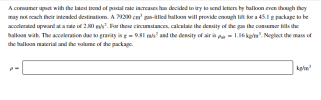 A consumer upset with the latest trend of postal rate increases has decided to try to send letters by balloon even though they may not reach their intended destinations. A 79200 cm gas-filled balloon will provide enough lift for a 45.1 g package to be accelerated upward at a rate of 2.80 m/s. For these circumstances, calculate the density of the gas the consumer fills the balloon with. The acceleration due to gravity is g = 9.81 m/s2 and the...
A consumer upset with the latest trend of postal rate increases has decided to try to...
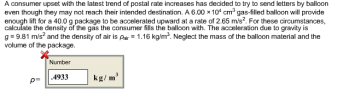 A consumer upset with the latest trend of postal rate increases has decided to try to send letters by balloon even though they may not reach their intended destination. A 6.00 times 10^4 cm^3 gas-filled balloon will provide enough lift for a 40.0 g package to be accelerated upward at a rate of 2.65 m/s^2. For these circumstances, calculate the density of the gas the consumer fills the balloon with. The acceleration due to gravity is g = 9.81 m/s^2...
1. A 0.550 kg metal cylinder is placed inside the top of a plastic tube, the...
1. A 0.550 kg metal cylinder is placed inside the top of a plastic tube, the lower end of which is sealed off by an adjustable plunger. The cylinder comes to rest some distance above the plunger. The plastic tube has an inner radius of 6.39 mm and is frictionless. Neither the plunger nor the metal cylinder allow any air to flow around them. If the plunger is suddenly pushed upwards, increasing the pressure between the plunger and the metal...
 A consumer upset with the latest trend of postal rate increases has decided to try to send letters by balloon even though they may not reach their intended destinations. A 79200 cm gas-filled balloon will provide enough lift for a 45.1 g package to be accelerated upward at a rate of 2.80 m/s. For these circumstances, calculate the density of the gas the consumer fills the balloon with. The acceleration due to gravity is g = 9.81 m/s2 and the...
 A consumer upset with the latest trend of postal rate increases has decided to try to send letters by balloon even though they may not reach their intended destination. A 6.00 times 10^4 cm^3 gas-filled balloon will provide enough lift for a 40.0 g package to be accelerated upward at a rate of 2.65 m/s^2. For these circumstances, calculate the density of the gas the consumer fills the balloon with. The acceleration due to gravity is g = 9.81 m/s^2...
Most questions answered within 3 hours.
-
Where is the error in this code sequence?
String s1 = "Hello";
String s2 = "ello";...
asked 11 months ago -
Financial data for Joel de Paris, Inc., for last year
follow:
Joel de Paris, Inc.
Balance...
asked 11 months ago -
Consider this reaction:
Al2(SO4)3 (aq)+ BaCl3
(aq) Al2Cl6 (aq)- +
3BaSO4(s) . What is the...
asked 11 months ago -
Suppose that Savneet is considering increasing her
recent random sample from 20 car rentals to 40...
asked 11 months ago -
Trucks arrive at an unloading terminal at an average rate of 120
per hour.
Trucks arrive...
asked 11 months ago -
Why are methanol and ethanol completely soluble in water while
octanol is not very little soluble....
asked 11 months ago -
A facilities manager at a university reads in a research report
that the mean amount of...
asked 11 months ago -
When the CuSO4 is rehydrated by adding water to the anhydrous
compound, is this an endothermic...
asked 11 months ago -
A ray of sunlight is passing from diamond into crown glass; the
angle of incidence is...
asked 11 months ago -
A block of mass 0.249 kg is placed on top of a light, vertical
spring of...
asked 11 months ago -
how do the kidneys compensate in the presences of acidosis
a) trigger hyperventilate
b) reserve acid...
asked 11 months ago -
Question 501 pts
The rental rate of capital to the firm increases. Which of the
following...
asked 11 months ago