1. The production of agricultural products like wheat is the closest example of a perfectly competitive...
1. The production of agricultural products like wheat is the closest example of a perfectly competitive market. In this question, you are asked to analyze results from a study released by the University of Arkansas about wheat production in the region assuming the industry was perfectly competitive.c. For 2010, the average variable cost per acre planted with wheat increased to $243.63 per acre. With an average yield of 52 bushels per acre, calculate the average variable cost per bushel of wheat.If the average price of wheat received by a farmer in September 2010 was still $4.42 per bushel, do you think the average farm would have exited the market in the short run? Explain
Homework Answers
Average variable cost = $ 243.63 per acre
Average yield = 52 bushels per acre
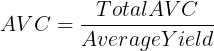

Average Variable cost = $ 4.69 per bushel.
The price = $ 4.42 per bushel
Since, the price is less than the Average Variable cost so the average farm should exit from the market. As it is unable to recover at least the variable cost.
Please contact before rating up will be obliged to you for your generous support. Thank you
Add Answer to:
1. The production of agricultural products like wheat is the
closest example of a perfectly competitive...
The graph below shows shows a perfectly competitive market for wheat and a typical farm in the market. The demand for wheat increases from D1 to D2. Assume that wheat production is a constant-cos...
 The graph below shows shows a perfectly competitive market for wheat and a typical farm in the market. The demand for wheat increases from D1 to D2. Assume that wheat production is a constant-cost industry. A typical farm The market for wheat Cost ($) Price (S per bushel) MC 10 10 9 ATC 8 7.20 715 751 D2 5 5 40 80 120 160 200 240 Quantity (thousands of bushels) 20 40 60 80 100 120 Quantity (milions of bushels)...
A purely competitive wheat farmer can sell any wheat he grows for $10 per bushel. His...
A purely competitive wheat farmer can sell any wheat he grows for $10 per bushel. His five acres of land show diminishing returns because some are better suited for wheat production than others. The first acre can produce 1,000 bushels of wheat, the second acre 900, the third 800, and so on. a. Fill in the table below to answer the following questions. How many bushels will each of the farmer’s five acres produce? How much revenue will each acre...
6. Short-run perfectly competitive equilibrium Consider a perfectly competitive market for wheat in Philadelphia. There...
 6. Short-run perfectly competitive equilibrium Consider a perfectly competitive market for wheat in Philadelphia. There are 80 firms in the industry, each of which has the cost curves shown on the following graph: MC ATC COST (Cents per bushel) AVC 0 5 10 15 20 25 30 35 40 45 50 Demand Supply Curve Equilibrium PRICE (Cents per bushel) 0 400 800 1200 1600 2000 2400 2800 3200 3600 4000 QUANTITY OF OUTPUT (Thousands of bushels) in the short run....
Farm A is a profit maximizing, perfectly competitive producer of wheat. It produces wheat using 1...
Farm A is a profit maximizing, perfectly competitive producer of wheat. It produces wheat using 1 acre of land (price = $1,000) and varying inputs of labor (price = $500 per man-month). The production function is as follows: Number of man-months Output per month (per month) (truckloads) 0 0 1 1 3 2 7 3 12 4 18 5 25 6 Show that the production of Farm A is subject to increasing marginal costs.
The wheat market is perfectly competitive, and the market supply and demand curves are given by the following equations:
The wheat market is perfectly competitive, and the market supply and demand curves are given by the following equations: QD = 20,000,000 - 4,000,000P QS = 7,000,000 + 2,500,000P, where QD and QS are quantity demanded and quantity supplied measured in bushels, and P = price per bushel. a. Determine consumer surplus at the equilibrium price and quantity. b. Assume that the government has imposed a price floor at $2.25 per bushel and agrees to buy any resulting excess supply. How many bushels of wheat...
The Hogg company are a group of Oklahoma agricultural producers. The Hoggs want to derive a...
The Hogg company are a group of Oklahoma agricultural producers. The Hoggs want to derive a production process that will satisfy their goals. These farmers can produce corn, wheat, and/or hogs. The acreage they can cultivate for crops is 1100 acres, of which 600 acres is for corn production and 500 acres for wheat production. The Hogs have a maximum of 2000 hr of labor available for crop operations and 600 hr of labor for their hog operation. Corn production...
Farmer Bogus is selling his product in a purely competitive market. His output is 600 bushels...
Farmer Bogus is selling his product in a purely competitive market. His output is 600 bushels which sell for $5 per bushel. At this level of output, marginal cost is $5, average total cost is $7and average variable cost is $6. Farmer Bogus should produce how many bushels of output?
6. Short-run perfectly competitive equilibrium Consider a perfectly competitive market for wheat in Chicago. There are...
 6. Short-run perfectly competitive equilibrium Consider a perfectly competitive market for wheat in Chicago. There are 90 firms in the industry, each of which has the cost curves shown on the following graph: ? 100 90 MC BO 70 60 ATC 50 COST (Cents per bushel) 40 30 20 AVC 10 0 O 5 10 15 20 25 30 35 QUANTITY OF OUTPUT (Thousands of bushels) 40 45 50 The following graph shows the market demand for wheat. Use the...
1) Assumption for a Perfectly competitive firm include a: (select) [homogeneous, unique, diverse, heterogeneous] product essentially/theoretically...
1) Assumption for a Perfectly competitive firm include a: (select) [homogeneous, unique, diverse, heterogeneous] product essentially/theoretically (select) [several, infinite, few, finite] sellers and (select) [unique, infinite, few, several] buyers (select) [difficult, easy, expensive, diminishing availability] entry and exit 2) The perfectly competitive firm's supply curve is the: a)marginal cost curve equal to and above the price/demand line b) doesn't exist c) no answer text provided d) is downward sloping e) upward sloping supply curve equal to the demand curve 3)...
The table shows the costs that a firm faces when producing corn in a perfectly competitive...
 The table shows the costs that a firm faces when producing corn in a perfectly competitive market. Use it to answer the following questions. Show your work. N Quantity (bushels) 01 2 3 4 5 6 8 9 10 Total Cost (dollars) |36|46|54| 60 | 64 | 65 | 69|77|92117160 If the price for corn is $16 per bushel, how many bushels of corn should the farm grow?
 The graph below shows shows a perfectly competitive market for wheat and a typical farm in the market. The demand for wheat increases from D1 to D2. Assume that wheat production is a constant-cost industry. A typical farm The market for wheat Cost ($) Price (S per bushel) MC 10 10 9 ATC 8 7.20 715 751 D2 5 5 40 80 120 160 200 240 Quantity (thousands of bushels) 20 40 60 80 100 120 Quantity (milions of bushels)...
 6. Short-run perfectly competitive equilibrium Consider a perfectly competitive market for wheat in Philadelphia. There are 80 firms in the industry, each of which has the cost curves shown on the following graph: MC ATC COST (Cents per bushel) AVC 0 5 10 15 20 25 30 35 40 45 50 Demand Supply Curve Equilibrium PRICE (Cents per bushel) 0 400 800 1200 1600 2000 2400 2800 3200 3600 4000 QUANTITY OF OUTPUT (Thousands of bushels) in the short run....
 6. Short-run perfectly competitive equilibrium Consider a perfectly competitive market for wheat in Chicago. There are 90 firms in the industry, each of which has the cost curves shown on the following graph: ? 100 90 MC BO 70 60 ATC 50 COST (Cents per bushel) 40 30 20 AVC 10 0 O 5 10 15 20 25 30 35 QUANTITY OF OUTPUT (Thousands of bushels) 40 45 50 The following graph shows the market demand for wheat. Use the...
 The table shows the costs that a firm faces when producing corn in a perfectly competitive market. Use it to answer the following questions. Show your work. N Quantity (bushels) 01 2 3 4 5 6 8 9 10 Total Cost (dollars) |36|46|54| 60 | 64 | 65 | 69|77|92117160 If the price for corn is $16 per bushel, how many bushels of corn should the farm grow?
Most questions answered within 3 hours.
-
Where is the error in this code sequence?
String s1 = "Hello";
String s2 = "ello";...
asked 11 months ago -
Financial data for Joel de Paris, Inc., for last year
follow:
Joel de Paris, Inc.
Balance...
asked 11 months ago -
Consider this reaction:
Al2(SO4)3 (aq)+ BaCl3
(aq) Al2Cl6 (aq)- +
3BaSO4(s) . What is the...
asked 11 months ago -
Suppose that Savneet is considering increasing her
recent random sample from 20 car rentals to 40...
asked 11 months ago -
Trucks arrive at an unloading terminal at an average rate of 120
per hour.
Trucks arrive...
asked 11 months ago -
Why are methanol and ethanol completely soluble in water while
octanol is not very little soluble....
asked 11 months ago -
A facilities manager at a university reads in a research report
that the mean amount of...
asked 11 months ago -
When the CuSO4 is rehydrated by adding water to the anhydrous
compound, is this an endothermic...
asked 11 months ago -
A ray of sunlight is passing from diamond into crown glass; the
angle of incidence is...
asked 11 months ago -
A block of mass 0.249 kg is placed on top of a light, vertical
spring of...
asked 11 months ago -
how do the kidneys compensate in the presences of acidosis
a) trigger hyperventilate
b) reserve acid...
asked 11 months ago -
Question 501 pts
The rental rate of capital to the firm increases. Which of the
following...
asked 11 months ago