Explain three types of benchmarks: 1. internal benchmarks 2. competitive benchmarks 3. industry benchmarks. Each explanation...
Homework Answers


Add Answer to:
Explain three types of benchmarks:
1. internal benchmarks
2. competitive benchmarks
3. industry benchmarks.
Each explanation...
3. (10 points) Please explain why each of the following is NOT a perfectly competitive industry...
 3. (10 points) Please explain why each of the following is NOT a perfectly competitive industry You have to explain in each case which one (or more) of the perfect competition assumptions are violated. You must give an explanation in each case. (a) One firm produces a large portion of the industry output and can influence the market price, but there are many other firms in that industry, and they all (including the large firm) produce an identical product. (b)...
Explain 3 features each of monopolistic competitive industry and an oligopoly.
Explain 3 features each of monopolistic competitive industry and an oligopoly.
Multiple Choice (2 pts. each) [Questions 1-3] Consider a competitive industry with a large number...
 Need explanations
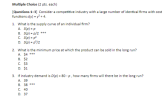
Multiple Choice (2 pts. each) [Questions 1-3] Consider a competitive industry with a large number of identical firms with cost functions c(y)-y, 4 1. What is the supply curve of an individual firm? A. S(p)-p B. S(p)-p/2 ** 2. What is the minimum price at which the product can be sold in the long run? A $4 C. $3 D. $1 3. If industry demand is Dip)- 80-p,how many firms will there be in the long run? A....
Need explanations
Multiple Choice (2 pts. each) [Questions 1-3] Consider a competitive industry with a large number of identical firms with cost functions c(y)-y, 4 1. What is the supply curve of an individual firm? A. S(p)-p B. S(p)-p/2 ** 2. What is the minimum price at which the product can be sold in the long run? A $4 C. $3 D. $1 3. If industry demand is Dip)- 80-p,how many firms will there be in the long run? A....
Explain why each of the following examples is not a perfectly competitive industry. One firm produces...
Explain why each of the following examples is not a perfectly competitive industry. One firm produces a large portion of the industry’s total output, but there are many firms in the industry, and their products are indistinguishable. Firms can easily exit and enter the industry. There are many buyers and sellers in the industry. Consumers have equal information about the prices of firms’ products, which differ moderately in quality from firm to firm. Many taxicabs compete in a city. The...
Explain why each of the following examples is not a perfectly competitive industry. One firm produces...
Explain why each of the following examples is not a perfectly competitive industry. One firm produces a large portion of the industry’s total output, but there are many firms in the industry, and their products are indistinguishable. Firms can easily exit and enter the industry. There are many buyers and sellers in the industry. Consumers have equal information about the prices of firms’ products, which differ moderately in quality from firm to firm. Many taxicabs compete in a city. The...
1. Performance measurement systems use externally imposed benchmarks of the competitive landscape to assess internal performance....
1. Performance measurement systems use externally imposed benchmarks of the competitive landscape to assess internal performance. True False 2. Which of the following is an example of a strategic performance measurement system? a.product costing system b.standard cost system c.lean management system d.balanced scorecard 3. Performance targets a.are an optional part of the balanced scorecard b.are never linked to incentive compensation c.are always linked to employee quarterly bonuses d.provide goals for employees 4. The balanced scorecard focuses on lagging indicators such...
2-1 2-2 2-3 2-4 Identify and explain the two types of competitive strategy. Identify three or...
 2-1 2-2 2-3 2-4 Identify and explain the two types of competitive strategy. Identify three or four well-known firms that succeed through cost leadership. Identify three or four well-known firms that succeed through product differentiation. How are the four strategic resources—SWOT analysis, execution, the value chain, and the balanced scorecard-linked in a comprehensive strategic analysis? What is a strategy map and how is it used? What is SWOT analysis? For what is it used? What is the role of the...
3. Under Internal Scale Economies and Monopolistic Competition, explain how International Trade can improve economic efficiency...
 3. Under Internal Scale Economies and Monopolistic Competition, explain how International Trade can improve economic efficiency within an industry by changing the types of firms in the industry. (2 points)
Problem 1. (13 points) Markets: Perfect Competition. Assume that a perfectly competitive, constant cost industry is...
Problem 1. (13 points) Markets: Perfect Competition. Assume that a perfectly competitive, constant cost industry is in a long run equilibrium with 35 firms. Each firm is producing 90 units of output which it sells at the price of $39 per unit; out of this amount each firm is paying $5 tax per unit of the output. The government decides to decrease the tax, so the firms will be paying $3 tax per unit. a) Explain what would happen in...
Please explain each of Four Types of Validities and give example of them: 1.Construct 2.External 3.Statistical...
Please explain each of Four Types of Validities and give example of them: 1.Construct 2.External 3.Statistical 4.Internal
 3. (10 points) Please explain why each of the following is NOT a perfectly competitive industry You have to explain in each case which one (or more) of the perfect competition assumptions are violated. You must give an explanation in each case. (a) One firm produces a large portion of the industry output and can influence the market price, but there are many other firms in that industry, and they all (including the large firm) produce an identical product. (b)...
 Need explanations
Multiple Choice (2 pts. each) [Questions 1-3] Consider a competitive industry with a large number of identical firms with cost functions c(y)-y, 4 1. What is the supply curve of an individual firm? A. S(p)-p B. S(p)-p/2 ** 2. What is the minimum price at which the product can be sold in the long run? A $4 C. $3 D. $1 3. If industry demand is Dip)- 80-p,how many firms will there be in the long run? A....
Need explanations
Multiple Choice (2 pts. each) [Questions 1-3] Consider a competitive industry with a large number of identical firms with cost functions c(y)-y, 4 1. What is the supply curve of an individual firm? A. S(p)-p B. S(p)-p/2 ** 2. What is the minimum price at which the product can be sold in the long run? A $4 C. $3 D. $1 3. If industry demand is Dip)- 80-p,how many firms will there be in the long run? A....
 2-1 2-2 2-3 2-4 Identify and explain the two types of competitive strategy. Identify three or four well-known firms that succeed through cost leadership. Identify three or four well-known firms that succeed through product differentiation. How are the four strategic resources—SWOT analysis, execution, the value chain, and the balanced scorecard-linked in a comprehensive strategic analysis? What is a strategy map and how is it used? What is SWOT analysis? For what is it used? What is the role of the...
 3. Under Internal Scale Economies and Monopolistic Competition, explain how International Trade can improve economic efficiency within an industry by changing the types of firms in the industry. (2 points)
Most questions answered within 3 hours.
-
Where is the error in this code sequence?
String s1 = "Hello";
String s2 = "ello";...
asked 10 months ago -
Financial data for Joel de Paris, Inc., for last year
follow:
Joel de Paris, Inc.
Balance...
asked 10 months ago -
Consider this reaction:
Al2(SO4)3 (aq)+ BaCl3
(aq) Al2Cl6 (aq)- +
3BaSO4(s) . What is the...
asked 10 months ago -
Suppose that Savneet is considering increasing her
recent random sample from 20 car rentals to 40...
asked 10 months ago -
Trucks arrive at an unloading terminal at an average rate of 120
per hour.
Trucks arrive...
asked 10 months ago -
Why are methanol and ethanol completely soluble in water while
octanol is not very little soluble....
asked 10 months ago -
A facilities manager at a university reads in a research report
that the mean amount of...
asked 10 months ago -
When the CuSO4 is rehydrated by adding water to the anhydrous
compound, is this an endothermic...
asked 10 months ago -
A ray of sunlight is passing from diamond into crown glass; the
angle of incidence is...
asked 10 months ago -
A block of mass 0.249 kg is placed on top of a light, vertical
spring of...
asked 10 months ago -
how do the kidneys compensate in the presences of acidosis
a) trigger hyperventilate
b) reserve acid...
asked 10 months ago -
Question 501 pts
The rental rate of capital to the firm increases. Which of the
following...
asked 10 months ago