Suppose you have the following preferences u(x,y) = xayb. Calculate the optimal demand functions. Is good...
Suppose you have the following preferences u(x,y) = xayb. Calculate the optimal demand functions. Is good y a normal or inferior good?
Please show work.
Homework Answers

To find the optimal demand functions, we need to maximize the utility function subject to the budget constraint. Let's assume the consumer has an income I, and the prices of goods x and y are Px and Py, respectively.
The consumer's optimization problem is as follows:
Maximize u(x, y) = x^a * y^b subject to the budget constraint: Px * x + Py * y = I
To find the optimal demand functions, we'll use the method of Lagrange multipliers. The Lagrangian function is defined as:
L(x, y, λ) = x^a * y^b + λ(I - Px * x - Py * y)
Now, we'll find the first-order conditions by taking partial derivatives with respect to x, y, and λ and setting them to zero:
∂L/∂x = a * x^(a-1) * y^b - λ * Px = 0 ... (1) ∂L/∂y = b * x^a * y^(b-1) - λ * Py = 0 ... (2) ∂L/∂λ = I - Px * x - Py * y = 0 ... (3)
From equations (1) and (2), we can solve for λ:
λ = a * x^(a-1) * y^b / Px ... (4) λ = b * x^a * y^(b-1) / Py ... (5)
Now, we'll equate the two expressions for λ:
a * x^(a-1) * y^b / Px = b * x^a * y^(b-1) / Py
Solving for x/y:
x / y = (b * Py) / (a * Px) ... (6)
Now, we'll use equation (3) to solve for x:
I = Px * x + Py * y I = Px * x + Py * (x / ((b * Py) / (a * Px))) [using equation (6)] I = Px * x + a * x x * (1 + Px/a) = I x = I / (1 + Px/a) ... (7)
Next, we'll find the optimal demand for y using equation (6):
x / y = (b * Py) / (a * Px) y = (a * Px * x) / (b * Py) [using equation (7)] y = (a * Px * (I / (1 + Px/a))) / (b * Py) y = (a * I) / (b * Py + a * Px) ... (8)
So, the optimal demand functions are:
Optimal demand for x: x = I / (1 + Px/a) Optimal demand for y: y = (a * I) / (b * Py + a * Px)
Now, let's analyze whether good y is a normal or inferior good. For that, we need to look at the income elasticity of demand for y. The income elasticity of demand (Ey) is given by:
Ey = (% change in quantity demanded of y) / (% change in income)
From the optimal demand function for y (equation 8), we can see that the income elasticity of demand for y is positive. This indicates that y is a normal good, as an increase in income will lead to a proportionate increase in the quantity demanded of y.
Add Answer to:
Suppose you have the following preferences u(x,y) =
xayb. Calculate the optimal demand functions.
Is good...
3. Suppose that Bob’s preferences can be represented by the utility function u(x, y) = 32x^0.5...
3. Suppose that Bob’s preferences can be represented by the utility function u(x, y) = 32x^0.5 + y. The MUx = 16x^-0.5 and MUy = 1. (a) Determine Bob’s demand functions for x and y. (b)If the price of x is $8, and Bob’s income is $1000, how many x would Bob consume? How much income would be devoted to spending on y? (c) Suppose that the price of x doubles to $16. Calculate the income and substitution effects. (d)Is...
2) Suppose that the price of good X is $2 and the price of good Y...
2) Suppose that the price of good X is $2 and the price of good Y is $3. You have $90 to spend and your preferences over X and Y are defined as: U(x,y) = x2/3y1/3 Keep in mind that we review this concept because consumer choice is based on their preferences. People demand items that fulfill their Utility (perhaps happiness). As a result, we need to visualize how an individual’s budget is allocated to create the highest level...
Suppose that the price of good X is $2 and good Y is $3. I have...
Suppose that the price of good X is $2 and good Y is $3. I have $90 to spend and my preferences over X and Y are U(x,y) = (x^2/3)(y^1/3). How can you calculate the marginal utility of both X and Y using calculus (show the steps/work)?
pts) Let U(X,Y,Z) = Xayb z a,b,c > 0 Find the Marshallian demand functions. Calculate og...
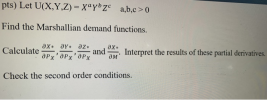 pts) Let U(X,Y,Z) = Xayb z a,b,c > 0 Find the Marshallian demand functions. Calculate og opp om and Interpret the results of these partial derivatives. Interpret | Check the second order conditions.
3. A consumer's preferences over a and y are given by the utility function u(x,y) -...
 3. A consumer's preferences over a and y are given by the utility function u(x,y) - 2vr 2/y. The individual's income is I $100. The price of a unit of good c is $2, while the price of a unit of good y is S1. a) Graphically describe: i. the consumer's preferences for r and y ii. the budget constraint (b) Find the optimal x that the consumer would choose. You may assume (c) What is the consumer's MRS at...
I need part D&E ASAP,third time posting! 3. Suppose that Bob's preferences can be represented by...
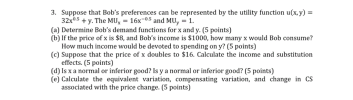 I need part D&E ASAP,third time posting!
3. Suppose that Bob's preferences can be represented by the utility function u(x,y)- 32x05y. The MUx 16x5 and MUy 1. (a) Determine Bob's demand functions for x and y. (5 points) (b) If the price of x is $8, and Bob's income is $1000, how many x would Bob consume? How much income would be devoted to spending on y? (5 points) (c) Suppose that the price of x doubles to $16. Calculate...
I need part D&E ASAP,third time posting!
3. Suppose that Bob's preferences can be represented by the utility function u(x,y)- 32x05y. The MUx 16x5 and MUy 1. (a) Determine Bob's demand functions for x and y. (5 points) (b) If the price of x is $8, and Bob's income is $1000, how many x would Bob consume? How much income would be devoted to spending on y? (5 points) (c) Suppose that the price of x doubles to $16. Calculate...
A consumer buys two goods, good X and a composite good Y. The utility function is...
A consumer buys two goods, good X and a composite good Y. The utility function is given as ?(?,?) = ? + ?√? . 1) Derive the demand function for good X.(5 marks) 2) Is good X a normal or an inferior good? Why? ( 5 marks) 3) Suppose that initially ?? = $1 and then it falls and becomes ?? = $0.5. Also suppose that Income=$10. Calculate the substitution effect, income effect, and the price effect and show...
1a. Consider two goods: x and y where y is a numeraire good. Suppose that x...
1a. Consider two goods: x and y where y is a numeraire good. Suppose that x is a normal good. Graphically derive the demand curve for good x based on the indifference curve framework by working out the optimal consumption choices when the price of good x falls. 1b. Rework 1a but now good x is an inferior good (but not a Giffen good).
2) Assume that utility is given by Utility-U(X,Y)-X03yo7 a) Calculate the ordinary demand functions, indirect utility function, and expenditure function. b) Use the expenditure function calculate...
 2) Assume that utility is given by Utility-U(X,Y)-X03yo7 a) Calculate the ordinary demand functions, indirect utility function, and expenditure function. b) Use the expenditure function calculated in part (a) together with Shephard's lemma to compute the compensated demand function for good X. Use the results from part (b) together with the ordinary demand function for good X to show that the Slutsky equation holds for this case. c) d) Prove that the expenditure function calculated in part (a) is homogeneous...
Two agents have identical quasilinear preferences U(x, y)-u(x) + y, where , x , x E...
 Two agents have identical quasilinear preferences U(x, y)-u(x) + y, where , x , x E [0,1] Agent 1's endowment is (3/2, 1/2) and agent 2's endowment is (1/2, 3/2). Normalize so that the price of good 2 is A) Calculate a Walrasian equilibrium at which the price of good 1 is greater than 1/2. Are there other Walrasian equilibria? B) Suppose agent 1's endowment were (2, 1/2). Find a Walrasian equilibrium for this economy. Note that agent is actually...
 pts) Let U(X,Y,Z) = Xayb z a,b,c > 0 Find the Marshallian demand functions. Calculate og opp om and Interpret the results of these partial derivatives. Interpret | Check the second order conditions.
 3. A consumer's preferences over a and y are given by the utility function u(x,y) - 2vr 2/y. The individual's income is I $100. The price of a unit of good c is $2, while the price of a unit of good y is S1. a) Graphically describe: i. the consumer's preferences for r and y ii. the budget constraint (b) Find the optimal x that the consumer would choose. You may assume (c) What is the consumer's MRS at...
 I need part D&E ASAP,third time posting!
3. Suppose that Bob's preferences can be represented by the utility function u(x,y)- 32x05y. The MUx 16x5 and MUy 1. (a) Determine Bob's demand functions for x and y. (5 points) (b) If the price of x is $8, and Bob's income is $1000, how many x would Bob consume? How much income would be devoted to spending on y? (5 points) (c) Suppose that the price of x doubles to $16. Calculate...
I need part D&E ASAP,third time posting!
3. Suppose that Bob's preferences can be represented by the utility function u(x,y)- 32x05y. The MUx 16x5 and MUy 1. (a) Determine Bob's demand functions for x and y. (5 points) (b) If the price of x is $8, and Bob's income is $1000, how many x would Bob consume? How much income would be devoted to spending on y? (5 points) (c) Suppose that the price of x doubles to $16. Calculate...
 2) Assume that utility is given by Utility-U(X,Y)-X03yo7 a) Calculate the ordinary demand functions, indirect utility function, and expenditure function. b) Use the expenditure function calculated in part (a) together with Shephard's lemma to compute the compensated demand function for good X. Use the results from part (b) together with the ordinary demand function for good X to show that the Slutsky equation holds for this case. c) d) Prove that the expenditure function calculated in part (a) is homogeneous...
 Two agents have identical quasilinear preferences U(x, y)-u(x) + y, where , x , x E [0,1] Agent 1's endowment is (3/2, 1/2) and agent 2's endowment is (1/2, 3/2). Normalize so that the price of good 2 is A) Calculate a Walrasian equilibrium at which the price of good 1 is greater than 1/2. Are there other Walrasian equilibria? B) Suppose agent 1's endowment were (2, 1/2). Find a Walrasian equilibrium for this economy. Note that agent is actually...
Most questions answered within 3 hours.
-
Where is the error in this code sequence?
String s1 = "Hello";
String s2 = "ello";...
asked 10 months ago -
Financial data for Joel de Paris, Inc., for last year
follow:
Joel de Paris, Inc.
Balance...
asked 10 months ago -
Consider this reaction:
Al2(SO4)3 (aq)+ BaCl3
(aq) Al2Cl6 (aq)- +
3BaSO4(s) . What is the...
asked 10 months ago -
Suppose that Savneet is considering increasing her
recent random sample from 20 car rentals to 40...
asked 10 months ago -
Trucks arrive at an unloading terminal at an average rate of 120
per hour.
Trucks arrive...
asked 10 months ago -
Why are methanol and ethanol completely soluble in water while
octanol is not very little soluble....
asked 10 months ago -
A facilities manager at a university reads in a research report
that the mean amount of...
asked 10 months ago -
When the CuSO4 is rehydrated by adding water to the anhydrous
compound, is this an endothermic...
asked 10 months ago -
A ray of sunlight is passing from diamond into crown glass; the
angle of incidence is...
asked 10 months ago -
A block of mass 0.249 kg is placed on top of a light, vertical
spring of...
asked 10 months ago -
how do the kidneys compensate in the presences of acidosis
a) trigger hyperventilate
b) reserve acid...
asked 10 months ago -
Question 501 pts
The rental rate of capital to the firm increases. Which of the
following...
asked 10 months ago