Why is the polymerization of diamines with dicarboxylic acids spontaneous, despite the fact the process dramatically...
Why is the polymerization of diamines with dicarboxylic acids spontaneous, despite the fact the process dramatically increases the order of the system as the bonds form?
Homework Answers
Dicarboxylic acid represent an important class of water - soluble organic compounds founds in atmosphere . In this work we are studying properties of dicarboxylic acid homodimer complexes (HO 2 (CH 2) n CO 2- [ HO 2 (CH 2) n CO 2 H ], n = 0-12), as potentially important intermediates in aerosol formation process . Our approach is based on experimental data from negative ion photoelectron spectra of the dimer complexes combined with updated measurements of the corresponding monomer species .
These results are analyzed with quantum - mechanical calculations , which provide further information about equillibrium structure , thermochemical parameters associated with the complex formation , and evaporation rates . Calculation indicate that these dimer complexes are characterized by the presence of the strong intermolecular hydrogen bonds with high binding energies and are thermodynamically favorable to form with low evaporation rates . these results imply that dicarboxylic acids not only can contribute to the heterogeneous complexes formation involving sulfuric acid and dicarboxylic acids , but also can promote the formation of homogeneous complexes by involving dicarboxylic acids themselves.
The polymerization of diamines with dicarboxylic acids to form polyamides (also known as nylon) is spontaneous due to the thermodynamic driving force associated with the formation of strong covalent bonds and the release of water molecules as a byproduct.
Although the polymerization process increases the order of the system as new bonds are formed between the monomers, it is still spontaneous for the following reasons:
Exothermic Reaction: The formation of polyamides involves the condensation reaction between diamines and dicarboxylic acids, resulting in the release of water molecules (H2O) as a byproduct. This condensation reaction is exothermic, meaning it releases energy to the surroundings. The release of energy in the form of heat helps drive the reaction forward, making it spontaneous.
Stability of Covalent Bonds: The formation of polyamides involves the formation of strong covalent bonds between the amine and carboxylic acid functional groups. Covalent bonds are very stable and have lower energy than the individual monomers. The system tends to move towards lower energy states, making the polymerization process thermodynamically favorable and spontaneous.
Entropy Change: Although the polymerization process increases the order of the system by forming long-chain polymers, it also leads to an increase in the entropy (randomness) of the system due to the release of water molecules. The entropy increase associated with the release of water molecules helps to drive the reaction forward and make it spontaneous.
Removal of Reaction Byproduct: The spontaneous nature of the reaction is also facilitated by the removal of the reaction byproduct (water) from the system. As the water is formed, it is removed from the reaction site, preventing its accumulation and further driving the reaction forward.
Add Answer to:
Why is the polymerization of diamines with dicarboxylic acids
spontaneous, despite the fact the process dramatically...
9. When cooling a polymer after plasticating it, we have to remove the excess energy from the par...
 Short answers
9. When cooling a polymer after plasticating it, we have to remove the excess energy from the part allowing it to reach room temperature. What molecular properties of the polymer will define how much energy must be removed for the part to cool down? 10. Why do the enthalpy diagrams for the melting of indium and low density polyethylene differ from one another? What does the breadth of the melting peak tell us about the polymer under study?...
Short answers
9. When cooling a polymer after plasticating it, we have to remove the excess energy from the part allowing it to reach room temperature. What molecular properties of the polymer will define how much energy must be removed for the part to cool down? 10. Why do the enthalpy diagrams for the melting of indium and low density polyethylene differ from one another? What does the breadth of the melting peak tell us about the polymer under study?...
why are the other options wrong? For a process to be spontaneous: the entropy of universe increases and Gibbs energy of...
 why are the other options wrong?
For a process to be spontaneous: the entropy of universe increases and Gibbs energy of the system decreases. a) the entropy of system decreases and Gibbs energy of the b) universe increases. the entropy of system increases and Gibbs energy of the universe decreases. c) of universe decreases and Gibbs energy of the d) the entropy increases system
why are the other options wrong?
For a process to be spontaneous: the entropy of universe increases and Gibbs energy of the system decreases. a) the entropy of system decreases and Gibbs energy of the b) universe increases. the entropy of system increases and Gibbs energy of the universe decreases. c) of universe decreases and Gibbs energy of the d) the entropy increases system
Why is the complementarity hypothesis so widely believed despite the fact that attraction research repeatedly fails...
Why is the complementarity hypothesis so widely believed despite the fact that attraction research repeatedly fails to confirm it?
For a process to be spontaneous: a) b) the entropy of universe increases and Gibbs energy...
 For a process to be spontaneous: a) b) the entropy of universe increases and Gibbs energy of the system decreases. the entropy of system decreases and Gibbs energy of the universe increases. the entropy of system increases and Gibbs energy of the universe decreases the entropy of universe decreases and Gibbs energy of the system increases. c) d)
The joining of two amino acids via a peptide bond (the process of protein synthesis) has...
The joining of two amino acids via a peptide bond (the process of protein synthesis) has a positive deltaG value. What does this imply? Forming a peptide bond increases the entropy of a system. Forming a peptide bond is nonspontaneous and must be coupled to another reaction. Forming a peptide bond is spontaneous and does not need to be coupled to another reaction.
Show that a spontaneous chemical process that is carried out in a closed system at constant...
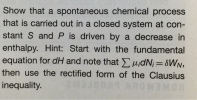 Show that a spontaneous chemical process that is carried out in a
closed system at constant S and P is driven by a decrease in
enthalpy.
Please help. Thank you!
how that a spontaneous chemical process that is carried out in a closed system at con- stant S and P is driven by a decrease in enthalpy. Hint: Start with the fundamental equation for dH and note that Σ μǐdNF SVVNs then use the rectified form of the Clausius inequality.
Show that a spontaneous chemical process that is carried out in a
closed system at constant S and P is driven by a decrease in
enthalpy.
Please help. Thank you!
how that a spontaneous chemical process that is carried out in a closed system at con- stant S and P is driven by a decrease in enthalpy. Hint: Start with the fundamental equation for dH and note that Σ μǐdNF SVVNs then use the rectified form of the Clausius inequality.
any spontaneous process, the entropy of the system increases. All spontaneous processes are accompanied by a...
 any spontaneous process, the entropy of the system increases. All spontaneous processes are accompanied by a decrease in free energy Question 2 In which state would two moles of Ar(g) have the lowest entropy?! at 45 °C in a volume of 10.0L All the listed conditions have the same entropy! at 150 °C in a volume of 10.0L at 150 °C in a volume of 2.5 L at 45 °C in a volume of 2.5 L Question 3 Which of...
BRCA1 and BRCA2 Genes Discuss how the primary structure of nucleic acids is the order of bases i...
BRCA1 and BRCA2 Genes Discuss how the primary structure of nucleic acids is the order of bases in the polynucleotide sequence, and the secondary structure is the three-dimensional conformation of the backbone. Discuss the monomers of nucleic acids are nucleotides. Discuss how the bases are bonded to the sugars, forming nucleosides. Summarize how nucleosides are linked by ester bonds to phosphoric acid to form the phosphodiester backbone. Specific proteins called single-strand binding proteins bind to the single-stranded regions and protect...
Identify the structure of amino acids, and describe the process by which they join together to...
Identify the structure of amino acids, and describe the process by which they join together to form polypeptides. Describe the 4 different groups of amino acids and their properties (Neutral, Polar, Acidic, Basic). Describe the levels of structure of proteins (primary, secondary, tertiary, and quaternary), including what bonds and interactions occur at EACH level. Describe denaturation of a protein and indicate how temperature and pH affect the protein functions. Describe the major functions of proteins
type only please 4. (C) Describe the chemical process by which multiple amino acids can form...
 type only please
4. (C) Describe the chemical process by which multiple amino acids can form covalent (peptide) bonds with each other, resulting in a polypeptide TT T Arial # 3 (12pt)
type only please
4. (C) Describe the chemical process by which multiple amino acids can form covalent (peptide) bonds with each other, resulting in a polypeptide TT T Arial # 3 (12pt)
 Short answers
9. When cooling a polymer after plasticating it, we have to remove the excess energy from the part allowing it to reach room temperature. What molecular properties of the polymer will define how much energy must be removed for the part to cool down? 10. Why do the enthalpy diagrams for the melting of indium and low density polyethylene differ from one another? What does the breadth of the melting peak tell us about the polymer under study?...
Short answers
9. When cooling a polymer after plasticating it, we have to remove the excess energy from the part allowing it to reach room temperature. What molecular properties of the polymer will define how much energy must be removed for the part to cool down? 10. Why do the enthalpy diagrams for the melting of indium and low density polyethylene differ from one another? What does the breadth of the melting peak tell us about the polymer under study?...
 why are the other options wrong?
For a process to be spontaneous: the entropy of universe increases and Gibbs energy of the system decreases. a) the entropy of system decreases and Gibbs energy of the b) universe increases. the entropy of system increases and Gibbs energy of the universe decreases. c) of universe decreases and Gibbs energy of the d) the entropy increases system
why are the other options wrong?
For a process to be spontaneous: the entropy of universe increases and Gibbs energy of the system decreases. a) the entropy of system decreases and Gibbs energy of the b) universe increases. the entropy of system increases and Gibbs energy of the universe decreases. c) of universe decreases and Gibbs energy of the d) the entropy increases system
 For a process to be spontaneous: a) b) the entropy of universe increases and Gibbs energy of the system decreases. the entropy of system decreases and Gibbs energy of the universe increases. the entropy of system increases and Gibbs energy of the universe decreases the entropy of universe decreases and Gibbs energy of the system increases. c) d)
 Show that a spontaneous chemical process that is carried out in a
closed system at constant S and P is driven by a decrease in
enthalpy.
Please help. Thank you!
how that a spontaneous chemical process that is carried out in a closed system at con- stant S and P is driven by a decrease in enthalpy. Hint: Start with the fundamental equation for dH and note that Σ μǐdNF SVVNs then use the rectified form of the Clausius inequality.
Show that a spontaneous chemical process that is carried out in a
closed system at constant S and P is driven by a decrease in
enthalpy.
Please help. Thank you!
how that a spontaneous chemical process that is carried out in a closed system at con- stant S and P is driven by a decrease in enthalpy. Hint: Start with the fundamental equation for dH and note that Σ μǐdNF SVVNs then use the rectified form of the Clausius inequality.
 any spontaneous process, the entropy of the system increases. All spontaneous processes are accompanied by a decrease in free energy Question 2 In which state would two moles of Ar(g) have the lowest entropy?! at 45 °C in a volume of 10.0L All the listed conditions have the same entropy! at 150 °C in a volume of 10.0L at 150 °C in a volume of 2.5 L at 45 °C in a volume of 2.5 L Question 3 Which of...
 type only please
4. (C) Describe the chemical process by which multiple amino acids can form covalent (peptide) bonds with each other, resulting in a polypeptide TT T Arial # 3 (12pt)
type only please
4. (C) Describe the chemical process by which multiple amino acids can form covalent (peptide) bonds with each other, resulting in a polypeptide TT T Arial # 3 (12pt)
Most questions answered within 3 hours.
-
Where is the error in this code sequence?
String s1 = "Hello";
String s2 = "ello";...
asked 11 months ago -
Financial data for Joel de Paris, Inc., for last year
follow:
Joel de Paris, Inc.
Balance...
asked 11 months ago -
Consider this reaction:
Al2(SO4)3 (aq)+ BaCl3
(aq) Al2Cl6 (aq)- +
3BaSO4(s) . What is the...
asked 11 months ago -
Suppose that Savneet is considering increasing her
recent random sample from 20 car rentals to 40...
asked 11 months ago -
Trucks arrive at an unloading terminal at an average rate of 120
per hour.
Trucks arrive...
asked 11 months ago -
Why are methanol and ethanol completely soluble in water while
octanol is not very little soluble....
asked 11 months ago -
A facilities manager at a university reads in a research report
that the mean amount of...
asked 11 months ago -
When the CuSO4 is rehydrated by adding water to the anhydrous
compound, is this an endothermic...
asked 11 months ago -
A ray of sunlight is passing from diamond into crown glass; the
angle of incidence is...
asked 11 months ago -
A block of mass 0.249 kg is placed on top of a light, vertical
spring of...
asked 11 months ago -
how do the kidneys compensate in the presences of acidosis
a) trigger hyperventilate
b) reserve acid...
asked 11 months ago -
Question 501 pts
The rental rate of capital to the firm increases. Which of the
following...
asked 11 months ago