(3 part question) There is a large double pane window (4 metres by 1.5 metres) in...
(3 part question)
There is a large double pane window (4 metres by 1.5 metres) in a house. A 3 millimetre gap exists between two layers of glass in the window. The gap is filled with nitrogen gas. The temperature inside the house is 298.15 K and the temperature outside is 253.15 K. Assume that the glass offers no resistance to the heat transfer. Nitrogen (28 kg/mol) has a collision diameter of 3.64 angstroms.
i. What is the thermal conductivity of this nitrogen gas?
ii. What is the steady-state transfer of heat through this window each day (24h)?
iii. What would happen to the flux of heat in the situation above if the following changed (no calculation necessary):
1. the gap in the window was 6mm? 2. the gap in the window was filled with hydrogen instead (2kg/mol, collision diameter 2.89 angstroms)?
3. the temperature outside was 233.15 K?
Homework Answers


To calculate the thermal conductivity of nitrogen gas, the steady-state transfer of heat through the window, and understand the impact of different scenarios, we can use the formula for heat transfer through a gas in a confined space. The formula for steady-state heat transfer (Q) through a gas layer is:
Q = (k * A * (T1 - T2)) / d
Where: Q = Steady-state heat transfer (in watts) k = Thermal conductivity of the gas (in watts per meter per kelvin, W/(m·K)) A = Area of the window (in square meters) T1 = Temperature inside the house (in Kelvin) T2 = Temperature outside the house (in Kelvin) d = Thickness of the gas layer (in meters)
i. Thermal Conductivity of Nitrogen Gas (k): To calculate the thermal conductivity of nitrogen gas, we need to find k in the formula above.
First, we need to convert the collision diameter from angstroms to meters: Collision diameter of nitrogen gas = 3.64 angstroms = 3.64 × 10^(-10) meters
Next, we can use kinetic theory to find the thermal conductivity (k) using the following formula:
k = (1/3) * (m / π * d^2) * √((8 * k_B * T) / (π * m))
Where: m = Mass of a nitrogen molecule (in kg/mol) = 28 g/mol = 0.028 kg/mol d = Collision diameter of nitrogen gas (in meters) k_B = Boltzmann constant = 1.380649 × 10^(-23) J/K (joules per Kelvin) T = Temperature in Kelvin (298.15 K)
Substitute the values and calculate k:
k = (1/3) * (0.028 / π * (3.64 × 10^(-10))^2) * √((8 * 1.380649 × 10^(-23) * 298.15) / (π * 0.028)) k ≈ 0.0255 W/(m·K)
ii. Steady-state Transfer of Heat through the Window (Q): Now, we can calculate the steady-state transfer of heat through the window each day (24h).
Area of the window (A) = 4 m * 1.5 m = 6 m² Thickness of the gas layer (d) = 3 mm = 3 × 10^(-3) m
Q = (0.0255 * 6 * (298.15 - 253.15)) / (3 × 10^(-3)) Q ≈ 1650 W
iii. Impact of Different Scenarios:
If the gap in the window was 6 mm: We would need to recalculate the thickness (d) and use the same formula to find the new steady-state transfer of heat (Q) through the window.
If the gap in the window was filled with hydrogen gas: We would need to use the mass of a hydrogen molecule (2 kg/mol) and the collision diameter of hydrogen gas (2.89 angstroms converted to meters) in the formula for thermal conductivity. Then, recalculate Q using the new k and the same window dimensions.
If the temperature outside was 233.15 K: Simply use the new temperature (T2) in the formula for Q, keeping all other values the same.
Add Answer to:
(3 part question)
There is a large double pane window (4 metres by 1.5 metres) in...
Consider a 1.2-m-high and 2-m-wide double-pane window consisting of two 3-mm-thick layers of glass (k =...
 Consider a 1.2-m-high and 2-m-wide double-pane window consisting of two 3-mm-thick layers of glass (k = 0.78 W/m K) separated by a 12-mm-wide stagnant air space (k = 0.026 W/m K). Determine the steady rate of heat transfer through this double-pane window. R . and all the surface temperatures (inner and outer of each pane) within the circuit (which you will draw and correctly label) for a day during which the room is maintained at 24°C while the temperature of...
Thermal Resistance Analysis: Consider a 1.2 m high and 1.4 m wide double-pane window consisting o...
 Thermal Resistance Analysis: Consider a 1.2 m high and 1.4 m wide double-pane window consisting of two 4 mm thick layers ofglass (k-0.85 W m-K) separated by a 8-min stagnant air space. (k= 0.025 W m-K) Determine the steady rate of heat transfer through this double-pane window and the temperature of its inner and outer surfaces on a day when the inside room temperature is maintained at 20 °C and the outside ambient temperature is 32 °C. Assume the convection...
a) Calculate the heat loss for the double-pane window Inside Glass Sir Glass Outside 10 mm...
 a) Calculate the heat loss for the double-pane window Inside Glass Sir Glass Outside 10 mm 10 mm 10 mm The thickness of glass (k = 0.74976 m.) is 10 mm and the distance between two glasses is 10 mm The thermal conductivity of air is k = 0.027 The temperature inside is T, = 30 C and temperature outside is C mK
Heat Transfer Problems 1. A window pane (1/8 inch thick) in an old house owned by...
 Heat Transfer
Problems 1. A window pane (1/8 inch thick) in an old house owned by a professor is 3 ft. by 4 ft. He likes to be warm in the winter so the inside temperature is kept at 70 °F even when the outside temperature is 10 •F. For this problem assume the inside and outside temperatures are for the window surface. How much heat is transferred through the window (k=.54 BTU/hr ft ° F)? 2. A small heated...
Heat Transfer
Problems 1. A window pane (1/8 inch thick) in an old house owned by a professor is 3 ft. by 4 ft. He likes to be warm in the winter so the inside temperature is kept at 70 °F even when the outside temperature is 10 •F. For this problem assume the inside and outside temperatures are for the window surface. How much heat is transferred through the window (k=.54 BTU/hr ft ° F)? 2. A small heated...
QUESTION 7 Consider a (1.25, 1.0, 1.3, 0.90)-m-high and (2.0, 2.1, 2.2, 2.3)-m-wide double-pane window (see...
 QUESTION 7 Consider a (1.25, 1.0, 1.3, 0.90)-m-high and (2.0, 2.1, 2.2, 2.3)-m-wide double-pane window (see Figure below) consisting of two 3-mm-thick layers of glass (k = 0.79 W/m.°c) separated by a 12-mm-wide stagnant air space (k = 0.028 W/m-°C). The room is maintained at (20, 21, 22, 23, 24) °C while the temperature of the outdoors is (5, 6, 7, 8)°C. Take the convection heat transfer coefficients on the inner and outer surfaces of the window to be h1...
1. Consider a 1.2-m-high and 2-m-wide double-pane window consisting of two 3-mm a W/m C) separated...
 1. Consider a 1.2-m-high and 2-m-wide double-pane window consisting of two 3-mm a W/m C) separated by a 12-mm-wide stagnant air space thick layers of glass ( 0.78 (0.026 W/m C). Determine the steady rate of heat transfer through this double- pane window and the temperature of its inner surface for a day during which the room is maintained at 24 C while the temperature of the outdoors is 5 C. Take the convection heat transfer coefficients on the inner...
Considera (1.25, 1.0, 1.3, 0.90).m-high and (2.0, 2.1, 2.2, 2.3).m-wide double-pane window (see Figure below) consisting...
 Considera (1.25, 1.0, 1.3, 0.90).m-high and (2.0, 2.1, 2.2, 2.3).m-wide double-pane window (see Figure below) consisting of two 3-mm-thick layers of glass (k = 0.79 W/m°c) separated by a 12-mm-wide stagnant air space (k -0.028 W/m.°c). The room is maintained at (20, 21, 22, 23, 24) ºc while the temperature of the outdoors is (5, 6, 7, 8)°C. Take the convection heat transfer coefficients on the inner and outer surfaces of the window to be h1 = 11 W/m2.0c and...
Consider the rate of heat conduction through a double-paned window that has a 1.45-m2 area and...
 Consider
the rate of heat conduction through a double-paned window that has
a 1.45-m2 area and is made of two panes of
0.715-cm-thick glass separated by a 1.25-cm air gap. You can ignore
the increased heat transfer in the air gap due to convection.
Calculate the rate of heat conduction through this window, in
watts, given that the inside surface temperature is 15.0°C, while
the outside temperature is -10.0°C. Make the assumption that the
temperature differences across the two glass...
Consider
the rate of heat conduction through a double-paned window that has
a 1.45-m2 area and is made of two panes of
0.715-cm-thick glass separated by a 1.25-cm air gap. You can ignore
the increased heat transfer in the air gap due to convection.
Calculate the rate of heat conduction through this window, in
watts, given that the inside surface temperature is 15.0°C, while
the outside temperature is -10.0°C. Make the assumption that the
temperature differences across the two glass...
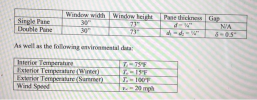
Window width Window height Pane thickness Gap N/A Single Pane Double Pane 30" 30" 73" 73" As well...
 Given the following data, solve for the heat transfer
coefficients
Window width Window height Pane thickness Gap N/A Single Pane Double Pane 30" 30" 73" 73" As well as the following environmental data: T, = 75°F Interior Temperature Exterior Temperature (Winter)159F Exterior Temperature (Summer) Wind Speed To = 100°F vo = 20 mph | ewrsstonk A-19) .74 CTable Heat transfer offinh e Convection free o ta «T >。.33; , Table 72, p746 ree = ta Mo 333 forced Convecfon O....
Given the following data, solve for the heat transfer
coefficients
Window width Window height Pane thickness Gap N/A Single Pane Double Pane 30" 30" 73" 73" As well as the following environmental data: T, = 75°F Interior Temperature Exterior Temperature (Winter)159F Exterior Temperature (Summer) Wind Speed To = 100°F vo = 20 mph | ewrsstonk A-19) .74 CTable Heat transfer offinh e Convection free o ta «T >。.33; , Table 72, p746 ree = ta Mo 333 forced Convecfon O....
I figured out the first question but im not sure how to answer question 2 and 3?
 i
figured out the first question but im not sure how to answer
question 2 and 3?
i
have figured out question 2. Question #3 is what is diffcult to
grasp because i have to guess my Fo #. Fo=time
1. To reduce building heating costs, modern building codes in many parts of the country require the use of double-pane windows (sometimes, called "double-glazed" or "thermopane" windows). Some of In one design of a double-pane window, each glass layer is...
i
figured out the first question but im not sure how to answer
question 2 and 3?
i
have figured out question 2. Question #3 is what is diffcult to
grasp because i have to guess my Fo #. Fo=time
1. To reduce building heating costs, modern building codes in many parts of the country require the use of double-pane windows (sometimes, called "double-glazed" or "thermopane" windows). Some of In one design of a double-pane window, each glass layer is...
 Consider a 1.2-m-high and 2-m-wide double-pane window consisting of two 3-mm-thick layers of glass (k = 0.78 W/m K) separated by a 12-mm-wide stagnant air space (k = 0.026 W/m K). Determine the steady rate of heat transfer through this double-pane window. R . and all the surface temperatures (inner and outer of each pane) within the circuit (which you will draw and correctly label) for a day during which the room is maintained at 24°C while the temperature of...
 Thermal Resistance Analysis: Consider a 1.2 m high and 1.4 m wide double-pane window consisting of two 4 mm thick layers ofglass (k-0.85 W m-K) separated by a 8-min stagnant air space. (k= 0.025 W m-K) Determine the steady rate of heat transfer through this double-pane window and the temperature of its inner and outer surfaces on a day when the inside room temperature is maintained at 20 °C and the outside ambient temperature is 32 °C. Assume the convection...
 a) Calculate the heat loss for the double-pane window Inside Glass Sir Glass Outside 10 mm 10 mm 10 mm The thickness of glass (k = 0.74976 m.) is 10 mm and the distance between two glasses is 10 mm The thermal conductivity of air is k = 0.027 The temperature inside is T, = 30 C and temperature outside is C mK
 Heat Transfer
Problems 1. A window pane (1/8 inch thick) in an old house owned by a professor is 3 ft. by 4 ft. He likes to be warm in the winter so the inside temperature is kept at 70 °F even when the outside temperature is 10 •F. For this problem assume the inside and outside temperatures are for the window surface. How much heat is transferred through the window (k=.54 BTU/hr ft ° F)? 2. A small heated...
Heat Transfer
Problems 1. A window pane (1/8 inch thick) in an old house owned by a professor is 3 ft. by 4 ft. He likes to be warm in the winter so the inside temperature is kept at 70 °F even when the outside temperature is 10 •F. For this problem assume the inside and outside temperatures are for the window surface. How much heat is transferred through the window (k=.54 BTU/hr ft ° F)? 2. A small heated...
 QUESTION 7 Consider a (1.25, 1.0, 1.3, 0.90)-m-high and (2.0, 2.1, 2.2, 2.3)-m-wide double-pane window (see Figure below) consisting of two 3-mm-thick layers of glass (k = 0.79 W/m.°c) separated by a 12-mm-wide stagnant air space (k = 0.028 W/m-°C). The room is maintained at (20, 21, 22, 23, 24) °C while the temperature of the outdoors is (5, 6, 7, 8)°C. Take the convection heat transfer coefficients on the inner and outer surfaces of the window to be h1...
 1. Consider a 1.2-m-high and 2-m-wide double-pane window consisting of two 3-mm a W/m C) separated by a 12-mm-wide stagnant air space thick layers of glass ( 0.78 (0.026 W/m C). Determine the steady rate of heat transfer through this double- pane window and the temperature of its inner surface for a day during which the room is maintained at 24 C while the temperature of the outdoors is 5 C. Take the convection heat transfer coefficients on the inner...
 Considera (1.25, 1.0, 1.3, 0.90).m-high and (2.0, 2.1, 2.2, 2.3).m-wide double-pane window (see Figure below) consisting of two 3-mm-thick layers of glass (k = 0.79 W/m°c) separated by a 12-mm-wide stagnant air space (k -0.028 W/m.°c). The room is maintained at (20, 21, 22, 23, 24) ºc while the temperature of the outdoors is (5, 6, 7, 8)°C. Take the convection heat transfer coefficients on the inner and outer surfaces of the window to be h1 = 11 W/m2.0c and...
 Consider
the rate of heat conduction through a double-paned window that has
a 1.45-m2 area and is made of two panes of
0.715-cm-thick glass separated by a 1.25-cm air gap. You can ignore
the increased heat transfer in the air gap due to convection.
Calculate the rate of heat conduction through this window, in
watts, given that the inside surface temperature is 15.0°C, while
the outside temperature is -10.0°C. Make the assumption that the
temperature differences across the two glass...
Consider
the rate of heat conduction through a double-paned window that has
a 1.45-m2 area and is made of two panes of
0.715-cm-thick glass separated by a 1.25-cm air gap. You can ignore
the increased heat transfer in the air gap due to convection.
Calculate the rate of heat conduction through this window, in
watts, given that the inside surface temperature is 15.0°C, while
the outside temperature is -10.0°C. Make the assumption that the
temperature differences across the two glass...
 Given the following data, solve for the heat transfer
coefficients
Window width Window height Pane thickness Gap N/A Single Pane Double Pane 30" 30" 73" 73" As well as the following environmental data: T, = 75°F Interior Temperature Exterior Temperature (Winter)159F Exterior Temperature (Summer) Wind Speed To = 100°F vo = 20 mph | ewrsstonk A-19) .74 CTable Heat transfer offinh e Convection free o ta «T >。.33; , Table 72, p746 ree = ta Mo 333 forced Convecfon O....
Given the following data, solve for the heat transfer
coefficients
Window width Window height Pane thickness Gap N/A Single Pane Double Pane 30" 30" 73" 73" As well as the following environmental data: T, = 75°F Interior Temperature Exterior Temperature (Winter)159F Exterior Temperature (Summer) Wind Speed To = 100°F vo = 20 mph | ewrsstonk A-19) .74 CTable Heat transfer offinh e Convection free o ta «T >。.33; , Table 72, p746 ree = ta Mo 333 forced Convecfon O....
 i
figured out the first question but im not sure how to answer
question 2 and 3?
i
have figured out question 2. Question #3 is what is diffcult to
grasp because i have to guess my Fo #. Fo=time
1. To reduce building heating costs, modern building codes in many parts of the country require the use of double-pane windows (sometimes, called "double-glazed" or "thermopane" windows). Some of In one design of a double-pane window, each glass layer is...
i
figured out the first question but im not sure how to answer
question 2 and 3?
i
have figured out question 2. Question #3 is what is diffcult to
grasp because i have to guess my Fo #. Fo=time
1. To reduce building heating costs, modern building codes in many parts of the country require the use of double-pane windows (sometimes, called "double-glazed" or "thermopane" windows). Some of In one design of a double-pane window, each glass layer is...
Most questions answered within 3 hours.
-
Where is the error in this code sequence?
String s1 = "Hello";
String s2 = "ello";...
asked 10 months ago -
Financial data for Joel de Paris, Inc., for last year
follow:
Joel de Paris, Inc.
Balance...
asked 10 months ago -
Consider this reaction:
Al2(SO4)3 (aq)+ BaCl3
(aq) Al2Cl6 (aq)- +
3BaSO4(s) . What is the...
asked 10 months ago -
Suppose that Savneet is considering increasing her
recent random sample from 20 car rentals to 40...
asked 10 months ago -
Trucks arrive at an unloading terminal at an average rate of 120
per hour.
Trucks arrive...
asked 10 months ago -
Why are methanol and ethanol completely soluble in water while
octanol is not very little soluble....
asked 10 months ago -
A facilities manager at a university reads in a research report
that the mean amount of...
asked 10 months ago -
When the CuSO4 is rehydrated by adding water to the anhydrous
compound, is this an endothermic...
asked 10 months ago -
A ray of sunlight is passing from diamond into crown glass; the
angle of incidence is...
asked 10 months ago -
A block of mass 0.249 kg is placed on top of a light, vertical
spring of...
asked 10 months ago -
how do the kidneys compensate in the presences of acidosis
a) trigger hyperventilate
b) reserve acid...
asked 10 months ago -
Question 501 pts
The rental rate of capital to the firm increases. Which of the
following...
asked 10 months ago