Given that the the sample space s is the ordered pairs of two whole numbers, the...
Given that the the sample space s is the ordered pairs
of two whole numbers, the first from one to three and the second
from one to four
It says let the event A=the sum is even and event B= the first
number is prime
so A=?
and B=?
Homework Answers
The sample space for given condition
s ={ (1,1),(1,2),(1,3),(1,4),(2,1),(2,2),(2,3),(2,4),(3,1),(3,2),(3,3),(3,4)}
The event A : sum is even
A = { (1,1),(1,3),(2,2),(2,4),(3,1),(3,3)} = 6
B = { (2,1),(2,2),(2,3),(2,4),(3,1),(3,2),(3,3),(3,4)} = 8
Let's first list all the possible outcomes in the sample space S, which consists of ordered pairs of two whole numbers as described:
S = {(1, 1), (1, 2), (1, 3), (1, 4), (2, 1), (2, 2), (2, 3), (2, 4), (3, 1), (3, 2), (3, 3), (3, 4)}
Now, we'll define the events A and B based on the given conditions:
Event A: The sum is even. To find the outcomes where the sum of the two numbers is even, we can consider the following pairs: (1, 1), (1, 3), (2, 2), (2, 4), (3, 1), (3, 3). So, Event A consists of the pairs: {(1, 1), (1, 3), (2, 2), (2, 4), (3, 1), (3, 3)}.
Event B: The first number is prime. The prime numbers between 1 and 3 are 2 and 3. So, Event B consists of the pairs: {(2, 1), (2, 2), (2, 3)}.
To summarize: Event A = {(1, 1), (1, 3), (2, 2), (2, 4), (3, 1), (3, 3)} Event B = {(2, 1), (2, 2), (2, 3)}
To find the events A and B as described, let's first list all the ordered pairs in the sample space S:
Sample space S: {(1, 1), (1, 2), (1, 3), (1, 4), (2, 1), (2, 2), (2, 3), (2, 4), (3, 1), (3, 2), (3, 3), (3, 4)}
Event A: The sum is even
For event A, we need to find all the ordered pairs whose sum is an even number.
Pairs with even sum:
(1, 1) → Sum: 1 + 1 = 2 (even)
(1, 3) → Sum: 1 + 3 = 4 (even)
(2, 2) → Sum: 2 + 2 = 4 (even)
(2, 4) → Sum: 2 + 4 = 6 (even)
(3, 1) → Sum: 3 + 1 = 4 (even)
(3, 3) → Sum: 3 + 3 = 6 (even)
Event A: {(1, 1), (1, 3), (2, 2), (2, 4), (3, 1), (3, 3)}
Event B: The first number is prime
For event B, we need to find all the ordered pairs where the first number is a prime number.
Prime numbers from 1 to 3: 2, 3
Pairs with the first number as prime:
(2, 1)
(2, 2)
(2, 3)
(2, 4)
(3, 1)
(3, 2)
(3, 3)
(3, 4)
Event B: {(2, 1), (2, 2), (2, 3), (2, 4), (3, 1), (3, 2), (3, 3), (3, 4)}
In summary:
Event A (the sum is even): {(1, 1), (1, 3), (2, 2), (2, 4), (3, 1), (3, 3)}
Event B (the first number is prime): {(2, 1), (2, 2), (2, 3), (2, 4), (3, 1), (3, 2), (3, 3), (3, 4)
Add Answer to:
Given that the the sample space s is the ordered pairs
of two whole numbers, the...
Conditional Probability Two fair dice are rolled: (a) Express the sample space S in set builder...
 Conditional Probability Two fair dice are rolled: (a) Express the sample space S in set builder notation and the probability P "At least one of the dice rolls a four." Write all possible outcomes of A (b) Consider the event A (c) What is the probability that at least one die rolls a four? (d) What is the conditional probability that the first die rolls a four given that the sum of the dice is six? (e) What is the...
2.6 Suppose two dice are tossed and the numbers on the upper faces are observed. Let...
 2.6 Suppose two dice are tossed and the numbers on the upper faces are observed. Let S denote the set of all possible pairs that can be observed. [These pairs can be listed, for example, by letting (2, 3) denote that a 2 was observed on the first die and a 3 on the second.] a Define the following subsets of S: A: The number on the second die is even. B: The sum of the two numbers is even....
1) Consider rolling a die two times. a.What is the sample space ?2 if the outcome...
1) Consider rolling a die two times. a.What is the sample space ?2 if the outcome of interest is the maximum of the two numbers observed? B.What is the sample space ?3 if the outcome of interest is the difference between the first and the second numbers? (Hint: ?1 − ?2) C.What is the sample space ?4 if the outcome of interest is the distance between the two number? D.Let ? be the event in which the distance between the...
2. Suppose the total sample space (area in the rectangle, denoted as S) is all products...
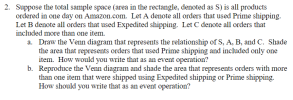 2. Suppose the total sample space (area in the rectangle, denoted as S) is all products ordered in one day on Amazon.com. Let A denote all orders that used Prime shipping Let B denote all orders that used Expedited shipping. Let C denote all orders that included more than one item. Draw the Venn diagram that represents the relationship of S, A, B, and C. Shade the area that represents orders that used Prime shipping and included only one item....
What is the most likely outcome when we throw two fair dice, i.e., what is the most likely sum th...
 What is the most likely outcome when we throw two fair dice,
i.e., what is the most likely sum that the two dice would add to?
Why? This problem can be solved by first principles. The probability
P(E) for an event E is the ratio |E|/|S|, where |E| is the
cardinality of the event space and |S| is the cardinality of the
sample space. For example, when we throw a fair die, the event
space is S = {1,2,3,4,5,6} and...
What is the most likely outcome when we throw two fair dice,
i.e., what is the most likely sum that the two dice would add to?
Why? This problem can be solved by first principles. The probability
P(E) for an event E is the ratio |E|/|S|, where |E| is the
cardinality of the event space and |S| is the cardinality of the
sample space. For example, when we throw a fair die, the event
space is S = {1,2,3,4,5,6} and...
A fair, six-sided die is rolled. Describe the sample space S, identify each of the following...
A fair, six-sided die is rolled. Describe the sample space S, identify each of the following events with a subset of S and compute its probability (an outcome is the number of dots that show up). a. Event T = the outcome is three. b. Event A = the outcome is an odd number c. Event B = the outcome is less than four. d. Event D = the complement of A e. A AND B f. A OR B...
Two fair dice are rolled. Let A be the event the sum is even and B...
Two fair dice are rolled. Let A be the event the sum is even and B be the event at least one of the numbers rolled is three. (a) What is the sample space? (b) Display the outcomes in a Karnaugh map in terms of events A and B. (c) Determine P(AB).
Problem 1 (35 points): Two numbers are chosen at random and simultaneously from among the numbers...
 Problem 1 (35 points): Two numbers are chosen at random and simultaneously from among the numbers 1 to 4 without replacement. Let A,产(1,2,3,41, be the event that the first number is . 1. Find the probability of the event B that the second number chosen is 3. 2. What is the probability that the first number is 1 given that the second number is 3?
Problem 5. Suppose two dice are tossed and the numbers on the upper faces are observed....
 Problem 5. Suppose two dice are tossed and the numbers on the upper faces are observed. Let S denote the set of all possible pairs that can be observed. The pairs can be listed, for example, by letting (2, 3) denote that a 2 was observed on the first die and a 3 on the second. Define the following subsets of S .A The number on the second die is odd. · B: The sum of the two numbers is...
Java Programmming Given three numbers from user input, decrement the first number by 2 and increment...
Java Programmming Given three numbers from user input, decrement the first number by 2 and increment the second number by 1, Then do the magic calculations as follows: get the sum of the first two numbers, deduct the third number from the second and get the product of the first and third number, then sum up the results of the three magic calculations. Sample run 1: Enter three numbers separated by spaces: 4 2 3 Output: Result of Magic calculations...
 Conditional Probability Two fair dice are rolled: (a) Express the sample space S in set builder notation and the probability P "At least one of the dice rolls a four." Write all possible outcomes of A (b) Consider the event A (c) What is the probability that at least one die rolls a four? (d) What is the conditional probability that the first die rolls a four given that the sum of the dice is six? (e) What is the...
 2.6 Suppose two dice are tossed and the numbers on the upper faces are observed. Let S denote the set of all possible pairs that can be observed. [These pairs can be listed, for example, by letting (2, 3) denote that a 2 was observed on the first die and a 3 on the second.] a Define the following subsets of S: A: The number on the second die is even. B: The sum of the two numbers is even....
 2. Suppose the total sample space (area in the rectangle, denoted as S) is all products ordered in one day on Amazon.com. Let A denote all orders that used Prime shipping Let B denote all orders that used Expedited shipping. Let C denote all orders that included more than one item. Draw the Venn diagram that represents the relationship of S, A, B, and C. Shade the area that represents orders that used Prime shipping and included only one item....
 What is the most likely outcome when we throw two fair dice,
i.e., what is the most likely sum that the two dice would add to?
Why? This problem can be solved by first principles. The probability
P(E) for an event E is the ratio |E|/|S|, where |E| is the
cardinality of the event space and |S| is the cardinality of the
sample space. For example, when we throw a fair die, the event
space is S = {1,2,3,4,5,6} and...
What is the most likely outcome when we throw two fair dice,
i.e., what is the most likely sum that the two dice would add to?
Why? This problem can be solved by first principles. The probability
P(E) for an event E is the ratio |E|/|S|, where |E| is the
cardinality of the event space and |S| is the cardinality of the
sample space. For example, when we throw a fair die, the event
space is S = {1,2,3,4,5,6} and...
 Problem 1 (35 points): Two numbers are chosen at random and simultaneously from among the numbers 1 to 4 without replacement. Let A,产(1,2,3,41, be the event that the first number is . 1. Find the probability of the event B that the second number chosen is 3. 2. What is the probability that the first number is 1 given that the second number is 3?
 Problem 5. Suppose two dice are tossed and the numbers on the upper faces are observed. Let S denote the set of all possible pairs that can be observed. The pairs can be listed, for example, by letting (2, 3) denote that a 2 was observed on the first die and a 3 on the second. Define the following subsets of S .A The number on the second die is odd. · B: The sum of the two numbers is...
Most questions answered within 3 hours.
-
Where is the error in this code sequence?
String s1 = "Hello";
String s2 = "ello";...
asked 10 months ago -
Financial data for Joel de Paris, Inc., for last year
follow:
Joel de Paris, Inc.
Balance...
asked 10 months ago -
Consider this reaction:
Al2(SO4)3 (aq)+ BaCl3
(aq) Al2Cl6 (aq)- +
3BaSO4(s) . What is the...
asked 10 months ago -
Suppose that Savneet is considering increasing her
recent random sample from 20 car rentals to 40...
asked 10 months ago -
Trucks arrive at an unloading terminal at an average rate of 120
per hour.
Trucks arrive...
asked 10 months ago -
Why are methanol and ethanol completely soluble in water while
octanol is not very little soluble....
asked 10 months ago -
A facilities manager at a university reads in a research report
that the mean amount of...
asked 10 months ago -
When the CuSO4 is rehydrated by adding water to the anhydrous
compound, is this an endothermic...
asked 10 months ago -
A ray of sunlight is passing from diamond into crown glass; the
angle of incidence is...
asked 10 months ago -
A block of mass 0.249 kg is placed on top of a light, vertical
spring of...
asked 10 months ago -
how do the kidneys compensate in the presences of acidosis
a) trigger hyperventilate
b) reserve acid...
asked 10 months ago -
Question 501 pts
The rental rate of capital to the firm increases. Which of the
following...
asked 10 months ago