Show that Kn has a Hamiltonian circuit whenever n >= 3. with a proof please
Show that Kn has a Hamiltonian circuit whenever n >= 3.
with a proof please
Homework Answers
To show that the complete graph Kn has a Hamiltonian circuit whenever n >= 3, we first need to understand what a Hamiltonian circuit is and then proceed with the proof.
Definition: Hamiltonian CircuitA Hamiltonian circuit in a graph is a closed walk that visits every vertex exactly once and returns to the starting vertex.
Proof:We will proceed with a constructive proof by demonstrating a method to construct a Hamiltonian circuit in the complete graph Kn for n >= 3.
Step 1: Setting up the Complete Graph KnThe complete graph Kn has n vertices, where every vertex is connected to every other vertex by an edge. In other words, there are (n-1) edges emanating from each vertex, leading to the other (n-1) vertices.
Step 2: Labeling the VerticesLabel the vertices of Kn as v1, v2, v3, ..., vn.
Step 3: Constructing the Hamiltonian Circuit
Start at any arbitrary vertex, say v1.
Move to an adjacent vertex, v2, as there is an edge connecting v1 and v2.
Continue to the next adjacent vertex, v3, as there is an edge connecting v2 and v3.
Repeat this process, visiting all the vertices in the order v1, v2, v3, ..., vn-1.
At this point, we have visited n-1 vertices, and we haven't visited vn yet. We need to complete the Hamiltonian circuit by returning to v1. Since every vertex in Kn is connected to every other vertex, there is an edge connecting vn and v1. Hence, we can simply move from vn to v1, completing the Hamiltonian circuit.
Step 4: ConclusionIn this construction, we have visited all n vertices of Kn exactly once and returned to the starting vertex, v1. Therefore, we have successfully constructed a Hamiltonian circuit in the complete graph Kn for n >= 3.
As a result, we have proven that the complete graph Kn has a Hamiltonian circuit whenever n >= 3.
Kn has a Hamiltonian circuit when n >= 3:
Hamiltonian circuit:
• It is a circuit in graph where each vertex is presented one and only one time.
• The circuit at the end will back to the starting node or vertex.
Proof:
• Let Kn be the connected graph with n number of vertices .
• Assume that vertices ordered in a graph as v1, v2, ... vn, where v1 considered as a starting vertex.
• Hamilton circuit is presented as v1 — v2 — .... — vn — v1 such that all the edges are present and it will back to starting vertex.
• Hence, having more numbers of vertices result in more number of edges that forms Hamiltonian circuit.
• In order to form a Hamiltonian circuit in graph which returns back to starting vertex, there must be n >= 3.
• Example: Suppose you have 3 vertices A, B and C then Hamiltonian circuit for K3 is represented as A — B — C — A.
Add Answer to:
Show that Kn has a Hamiltonian circuit whenever n >=
3.
with a proof please
G3: I can determine whether a graph has an Euler trail (or circuit), or a Hamiltonian...
 G3: I can determine whether a graph has an Euler trail (or circuit), or a Hamiltonian path (or cycle), and I can clearly explain my reasoning. Answer each question in the space provided below. 1. Draw a simple graph with 7 vertices and 11 edges that has an Euler circuit. Demonstrate the Euler circuit by listing in order the vertices on it. 2. For what pairs (m, n) does the complete bipartite graph, Km,n contain a Hamiltonian cycle? Justify your...
From the proof of (ii) . Explain/Show why -n+ 1Sm-kn-1 is true by construction. . Explain/Show wh...
 From the proof of (ii) . Explain/Show why -n+ 1Sm-kn-1 is true by construction. . Explain/Show why 0 is the only number divisible by n in the range -n+1 ton-1 Proposition 6.24. Fix a modulus nEN. (i) is an equivalence relation on Z. (ii) The equivalence relation-has exactly n distinct equivalence classes, namely (ii) We need to prove that every integer falls into one of the equivalence classes [0], [1],..., [n -1], and that they are all distinct. For each...
(a) Using the three rules that must be followed to when building a Hamiltonian circuit, give a careful step by step argument to show that the following graph G does not have a Hamiltonian circuit....
 (a) Using the three rules that must be followed to when building a Hamiltonian circuit, give a careful step by step argument to show that the following graph G does not have a Hamiltonian circuit. Explain your work in details Consider two possible cases: Case 1: At the vertex 1, choose edges 17 and 12 4. 4 Case 2: At the vertex 1. Choose edges 16 and 12.
(a) Using the three rules that must be followed to when building...
(a) Using the three rules that must be followed to when building a Hamiltonian circuit, give a careful step by step argument to show that the following graph G does not have a Hamiltonian circuit. Explain your work in details Consider two possible cases: Case 1: At the vertex 1, choose edges 17 and 12 4. 4 Case 2: At the vertex 1. Choose edges 16 and 12.
(a) Using the three rules that must be followed to when building...
HW: Show that the series __, an n=0 converges whenever ſal < 1, and diverges whenever...
 HW: Show that the series __, an n=0 converges whenever ſal < 1, and diverges whenever al > 0.
Is log((n^2)!) , ?(?log?)? Please show steps of proof. (use limits if possible)
Is log((n^2)!) , ?(?log?)? Please show steps of proof. (use limits if possible)
1. The two dimensional Harmonic Oscillator has the Hamiltonian n, n'>denotes the state In> of the...
 Please solve with the
explanations of notations
1. The two dimensional Harmonic Oscillator has the Hamiltonian n, n'>denotes the state In> of the x-oscillator and In'> of the y-oscillator. This system is perturbed with the potential energy: Hi-Kix y. The perturbation removes the The perturbation removes the degeneracy of the states | 1,0> and |0,1> a) In first order perturbation theory find the two nondegenerate eigenstates of the full b) Find the corresponding energy eigenvalues. На Hamiltonian as normalized linear...
Please solve with the
explanations of notations
1. The two dimensional Harmonic Oscillator has the Hamiltonian n, n'>denotes the state In> of the x-oscillator and In'> of the y-oscillator. This system is perturbed with the potential energy: Hi-Kix y. The perturbation removes the The perturbation removes the degeneracy of the states | 1,0> and |0,1> a) In first order perturbation theory find the two nondegenerate eigenstates of the full b) Find the corresponding energy eigenvalues. На Hamiltonian as normalized linear...
PLEASE HELP WITH PROOF!! 8. Let an > 0 for all n in 1. Show that...
 PLEASE HELP WITH PROOF!!
8. Let an > 0 for all n in 1. Show that if an converges, then Ĉ vanın converges. [Hint: Expand [van - (1/n)]2.) N =
PLEASE HELP WITH PROOF!!
8. Let an > 0 for all n in 1. Show that if an converges, then Ĉ vanın converges. [Hint: Expand [van - (1/n)]2.) N =
Please show all work if possible, thanks! Show that the system of differential equations is Hamiltonian,...
 Please show all work if possible, thanks!
Show that the system of differential equations is Hamiltonian, and find a Hamiltonian function H(x,y). You may assume that H(0,0) = 0. 3y2 - 2.c dx dt dy dt 6x2 + 2y
Please show all work if possible, thanks!
Show that the system of differential equations is Hamiltonian, and find a Hamiltonian function H(x,y). You may assume that H(0,0) = 0. 3y2 - 2.c dx dt dy dt 6x2 + 2y
Q3. (15 PTS) Another proof of the irrationality of V2. Please fill in the details and...
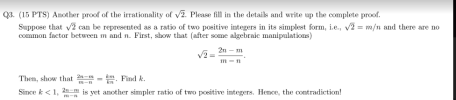 Q3. (15 PTS) Another proof of the irrationality of V2. Please fill in the details and write up the complete proof. Suppose that can be represented as a ratio of two positive integers in its simplest form, i.e., V2 = m/n and there are no common factor between m and n. First, show that after some algebraic manipulations) 2n-m V2= m-n m-7 kn Then, show that 2n-m = km Find k. Since k <1, 2n=" is yet another simpler ratio...
Use induction to show that 6 divides n3 −n whenever n is a nonnegative integer.
Use induction to show that 6 divides n3 −n whenever n is a nonnegative integer.
 G3: I can determine whether a graph has an Euler trail (or circuit), or a Hamiltonian path (or cycle), and I can clearly explain my reasoning. Answer each question in the space provided below. 1. Draw a simple graph with 7 vertices and 11 edges that has an Euler circuit. Demonstrate the Euler circuit by listing in order the vertices on it. 2. For what pairs (m, n) does the complete bipartite graph, Km,n contain a Hamiltonian cycle? Justify your...
 From the proof of (ii) . Explain/Show why -n+ 1Sm-kn-1 is true by construction. . Explain/Show why 0 is the only number divisible by n in the range -n+1 ton-1 Proposition 6.24. Fix a modulus nEN. (i) is an equivalence relation on Z. (ii) The equivalence relation-has exactly n distinct equivalence classes, namely (ii) We need to prove that every integer falls into one of the equivalence classes [0], [1],..., [n -1], and that they are all distinct. For each...
 (a) Using the three rules that must be followed to when building a Hamiltonian circuit, give a careful step by step argument to show that the following graph G does not have a Hamiltonian circuit. Explain your work in details Consider two possible cases: Case 1: At the vertex 1, choose edges 17 and 12 4. 4 Case 2: At the vertex 1. Choose edges 16 and 12.
(a) Using the three rules that must be followed to when building...
(a) Using the three rules that must be followed to when building a Hamiltonian circuit, give a careful step by step argument to show that the following graph G does not have a Hamiltonian circuit. Explain your work in details Consider two possible cases: Case 1: At the vertex 1, choose edges 17 and 12 4. 4 Case 2: At the vertex 1. Choose edges 16 and 12.
(a) Using the three rules that must be followed to when building...
 HW: Show that the series __, an n=0 converges whenever ſal < 1, and diverges whenever al > 0.
 Please solve with the
explanations of notations
1. The two dimensional Harmonic Oscillator has the Hamiltonian n, n'>denotes the state In> of the x-oscillator and In'> of the y-oscillator. This system is perturbed with the potential energy: Hi-Kix y. The perturbation removes the The perturbation removes the degeneracy of the states | 1,0> and |0,1> a) In first order perturbation theory find the two nondegenerate eigenstates of the full b) Find the corresponding energy eigenvalues. На Hamiltonian as normalized linear...
Please solve with the
explanations of notations
1. The two dimensional Harmonic Oscillator has the Hamiltonian n, n'>denotes the state In> of the x-oscillator and In'> of the y-oscillator. This system is perturbed with the potential energy: Hi-Kix y. The perturbation removes the The perturbation removes the degeneracy of the states | 1,0> and |0,1> a) In first order perturbation theory find the two nondegenerate eigenstates of the full b) Find the corresponding energy eigenvalues. На Hamiltonian as normalized linear...
 PLEASE HELP WITH PROOF!!
8. Let an > 0 for all n in 1. Show that if an converges, then Ĉ vanın converges. [Hint: Expand [van - (1/n)]2.) N =
PLEASE HELP WITH PROOF!!
8. Let an > 0 for all n in 1. Show that if an converges, then Ĉ vanın converges. [Hint: Expand [van - (1/n)]2.) N =
 Please show all work if possible, thanks!
Show that the system of differential equations is Hamiltonian, and find a Hamiltonian function H(x,y). You may assume that H(0,0) = 0. 3y2 - 2.c dx dt dy dt 6x2 + 2y
Please show all work if possible, thanks!
Show that the system of differential equations is Hamiltonian, and find a Hamiltonian function H(x,y). You may assume that H(0,0) = 0. 3y2 - 2.c dx dt dy dt 6x2 + 2y
 Q3. (15 PTS) Another proof of the irrationality of V2. Please fill in the details and write up the complete proof. Suppose that can be represented as a ratio of two positive integers in its simplest form, i.e., V2 = m/n and there are no common factor between m and n. First, show that after some algebraic manipulations) 2n-m V2= m-n m-7 kn Then, show that 2n-m = km Find k. Since k <1, 2n=" is yet another simpler ratio...
Most questions answered within 3 hours.
-
Where is the error in this code sequence?
String s1 = "Hello";
String s2 = "ello";...
asked 10 months ago -
Financial data for Joel de Paris, Inc., for last year
follow:
Joel de Paris, Inc.
Balance...
asked 10 months ago -
Consider this reaction:
Al2(SO4)3 (aq)+ BaCl3
(aq) Al2Cl6 (aq)- +
3BaSO4(s) . What is the...
asked 10 months ago -
Suppose that Savneet is considering increasing her
recent random sample from 20 car rentals to 40...
asked 10 months ago -
Trucks arrive at an unloading terminal at an average rate of 120
per hour.
Trucks arrive...
asked 10 months ago -
Why are methanol and ethanol completely soluble in water while
octanol is not very little soluble....
asked 10 months ago -
A facilities manager at a university reads in a research report
that the mean amount of...
asked 10 months ago -
When the CuSO4 is rehydrated by adding water to the anhydrous
compound, is this an endothermic...
asked 10 months ago -
A ray of sunlight is passing from diamond into crown glass; the
angle of incidence is...
asked 10 months ago -
A block of mass 0.249 kg is placed on top of a light, vertical
spring of...
asked 10 months ago -
how do the kidneys compensate in the presences of acidosis
a) trigger hyperventilate
b) reserve acid...
asked 10 months ago -
Question 501 pts
The rental rate of capital to the firm increases. Which of the
following...
asked 10 months ago