Esters can be prepared by the reaction of carboxylic acids with alcohols. Bearing this in mind,...
Esters can be prepared by the reaction of carboxylic acids with alcohols. Bearing this in mind, propose a route to the preparation of γ-Butyrolactone, the structure of which is shown below. Share your proposed route.
Homework Answers


To prepare γ-Butyrolactone, we can use the reaction between a carboxylic acid and an alcohol to form an ester, followed by intramolecular cyclization to obtain the lactone. Here's the proposed route:
Step 1: Preparation of Butyric Acid (Carboxylic Acid) Start by obtaining butyric acid, a carboxylic acid. Butyric acid has the chemical formula CH3CH2CH2COOH.
Step 2: Esterification with Alcohol React butyric acid with an alcohol, methanol (CH3OH), in the presence of a catalyst (usually concentrated sulfuric acid, H2SO4, or an acid catalyst) to form the corresponding ester, methyl butyrate.
The reaction can be represented as follows:
CH3CH2CH2COOH + CH3OH → CH3CH2CH2COOCH3 + H2O
Step 3: Intramolecular Cyclization Next, perform intramolecular cyclization of methyl butyrate to obtain γ-Butyrolactone. The cyclization reaction involves the ester functional group reacting with the adjacent carboxylic acid functional group within the same molecule.
The reaction can be represented as follows:
CH3CH2CH2COOCH3 → γ-Butyrolactone + CH3COOH
The final product is γ-Butyrolactone, and it has the chemical formula C4H6O2. The ring closure results in the formation of a lactone, specifically a four-membered ring.
Please note that this synthesis is a simplified representation and might require specific reaction conditions, purification steps, and precautions based on the specific laboratory setting and scale of the reaction. Additionally, chemical reactions should be performed by trained individuals in a laboratory with appropriate safety measures.
To prepare γ-Butyrolactone, we can use the reaction between a carboxylic acid and an alcohol to form an ester, followed by intramolecular cyclization to obtain the lactone. Here's the proposed route:
Step 1: Preparation of Butyric Acid (Carboxylic Acid) Start by obtaining butyric acid, a carboxylic acid. Butyric acid has the chemical formula CH3CH2CH2COOH.
Step 2: Esterification with Alcohol React butyric acid with an alcohol, methanol (CH3OH), in the presence of a catalyst (usually concentrated sulfuric acid, H2SO4, or an acid catalyst) to form the corresponding ester, methyl butyrate.
The reaction can be represented as follows:
CH3CH2CH2COOH + CH3OH → CH3CH2CH2COOCH3 + H2O
Step 3: Intramolecular Cyclization Next, perform intramolecular cyclization of methyl butyrate to obtain γ-Butyrolactone. The cyclization reaction involves the ester functional group reacting with the adjacent carboxylic acid functional group within the same molecule.
The reaction can be represented as follows:
CH3CH2CH2COOCH3 → γ-Butyrolactone + CH3COOH
The final product is γ-Butyrolactone, and it has the chemical formula C4H6O2. The ring closure results in the formation of a lactone, specifically a four-membered ring.
Please note that this synthesis is a simplified representation and might require specific reaction conditions, purification steps, and precautions based on the specific laboratory setting and scale of the reaction. Additionally, chemical reactions should be performed by trained individuals in a laboratory with appropriate safety measures.
Add Answer to:
Esters can be prepared by the reaction of carboxylic acids with
alcohols. Bearing this in mind,...
Esters can be prepared by the reaction of carboxylic acids with alcohols. Bearing this in mind,...
 Esters can be prepared by the reaction of carboxylic acids with alcohols. Bearing this in mind, propose a route to the preparation of y-Butyrolactone, the structure of which is shown below. Share your proposed route in a post with others in your group. Comment on the posts of at least two other students.
2) Explain why the esterification reaction of carboxylic acids with bulky alcohols(eg tBuOH) does not generate...
2) Explain why the esterification reaction of carboxylic acids with bulky alcohols(eg tBuOH) does not generate products. What would be an alternative method to obtain these esteres? esters
We made esters from carboxylic acids and alcohol. (for one of them, acetic acid + isopentyl...
We made esters from carboxylic acids and alcohol. (for one of them, acetic acid + isopentyl alcohol + couple drops of sulfuric acid). Could someone please explain those. Thank you 1. Consider if we had prepared high molecular weight esters, what problems would this pose regarding our method of analysis 2. We used sulfuric acid as a catalyst, but carboxylic acids are a reagent in this reaction. Would simply using excess carboxylic acid work as efficiently as sulfuric acid to...
1. Acid chiorides have the general structure shown below They are prepared from carboxylic acids using....
 1. Acid chiorides have the general structure shown below They are prepared from carboxylic acids using. eg. thiony chloride (SOC) SOC2 Acid chlorides are very reactive and an effective way to transfer an acyl group (R-CO)H to make esters or amides. a. Acyl groups are named after the corresponding carboxylic acid parent: Carboxylic Acid Acyl Chloride ethanoic acid ethanoyl chloride propanoic acid propanoyl chloride benzoic acid benzoyl chloride Name the acyl chlorides below: Acyl chlorides are very reactive molecules, reacting...
Can someone help with the 4 POST LAB questions thanks Carboxylic Acids and Esters acid). like...
 Can someone help with the 4 POST LAB questions thanks
Carboxylic Acids and Esters acid). like citric acid. Face crearboxyl the name implies, a Carbexylic Aclds A salad dressing made of The sour taste of fruits such as lemons is due to the presence of acids like citric acid. tcarboxyl a-hydroxy acids such functional group - that is, a carbonyl group attached to a hydroxyl group. AS dicarboxylic acid carboxylic acid of benzene is called benzoic acid (Figure 1). oil...
Can someone help with the 4 POST LAB questions thanks
Carboxylic Acids and Esters acid). like citric acid. Face crearboxyl the name implies, a Carbexylic Aclds A salad dressing made of The sour taste of fruits such as lemons is due to the presence of acids like citric acid. tcarboxyl a-hydroxy acids such functional group - that is, a carbonyl group attached to a hydroxyl group. AS dicarboxylic acid carboxylic acid of benzene is called benzoic acid (Figure 1). oil...
Carboxylic Acids and Esters EXPERIMENT 22 OBSERVATIONS AND RESULTS Synthesis and Identification of an Ester: Esterification...
 Carboxylic Acids and Esters EXPERIMENT 22 OBSERVATIONS AND RESULTS Synthesis and Identification of an Ester: Esterification 1. Give the name and structure of the ester which you synthesized. What fruit did you associate with the odor of the ester? to noldsoinogs w to esar bnn eaman sd vio stolpi Look up the ester and its fruit sburce in your textbook. (If it is not in your textbook, ask your instructor.) Did you associate the ester with the right fruit? If...
2. If one were esterifying an expensive alcohol with an expensive carboxylic acid derivative, would it...
 2. If one were esterifying an expensive alcohol with an expensive carboxylic acid derivative, would it be wiser to use the acid chloride or acid anhydride reagent? Why? 3. Why is so much NaOH used in the extraction? Recall that only four drops (small amount) of sulfuric acid were used as a catalyst. Esters are an important class of organic molecules, which are formally derived from alcohols and carboxylic acids. Esters occur widely in nature and are often an important...
Which of the following alcohols can be prepared by the reaction of methyl formate with excess...
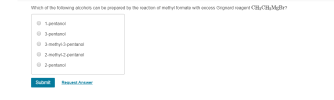 Which of the following alcohols can be prepared by the reaction of methyl formate with excess Grignard reagent CH3CH2MgBr? 1-pentanol 3-pentanol 3-methyl-3-pentanol 2-methyl-2-pentanol O2-pentanol Submit Request Answer
A. aldehyde B. ketones C. carboxylic acids D. esters 7, How many stereoisomers of 2,4-pentanediol are...
 A. aldehyde B. ketones C. carboxylic acids D. esters 7, How many stereoisomers of 2,4-pentanediol are possible? но он В. З A. 2 C. 4 D. 6 8.Which one of the following is a diastereomer of (2R, 3R)-2,3-dibromopentane? A. (2S,3S)-2,3-dibromopentane C.R-1,2-dibromopentane B. (2S,3R)-2,3-dibromopentane D. (2R,4R)-2,4-dibromopentane 9. Which one of the following groups has the highest rank as assigned by the Cahn-Ir Prelog system for stereogenic carbons? A. -CH-CH2 B. -CH20H C.-CH-0 D. -CH2SH 10. Which of the following statements are...
a) Grignard reagents react with oxirane (ethylene oxide) to form 1° alcohols but can be prepared...
 a) Grignard reagents react with oxirane (ethylene oxide) to form 1° alcohols but can be prepared in tetrahydrofuran (THF) solvent. Why is this difference in behavior observed? Explain clearly b) A compound has the formula CsHio, with the 13C and IH NMR spectral data shown. Propose a structure that fits this data. BC NMR Broadband decoupled 13C NMR: 23.5, 26.7, 68.9 δ DEPT-90: no peaks DEPT-135: no positive peaks negative peaks at 23.5, 267, 689 δ HNMR 1.7 δ, multiplet...
 Esters can be prepared by the reaction of carboxylic acids with alcohols. Bearing this in mind, propose a route to the preparation of y-Butyrolactone, the structure of which is shown below. Share your proposed route in a post with others in your group. Comment on the posts of at least two other students.
 1. Acid chiorides have the general structure shown below They are prepared from carboxylic acids using. eg. thiony chloride (SOC) SOC2 Acid chlorides are very reactive and an effective way to transfer an acyl group (R-CO)H to make esters or amides. a. Acyl groups are named after the corresponding carboxylic acid parent: Carboxylic Acid Acyl Chloride ethanoic acid ethanoyl chloride propanoic acid propanoyl chloride benzoic acid benzoyl chloride Name the acyl chlorides below: Acyl chlorides are very reactive molecules, reacting...
 Can someone help with the 4 POST LAB questions thanks
Carboxylic Acids and Esters acid). like citric acid. Face crearboxyl the name implies, a Carbexylic Aclds A salad dressing made of The sour taste of fruits such as lemons is due to the presence of acids like citric acid. tcarboxyl a-hydroxy acids such functional group - that is, a carbonyl group attached to a hydroxyl group. AS dicarboxylic acid carboxylic acid of benzene is called benzoic acid (Figure 1). oil...
Can someone help with the 4 POST LAB questions thanks
Carboxylic Acids and Esters acid). like citric acid. Face crearboxyl the name implies, a Carbexylic Aclds A salad dressing made of The sour taste of fruits such as lemons is due to the presence of acids like citric acid. tcarboxyl a-hydroxy acids such functional group - that is, a carbonyl group attached to a hydroxyl group. AS dicarboxylic acid carboxylic acid of benzene is called benzoic acid (Figure 1). oil...
 Carboxylic Acids and Esters EXPERIMENT 22 OBSERVATIONS AND RESULTS Synthesis and Identification of an Ester: Esterification 1. Give the name and structure of the ester which you synthesized. What fruit did you associate with the odor of the ester? to noldsoinogs w to esar bnn eaman sd vio stolpi Look up the ester and its fruit sburce in your textbook. (If it is not in your textbook, ask your instructor.) Did you associate the ester with the right fruit? If...
 2. If one were esterifying an expensive alcohol with an expensive carboxylic acid derivative, would it be wiser to use the acid chloride or acid anhydride reagent? Why? 3. Why is so much NaOH used in the extraction? Recall that only four drops (small amount) of sulfuric acid were used as a catalyst. Esters are an important class of organic molecules, which are formally derived from alcohols and carboxylic acids. Esters occur widely in nature and are often an important...
 Which of the following alcohols can be prepared by the reaction of methyl formate with excess Grignard reagent CH3CH2MgBr? 1-pentanol 3-pentanol 3-methyl-3-pentanol 2-methyl-2-pentanol O2-pentanol Submit Request Answer
 A. aldehyde B. ketones C. carboxylic acids D. esters 7, How many stereoisomers of 2,4-pentanediol are possible? но он В. З A. 2 C. 4 D. 6 8.Which one of the following is a diastereomer of (2R, 3R)-2,3-dibromopentane? A. (2S,3S)-2,3-dibromopentane C.R-1,2-dibromopentane B. (2S,3R)-2,3-dibromopentane D. (2R,4R)-2,4-dibromopentane 9. Which one of the following groups has the highest rank as assigned by the Cahn-Ir Prelog system for stereogenic carbons? A. -CH-CH2 B. -CH20H C.-CH-0 D. -CH2SH 10. Which of the following statements are...
 a) Grignard reagents react with oxirane (ethylene oxide) to form 1° alcohols but can be prepared in tetrahydrofuran (THF) solvent. Why is this difference in behavior observed? Explain clearly b) A compound has the formula CsHio, with the 13C and IH NMR spectral data shown. Propose a structure that fits this data. BC NMR Broadband decoupled 13C NMR: 23.5, 26.7, 68.9 δ DEPT-90: no peaks DEPT-135: no positive peaks negative peaks at 23.5, 267, 689 δ HNMR 1.7 δ, multiplet...
Most questions answered within 3 hours.
-
Where is the error in this code sequence?
String s1 = "Hello";
String s2 = "ello";...
asked 10 months ago -
Financial data for Joel de Paris, Inc., for last year
follow:
Joel de Paris, Inc.
Balance...
asked 10 months ago -
Consider this reaction:
Al2(SO4)3 (aq)+ BaCl3
(aq) Al2Cl6 (aq)- +
3BaSO4(s) . What is the...
asked 10 months ago -
Suppose that Savneet is considering increasing her
recent random sample from 20 car rentals to 40...
asked 10 months ago -
Trucks arrive at an unloading terminal at an average rate of 120
per hour.
Trucks arrive...
asked 10 months ago -
Why are methanol and ethanol completely soluble in water while
octanol is not very little soluble....
asked 10 months ago -
A facilities manager at a university reads in a research report
that the mean amount of...
asked 10 months ago -
When the CuSO4 is rehydrated by adding water to the anhydrous
compound, is this an endothermic...
asked 10 months ago -
A ray of sunlight is passing from diamond into crown glass; the
angle of incidence is...
asked 10 months ago -
A block of mass 0.249 kg is placed on top of a light, vertical
spring of...
asked 10 months ago -
how do the kidneys compensate in the presences of acidosis
a) trigger hyperventilate
b) reserve acid...
asked 10 months ago -
Question 501 pts
The rental rate of capital to the firm increases. Which of the
following...
asked 10 months ago