Explain the effects on aromaticity in the following groups of compounds: 1. Big Rings 2. Heterociclicos...
Explain the effects on
aromaticity in the following groups of compounds:
1. Big Rings
2. Heterociclicos
3. Ions
4. Polynuclear hydrocarbons
Homework Answers
Aromaticity is a phenomenon showed by cyclic,planar compounds with resonance exhibiting special stabilisation to compounds.
Requirement for aromaticity:
1.) Cyclic 2.) Planar 3.) conjugation and 4.) should obey Huckel rule
Bigger rings : The rings with alternate single and double bond can exhibit aromaticity if they follow all above rules. Annulene compounds can be categorised into this. they can be aromatic (benzene),non aromatic(10-annulene) or antiaromatic (cyclobutadiene). The most important factor is although they follow huckel rule,most of compounds fail to achieve planarity due to arge size and interefering H-atoms. It is found 18-annulene compound is the most stable aromatic compound closest to benzene rest other have some or the other interfering factors.
Heterocyclic compounds: It means cyclic compound having one or more atom other than carbon commonly found are nitrogen,oxygen and sulfur. These compounds also exhibit aromaticity similar as benzene because they exhibit all the above four criteria only difference is hetero atom present which has lone pair and can be used in delocalisation of electrons in the ring.
Example: Pyridine and pyrrole both exhibit aromaticity only difference is in case of former five sp2 carbons contributing one pi electron,in addition N-atom is also sp2 hybridised giving one electron this completes 6 pi-electrons for delocalisation (Huckel 4n+2pi electrons rule) so lone pair on N-atom remains free while in latter case each of four sp2 carbons contribute one pi electron while N-atom is also sp2 hybridised contributing 2 pi electrons from its lone pair. similar explaination can be given for other compound slike thiophene,furan,oxazole,pyrazole compounds.
Ions: Charged compounds can also come under the category of aromaticity,so cation or anion both cannot be ignored if they follow 4 criteria. In case of carbocations are sp2 hybridised with empty p-orbital which can accept pair of electrons and in turn can resonate with other pi bonds.
Example: 3-membered ring with one double bond and positive charge on C-atom makes it aromatic. It is cyclic,planar,conjugated,it has two resonating electrons making it aromatic.
In case of carbanions the negative charged atom contains 2 electrons which can easily resonate in the conjuagted system making compound aromatic.
Example: Cyclopentadienyl anion is cyclic,planar,conjugated i.e 4 electrons pi bond while other pair from lone pair of anion making it aromatic following huckel rule.
Polynulcear hydrocarbons: Aromaticity can be extended to fused rings also by sharing of neighboring carbon atoms. The key point is they should follow 4 criterias.
Example: Napthalene contans 2 fused benzene rings which is cyclic,planar,conjugated contains 10 pi electrons i.e 5 electron pair for huckel rule,having overlap of p-orbitals above and below ring.
Aromaticity refers to a special property found in certain planar, cyclic, and conjugated compounds that exhibit extra stability due to a specific arrangement of π-electrons. Aromatic compounds follow Hückel's Rule, which states that a compound must have a fully conjugated ring with 4n+2 π-electrons (where n is an integer) to be aromatic.
Let's explore the effects on aromaticity for each group of compounds:
Big Rings: Aromaticity tends to be more pronounced in smaller rings due to the greater ease of π-orbital overlap. As the size of the ring increases, it becomes more difficult for the π-electrons to be delocalized and satisfy Hückel's Rule. Large rings may become less aromatic or even lose aromaticity altogether, leading to a decrease in stability. However, if the ring is large enough to accommodate multiple fully conjugated substructures (fulfilling the 4n+2 rule), it may still exhibit aromatic character.
Heterocyclics: Heterocyclic aromatic compounds contain one or more heteroatoms (atoms other than carbon) within the cyclic ring. The presence of heteroatoms can significantly influence aromaticity. For example, if the heteroatom is capable of contributing to the π-electron delocalization, it can enhance the aromatic character of the compound. Heteroatoms like nitrogen, oxygen, and sulfur are commonly found in aromatic rings and can participate in π-conjugation. However, the presence of certain heteroatoms or specific substitution patterns can also disrupt aromaticity, making the compound non-aromatic.
Ions: Aromatic ions, also known as aromaticity in charged species, can be found in compounds where the π-electrons are delocalized over both the ring and the charge center. This additional delocalization can enhance the aromatic character and stability of the ion. For example, the cyclopentadienyl anion (cyclopentadiene with an extra electron) is a well-known aromatic ion. In contrast, if the charge center disrupts the π-electron delocalization, the compound may lose aromaticity.
Polynuclear hydrocarbons: Polynuclear hydrocarbons are compounds containing multiple fused aromatic rings. The aromaticity in such compounds can be influenced by the degree of conjugation between the rings. When the rings are fused in a way that allows for continuous π-electron delocalization throughout the molecule, the compound is often highly aromatic and stable. As the number of fused rings increases, the overall stability of the compound may increase as a result of the extended conjugation. However, there is a limit to the number of fused rings before the compound becomes too strained and loses its aromatic character.
In summary, aromaticity is a complex property influenced by various factors such as ring size, the presence of heteroatoms, charge centers, and the degree of conjugation in polynuclear hydrocarbons. Understanding these effects is crucial in predicting the behavior and stability of aromatic compounds in organic chemistry.
Aromaticity is a property of some organic compounds that have a planar, cyclic, and conjugated system of π-electrons, typically represented by a resonance-stabilized ring of alternating single and double bonds. These compounds are known as aromatic compounds and exhibit unique stability and reactivity due to their delocalized π-electron system. Let's explore the effects of the mentioned groups on aromaticity:
Big Rings: Aromaticity is less favored in larger rings. As the ring size increases, the strain in the ring also increases due to bond angles and bond lengths deviating from the ideal values. This strain destabilizes the molecule, making it less likely to exhibit aromaticity. While aromaticity can be observed in relatively larger rings (e.g., 10-membered or 12-membered rings), it becomes less pronounced compared to smaller aromatic rings like benzene (6-membered ring).
Heterocyclics: Heterocyclic aromatic compounds contain at least one heteroatom (e.g., nitrogen, oxygen, sulfur) in the ring, in addition to carbon atoms. The presence of heteroatoms can influence aromaticity. For example, pyridine is a heterocyclic aromatic compound that resembles benzene but has one nitrogen atom in place of a carbon atom. The lone pair of electrons on the nitrogen atom participates in the aromatic π-electron system, contributing to the stability of the compound. However, the degree of aromaticity in heterocyclics may vary depending on the specific heteroatom and its position in the ring.
Ions: Aromaticity can also be observed in charged ions, known as aromatic ions. For example, the cyclopentadienyl anion (C5H5-) and the cycloheptatrienyl cation (C7H7+) are examples of aromatic ions. In these cases, the charge is distributed evenly across the ring, involving resonance structures that maintain the planar and cyclic arrangement of π-electrons, resulting in enhanced stability.
Polynuclear Hydrocarbons: Polynuclear hydrocarbons are compounds composed of multiple fused aromatic rings. The aromaticity of polynuclear hydrocarbons depends on the number and arrangement of fused rings. If the fused rings create a continuous, conjugated system of π-electrons, the compound can exhibit enhanced aromaticity due to the extended delocalization of π-electrons. Examples of polynuclear hydrocarbons with enhanced aromaticity include naphthalene (two fused benzene rings) and anthracene (three fused benzene rings).
In summary, aromaticity is influenced by the size of the ring, the presence of heteroatoms, the charge of the ions, and the arrangement of fused rings in polynuclear hydrocarbons. Understanding these effects helps in predicting the stability and reactivity of aromatic compounds in organic chemistry.
Aromaticity refers to the property of certain compounds, particularly those with conjugated pi electron systems, that exhibit enhanced stability due to a delocalized ring of π electrons. This stability is a result of the cyclic, planar, and fully conjugated structure of aromatic compounds. Now, let's discuss the effects of the mentioned groups of compounds on aromaticity:
Big Rings: Aromaticity tends to be more pronounced in smaller rings, specifically those containing 6 π electrons, known as Hückel's rule. As the ring size increases, aromaticity becomes less favorable, and the compound's stability may diminish. Larger rings may still exhibit some degree of aromatic character, but they are less likely to be as stable as smaller aromatic systems. The distortion from planarity increases with ring size, and the pi electron cloud becomes less effectively delocalized, reducing aromatic stability.
Heterocyclic Compounds: Heterocyclic compounds are aromatic compounds that contain at least one heteroatom (an atom other than carbon) in the ring. The presence of heteroatoms can affect the aromaticity of the compound. In some cases, the heteroatom can contribute to the delocalization of π electrons, reinforcing the aromatic character. For example, pyridine (C5H5N) contains a nitrogen atom, which contributes to its aromaticity. However, in other cases, the presence of a heteroatom can disrupt the planarity or electron delocalization, leading to reduced aromaticity or even non-aromatic behavior.
Ions: Aromatic ions, such as cyclopentadienyl anion (C5H5^-), can exhibit significant aromatic character due to the presence of a fully conjugated ring of π electrons. Aromaticity in ions can be particularly stable because the charge is delocalized within the π electron cloud. However, the presence of positive charges can weaken the aromaticity, as positive charges often reduce the electron delocalization and lead to a less stable system.
Polynuclear Hydrocarbons: Polynuclear hydrocarbons are compounds that contain multiple fused aromatic rings, such as naphthalene or anthracene. These compounds can still exhibit aromaticity, provided that the rings remain fully conjugated and planar. The extended π electron system of polynuclear hydrocarbons enhances the aromatic stability of the compound. However, as the number of fused rings increases, the distortion from planarity becomes more significant, and the aromaticity may be affected.
In summary, the effects on aromaticity in different groups of compounds depend on the size of the ring, the presence of heteroatoms, the presence of charges in the compound, and the extent of π electron delocalization. Aromaticity is most pronounced in smaller rings with 6 π electrons, while larger rings, heterocyclic compounds, and charged species may exhibit varying degrees of aromatic character depending on their structural features.
Add Answer to:
Explain the effects on
aromaticity in the following groups of compounds:
1. Big Rings
2. Heterociclicos...
2. Increasing the aromaticity of by fusing more benzene rings together forms a special class of...
2. Increasing the aromaticity of by fusing more benzene rings together forms a special class of compounds that are called Polycyclic Aromatic Hydrocarbons (PAHs). Primary sources of these compounds are from burning coal, gasoline, wood and trash. These compounds are very persistent organic pollutants and are carcinogenic. We will predict their UV-Vis properties using the Particle-in-a-2- D box model. For the following two aromatic compounds, calculate the wavelength corresponding to the lowest energy wavelength. Should it be a colored compound?...
Problem 3: Answer the questions regarding aromaticity 5 Q18: Aromatic compounds are: 1:1, 2 and 3...
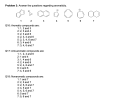 Problem 3: Answer the questions regarding aromaticity 5 Q18: Aromatic compounds are: 1:1, 2 and 3 2:2, 3 and 4 3:2, 3 and 6 4:2, 3, 4 and 6 5:2, 3, 4, 6 and 7 6:3, 4 and 6 7:3, 4, 6 and 7 Q17. Anti-aromatic compounds are: 1: 1, 2, 4 and 6 2:1 and 4 3:1, 4 and 6 4:2, 4 and 6 5: 2, 4, 6 and 7 6:4 and 6 7:4, 5 and 6 Q18: Nonaromatic...
3.1 Apply the aromaticity rules to determine whether the following compounds are aromatic or not. А...
 3.1 Apply the aromaticity rules to determine whether the following compounds are aromatic or not. А B (6) 3.2 Draw an orbital representation of pyrrole to show how the molecule is aromatic (5) 3.3 Consider the reaction of benzene with 1-chloropropane in the presence of AlCl3. (0) Propose a mechanism for formation of 1-methylethylbenzene as the product 10) Explain why 1-propylbenzene is not formed. (7)
2. Draw the structures of the following compounds m-nitrobenzoic acid o-bromoaniline Dojannolane The concept of aromaticity...
 2. Draw the structures of the following compounds m-nitrobenzoic acid o-bromoaniline Dojannolane The concept of aromaticity (6 points each) No crt withot coreer ptenaion
Please answer all 4 questions 1) Draw condensed structure formulas for the following compounds 2) How...
 Please answer all 4 questions
1) Draw condensed structure formulas for the following
compounds
2) How would you describe the difference between saturated and
unsaturated hydrocarbons and what is a distinguishing feature of
aromatic hydrocarbons?
5) Do you expect the aromatic hydrocarbons to react in a similar
way to the cyclic alkenes, since they are both cyclic compounds and
have a double bond? explain
6) write the structure of the product. if no reaction occurs
write NR
Final questions 1....
Please answer all 4 questions
1) Draw condensed structure formulas for the following
compounds
2) How would you describe the difference between saturated and
unsaturated hydrocarbons and what is a distinguishing feature of
aromatic hydrocarbons?
5) Do you expect the aromatic hydrocarbons to react in a similar
way to the cyclic alkenes, since they are both cyclic compounds and
have a double bond? explain
6) write the structure of the product. if no reaction occurs
write NR
Final questions 1....
2. C ircle and name the functional groups in the following compounds CH 0 1 0 2. C ircle and name the functional groups in the following compounds CH 0 1 0
 2. C ircle and name the functional groups in the following compounds CH 0 1 0
2. C ircle and name the functional groups in the following compounds CH 0 1 0
2. C ircle and name the functional groups in the following compounds CH 0 1 0
2. Determine if the following compounds are aromatic/ antiaromatic/ non aromatic, Explain your choice: ( 10...
 2. Determine if the following compounds
are aromatic/ antiaromatic/ non aromatic, Explain your choice: ( 10
points) (assume rings are planar unless otherwise
indicated)
2. Determine if the following compounds are aromatic/ antiaromatic/ non aromatic, Explain your choice: (10 points) (assume rings are planar unless otherwise indicated) NH2 N: :N H d.
2. Determine if the following compounds
are aromatic/ antiaromatic/ non aromatic, Explain your choice: ( 10
points) (assume rings are planar unless otherwise
indicated)
2. Determine if the following compounds are aromatic/ antiaromatic/ non aromatic, Explain your choice: (10 points) (assume rings are planar unless otherwise indicated) NH2 N: :N H d.
CHEM 224 Organic Chemistry II Name AROMATICITY & NOMENCLATURE OF AROMATICS 1. Rank the following in...
 CHEM 224 Organic Chemistry II Name AROMATICITY & NOMENCLATURE OF AROMATICS 1. Rank the following in order of increasing stability: NM NA 2. Determine which compounds are aromatic (A), antiaromatic (AA), or nonaromatic (NA): Give the common and IUPAC names for the following compounds: бе" до 3 o & com a фsso 2 Sex g-
1. List the compounds that have allylic methyl groups. (from the image given) 2. Explain how...
 1. List the compounds that have allylic methyl groups. (from
the image given)
2. Explain how you could distinguish a compound that contains
one or more alkenes from a conpound that contains an aromatic group
using NMR.
3. List four ways you could differeniate the compounds shown
in the picture using NMR (1H and 13C) and IR.
OH carvone citronellal citronellol geranial {xo! OH geraniol limonene menthone a-terpinene
1. List the compounds that have allylic methyl groups. (from
the image given)
2. Explain how you could distinguish a compound that contains
one or more alkenes from a conpound that contains an aromatic group
using NMR.
3. List four ways you could differeniate the compounds shown
in the picture using NMR (1H and 13C) and IR.
OH carvone citronellal citronellol geranial {xo! OH geraniol limonene menthone a-terpinene
What are the meso compounds of the following compounds and explain the reason? 1) 2,3-dimethylbutane 2)...
What are the meso compounds of the following compounds and explain the reason? 1) 2,3-dimethylbutane 2) 2,3-dichlorobutane 3) 2,4-dibromopentane 4) 3,4-dimethylhexane 5) 1,2-dimethylcyclopentane
 Problem 3: Answer the questions regarding aromaticity 5 Q18: Aromatic compounds are: 1:1, 2 and 3 2:2, 3 and 4 3:2, 3 and 6 4:2, 3, 4 and 6 5:2, 3, 4, 6 and 7 6:3, 4 and 6 7:3, 4, 6 and 7 Q17. Anti-aromatic compounds are: 1: 1, 2, 4 and 6 2:1 and 4 3:1, 4 and 6 4:2, 4 and 6 5: 2, 4, 6 and 7 6:4 and 6 7:4, 5 and 6 Q18: Nonaromatic...
 3.1 Apply the aromaticity rules to determine whether the following compounds are aromatic or not. А B (6) 3.2 Draw an orbital representation of pyrrole to show how the molecule is aromatic (5) 3.3 Consider the reaction of benzene with 1-chloropropane in the presence of AlCl3. (0) Propose a mechanism for formation of 1-methylethylbenzene as the product 10) Explain why 1-propylbenzene is not formed. (7)
 2. Draw the structures of the following compounds m-nitrobenzoic acid o-bromoaniline Dojannolane The concept of aromaticity (6 points each) No crt withot coreer ptenaion
 Please answer all 4 questions
1) Draw condensed structure formulas for the following
compounds
2) How would you describe the difference between saturated and
unsaturated hydrocarbons and what is a distinguishing feature of
aromatic hydrocarbons?
5) Do you expect the aromatic hydrocarbons to react in a similar
way to the cyclic alkenes, since they are both cyclic compounds and
have a double bond? explain
6) write the structure of the product. if no reaction occurs
write NR
Final questions 1....
Please answer all 4 questions
1) Draw condensed structure formulas for the following
compounds
2) How would you describe the difference between saturated and
unsaturated hydrocarbons and what is a distinguishing feature of
aromatic hydrocarbons?
5) Do you expect the aromatic hydrocarbons to react in a similar
way to the cyclic alkenes, since they are both cyclic compounds and
have a double bond? explain
6) write the structure of the product. if no reaction occurs
write NR
Final questions 1....
 2. C ircle and name the functional groups in the following compounds CH 0 1 0
2. C ircle and name the functional groups in the following compounds CH 0 1 0
2. C ircle and name the functional groups in the following compounds CH 0 1 0
 2. Determine if the following compounds
are aromatic/ antiaromatic/ non aromatic, Explain your choice: ( 10
points) (assume rings are planar unless otherwise
indicated)
2. Determine if the following compounds are aromatic/ antiaromatic/ non aromatic, Explain your choice: (10 points) (assume rings are planar unless otherwise indicated) NH2 N: :N H d.
2. Determine if the following compounds
are aromatic/ antiaromatic/ non aromatic, Explain your choice: ( 10
points) (assume rings are planar unless otherwise
indicated)
2. Determine if the following compounds are aromatic/ antiaromatic/ non aromatic, Explain your choice: (10 points) (assume rings are planar unless otherwise indicated) NH2 N: :N H d.
 CHEM 224 Organic Chemistry II Name AROMATICITY & NOMENCLATURE OF AROMATICS 1. Rank the following in order of increasing stability: NM NA 2. Determine which compounds are aromatic (A), antiaromatic (AA), or nonaromatic (NA): Give the common and IUPAC names for the following compounds: бе" до 3 o & com a фsso 2 Sex g-
 1. List the compounds that have allylic methyl groups. (from
the image given)
2. Explain how you could distinguish a compound that contains
one or more alkenes from a conpound that contains an aromatic group
using NMR.
3. List four ways you could differeniate the compounds shown
in the picture using NMR (1H and 13C) and IR.
OH carvone citronellal citronellol geranial {xo! OH geraniol limonene menthone a-terpinene
1. List the compounds that have allylic methyl groups. (from
the image given)
2. Explain how you could distinguish a compound that contains
one or more alkenes from a conpound that contains an aromatic group
using NMR.
3. List four ways you could differeniate the compounds shown
in the picture using NMR (1H and 13C) and IR.
OH carvone citronellal citronellol geranial {xo! OH geraniol limonene menthone a-terpinene
Most questions answered within 3 hours.
-
Where is the error in this code sequence?
String s1 = "Hello";
String s2 = "ello";...
asked 10 months ago -
Financial data for Joel de Paris, Inc., for last year
follow:
Joel de Paris, Inc.
Balance...
asked 10 months ago -
Consider this reaction:
Al2(SO4)3 (aq)+ BaCl3
(aq) Al2Cl6 (aq)- +
3BaSO4(s) . What is the...
asked 10 months ago -
Suppose that Savneet is considering increasing her
recent random sample from 20 car rentals to 40...
asked 10 months ago -
Trucks arrive at an unloading terminal at an average rate of 120
per hour.
Trucks arrive...
asked 10 months ago -
Why are methanol and ethanol completely soluble in water while
octanol is not very little soluble....
asked 10 months ago -
A facilities manager at a university reads in a research report
that the mean amount of...
asked 10 months ago -
When the CuSO4 is rehydrated by adding water to the anhydrous
compound, is this an endothermic...
asked 10 months ago -
A ray of sunlight is passing from diamond into crown glass; the
angle of incidence is...
asked 10 months ago -
A block of mass 0.249 kg is placed on top of a light, vertical
spring of...
asked 10 months ago -
how do the kidneys compensate in the presences of acidosis
a) trigger hyperventilate
b) reserve acid...
asked 10 months ago -
Question 501 pts
The rental rate of capital to the firm increases. Which of the
following...
asked 10 months ago