urgent please Consider the following Scheme program' (define mult *) (define div /) (define myfunc (lambda...
urgent please
Consider the following Scheme program'
(define mult *)
(define div /)
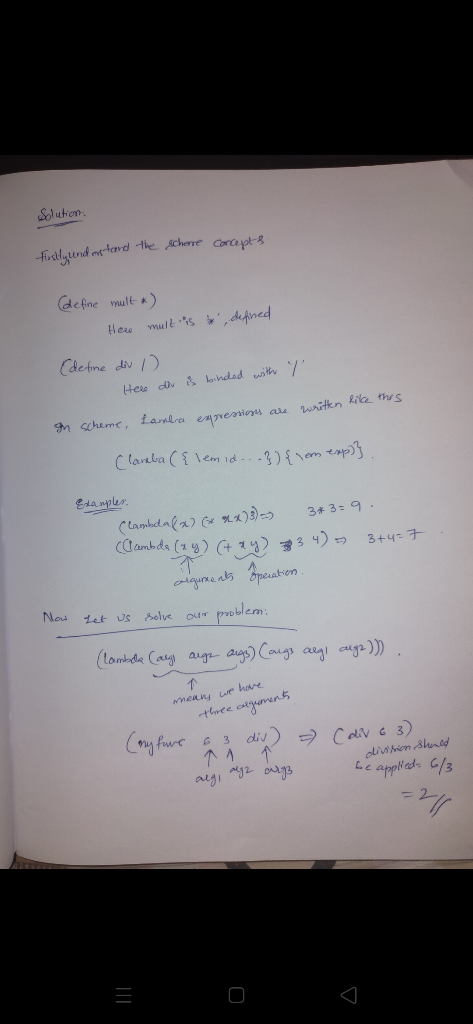
(define myfunc (lambda (arg1 arg2 arg3) (arg3 arg1 arg2)))
If this program were used to evaluate the expression (myfunc 6 3
div), what numerical value would be assigned to this
expression?
Homework Answers
2 is the value assigned to the expression
Please upvote and comment for doubts
Add Answer to:
urgent please
Consider the following Scheme program'
(define mult *)
(define div /)
(define myfunc (lambda...
Consider this scheme function and explain it Consider the following Scheme function: (define f (lambda (1st)...
 Consider this scheme function and explain it
Consider the following Scheme function: (define f (lambda (1st) (cond (null? 1st)) 0) ((number? (car 1st) (+ 1 (f (cdr 1st)))) (else (f (cdr 1st))))) Explain what the function f computes for lists. consider (f '(1 a b 2)) for example.
Consider this scheme function and explain it
Consider the following Scheme function: (define f (lambda (1st) (cond (null? 1st)) 0) ((number? (car 1st) (+ 1 (f (cdr 1st)))) (else (f (cdr 1st))))) Explain what the function f computes for lists. consider (f '(1 a b 2)) for example.
(CO 7) Evaluate the value of the following Scheme expressions. 1. (* 4 5) 2. (+...
(CO 7) Evaluate the value of the following Scheme expressions. 1. (* 4 5) 2. (+ 1 5 3) 3. (+ 2 (- 6 3)) 4. ((LAMBDA (x) (* x x x)) 2) (CO 5) What are the arguments for and against the C++ policy on inlining of methods? (CO 6) Explain why allowing a class to implement multiple interfaces in Java and C# does not create the same problems that multiple inheritance in C++ creates. (CO 8) Describe how...
Suppose you were debugging the push() function of your program. Which of the following variables would...
 Suppose you were debugging the push() function of your program. Which of the following variables would be accessible to the debugger before the function is called? static struct node *stack; static struct node *new_node() { int size = sizeof(struct node); return malloc(size); void push(void *value) { struct node *n = new_node(); n->value = value; n->next = stack; stack = n; return malloc(size); void push (void *value) { struct node *n = new_node(); n->value = value; n->next = stack; stack =...
Please write in the Julia Language. Consider a steel rod. Write a program which will calculate th...
 Please write in the Julia Language. Consider a steel rod.
Write a program which will calculate the temperature profile in the
rod using a finite difference scheme. The user should enter the
length of the rod (L), the value for k (= 65 W/mK), and a value for
q in W/m^3. The user should also enter the number of intervals N
,(so you can calculate Δx=L/N). The user should also enter the end
temperatures.
Your program should create the matrix...
Please write in the Julia Language. Consider a steel rod.
Write a program which will calculate the temperature profile in the
rod using a finite difference scheme. The user should enter the
length of the rod (L), the value for k (= 65 W/mK), and a value for
q in W/m^3. The user should also enter the number of intervals N
,(so you can calculate Δx=L/N). The user should also enter the end
temperatures.
Your program should create the matrix...
matlap Question 1 1. Consider the following Matlab program 5 - (2 < 3) & (C2...
 matlap
Question 1 1. Consider the following Matlab program 5 - (2 < 3) & (C2 > 3) 1 (1 - 0)) What is the final value of s? A. True B. *1 CO D. false 2- Which expression tests whether variable x is between (but not the same as) the values 5 and 10 (a) 5 <x< 10 (b) 5 <= x <= 10 (c) 5 < X & X > 10 (d) x < 10 & 5 <...
matlap
Question 1 1. Consider the following Matlab program 5 - (2 < 3) & (C2 > 3) 1 (1 - 0)) What is the final value of s? A. True B. *1 CO D. false 2- Which expression tests whether variable x is between (but not the same as) the values 5 and 10 (a) 5 <x< 10 (b) 5 <= x <= 10 (c) 5 < X & X > 10 (d) x < 10 & 5 <...
Dynamic vs Static Scoping: please explain answer Consider the following program: Fill in the blanks with...
 Dynamic vs Static Scoping: please explain answer
Consider the following program: Fill in the blanks with the resulting value you would expect from the following interpreters (enter only a single number in each blank): 1. An interpreter that implements dynamic scoping: 2. An interpreter that implements static, lexical scoping:
Dynamic vs Static Scoping: please explain answer
Consider the following program: Fill in the blanks with the resulting value you would expect from the following interpreters (enter only a single number in each blank): 1. An interpreter that implements dynamic scoping: 2. An interpreter that implements static, lexical scoping:
Hi, Looking for some help with this Python question as follows: Consider the following Python program:...
Hi, Looking for some help with this Python question as follows: Consider the following Python program: def fun(x, y): return x * y a = fun(2, 3) b = fun("2", 3) print(a, b) What does the function evaluate to? What would happen if we replace the last statement print a, b with print a + b? Thanks for any help. John
Consider the following Python program: def fun(x, y): return x + y # [2] # [1]...
 Consider the following Python program: def fun(x, y): return x + y # [2] # [1] a = fun(2, 3) b = fun("2", 3) print a, b What does it evaluate to? Replace the last statement print a, b with print a + b and explain the traceback. What's wrong? Now eliminate the line marked [1] and change line [2] to read return x + y. Run the program and explain the traceback. Consider the following definition: def fun(n, m):...
Task 5.2 Numerical Analysis Using Nested Loops (13 pts) Consider the following program: void setup() {...
Task 5.2 Numerical Analysis Using Nested Loops (13 pts) Consider the following program: void setup() { //Read a positive integer from the user //Your code starts here } Complete this program such that it calculates all prime numbers between 1 and the value that is assigned to variable num and outputs them on the screen. A prime number is a positive integer that has no other factors other than itself and 1. You should use a nested loop, i.e., write...
Consider the following, partially-complete, C-program: #include <stdlib.h> #include <stdio.h> #include <fcntl.h> #define BUFFERSIZE 100 #define COPYMODE...
Consider the following, partially-complete, C-program: #include <stdlib.h> #include <stdio.h> #include <fcntl.h> #define BUFFERSIZE 100 #define COPYMODE 0644 main(int argC, char* argv[]) { int srcFd; int dstFd; int charCnt; char buf[BUFFERSIZE]; /*Check args*/ if( argC!=3 ){ fprintf( stderr, "usage: %s source destination\n", argv[0]); exit(1); } /*Open the files*/ srcFd= open(argv[1],O_RDONLY); if( srcFd==-1 ){ fprintf(stderr,"Cannot open %s \n", argv[1]); } dstFd= creat(argv[2],COPYMODE); ...
 Consider this scheme function and explain it
Consider the following Scheme function: (define f (lambda (1st) (cond (null? 1st)) 0) ((number? (car 1st) (+ 1 (f (cdr 1st)))) (else (f (cdr 1st))))) Explain what the function f computes for lists. consider (f '(1 a b 2)) for example.
Consider this scheme function and explain it
Consider the following Scheme function: (define f (lambda (1st) (cond (null? 1st)) 0) ((number? (car 1st) (+ 1 (f (cdr 1st)))) (else (f (cdr 1st))))) Explain what the function f computes for lists. consider (f '(1 a b 2)) for example.
 Suppose you were debugging the push() function of your program. Which of the following variables would be accessible to the debugger before the function is called? static struct node *stack; static struct node *new_node() { int size = sizeof(struct node); return malloc(size); void push(void *value) { struct node *n = new_node(); n->value = value; n->next = stack; stack = n; return malloc(size); void push (void *value) { struct node *n = new_node(); n->value = value; n->next = stack; stack =...
 Please write in the Julia Language. Consider a steel rod.
Write a program which will calculate the temperature profile in the
rod using a finite difference scheme. The user should enter the
length of the rod (L), the value for k (= 65 W/mK), and a value for
q in W/m^3. The user should also enter the number of intervals N
,(so you can calculate Δx=L/N). The user should also enter the end
temperatures.
Your program should create the matrix...
Please write in the Julia Language. Consider a steel rod.
Write a program which will calculate the temperature profile in the
rod using a finite difference scheme. The user should enter the
length of the rod (L), the value for k (= 65 W/mK), and a value for
q in W/m^3. The user should also enter the number of intervals N
,(so you can calculate Δx=L/N). The user should also enter the end
temperatures.
Your program should create the matrix...
 matlap
Question 1 1. Consider the following Matlab program 5 - (2 < 3) & (C2 > 3) 1 (1 - 0)) What is the final value of s? A. True B. *1 CO D. false 2- Which expression tests whether variable x is between (but not the same as) the values 5 and 10 (a) 5 <x< 10 (b) 5 <= x <= 10 (c) 5 < X & X > 10 (d) x < 10 & 5 <...
matlap
Question 1 1. Consider the following Matlab program 5 - (2 < 3) & (C2 > 3) 1 (1 - 0)) What is the final value of s? A. True B. *1 CO D. false 2- Which expression tests whether variable x is between (but not the same as) the values 5 and 10 (a) 5 <x< 10 (b) 5 <= x <= 10 (c) 5 < X & X > 10 (d) x < 10 & 5 <...
 Dynamic vs Static Scoping: please explain answer
Consider the following program: Fill in the blanks with the resulting value you would expect from the following interpreters (enter only a single number in each blank): 1. An interpreter that implements dynamic scoping: 2. An interpreter that implements static, lexical scoping:
Dynamic vs Static Scoping: please explain answer
Consider the following program: Fill in the blanks with the resulting value you would expect from the following interpreters (enter only a single number in each blank): 1. An interpreter that implements dynamic scoping: 2. An interpreter that implements static, lexical scoping:
 Consider the following Python program: def fun(x, y): return x + y # [2] # [1] a = fun(2, 3) b = fun("2", 3) print a, b What does it evaluate to? Replace the last statement print a, b with print a + b and explain the traceback. What's wrong? Now eliminate the line marked [1] and change line [2] to read return x + y. Run the program and explain the traceback. Consider the following definition: def fun(n, m):...
Most questions answered within 3 hours.
-
Where is the error in this code sequence?
String s1 = "Hello";
String s2 = "ello";...
asked 10 months ago -
Financial data for Joel de Paris, Inc., for last year
follow:
Joel de Paris, Inc.
Balance...
asked 10 months ago -
Consider this reaction:
Al2(SO4)3 (aq)+ BaCl3
(aq) Al2Cl6 (aq)- +
3BaSO4(s) . What is the...
asked 10 months ago -
Suppose that Savneet is considering increasing her
recent random sample from 20 car rentals to 40...
asked 10 months ago -
Trucks arrive at an unloading terminal at an average rate of 120
per hour.
Trucks arrive...
asked 10 months ago -
Why are methanol and ethanol completely soluble in water while
octanol is not very little soluble....
asked 10 months ago -
A facilities manager at a university reads in a research report
that the mean amount of...
asked 10 months ago -
When the CuSO4 is rehydrated by adding water to the anhydrous
compound, is this an endothermic...
asked 10 months ago -
A ray of sunlight is passing from diamond into crown glass; the
angle of incidence is...
asked 10 months ago -
A block of mass 0.249 kg is placed on top of a light, vertical
spring of...
asked 10 months ago -
how do the kidneys compensate in the presences of acidosis
a) trigger hyperventilate
b) reserve acid...
asked 10 months ago -
Question 501 pts
The rental rate of capital to the firm increases. Which of the
following...
asked 10 months ago