International trade should be based on: Group of answer choices the law of one price purchasing...
International trade should be based on:
Group of answer choices
the law of one price
purchasing parity
comparative advantage
absolute advantage
Homework Answers
The International Trade is most preferably based on the Comparative Cost advantage principle. Firstly we need to understand the concept of comparative advantage. Comparative advantage is an economic term that refers to an economy's ability to produce goods and services at a lower opportunity cost than that of trade partners. A comparative advantage gives a company the ability to sell goods and services at a lower price than its competitors and realize stronger sales margins. Comparative advantage suggests that countries will engage in trade with one another, exporting the goods that they have a relative advantage in productivity.
Now we need to look at the Absolute cost advantage theory. Absolute advantage is when a producer can produce a good or service in greater quantity for the same cost, or the same quantity at lower cost, than other producers. By specialization, division of labor, and trade, producers with different absolute advantages can always gain over producing in isolation. Absolute advantage is related to comparative advantage, which can open up even more widespread opportunities for the division of labor and gains from trade.
If we look at the concept of Purchasing Power parity, which is based on the Law of one price. The law of one price explains that, the price of an identical asset or commodity will have the same price globally, regardless of location, when certain factors are considered.The law of one price takes into account a friction less market, where there are no transaction costs, transportation costs, or legal restrictions, the currency exchange rates are the same, and that there is no price manipulation by buyers or sellers.
Add Answer to:
International trade should be based on:
Group of answer choices
the law of one price
purchasing...
International trade based on scale economies is likely to be associated with O A. the law...
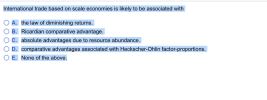 International trade based on scale economies is likely to be associated with O A. the law of diminishing returns O B. Ricardian comparative advantage O C. absolute advantages due to resource abundance. O D. comparative advantages associated with Heckscher-Ohlin factor-proportions. O ENone of the above.
Letters of credit frequently are used in ________. Group of answer choices credit trade international trade...
Letters of credit frequently are used in ________. Group of answer choices credit trade international trade domestic trade none of these
The loss of jobs due to international trade is often: Group of answer choices a) more...
The loss of jobs due to international trade is often: Group of answer choices a) more visible than the decline in consumer prices due to international trade. b) less visible than the decline in prices due to international trade. c) greater than the benefit of trade in the form of decline in prices. d) spread across all sectors while decline in prices is concentrated in one sector.
The trade theory that says the government should work to maintain and maximize a trade surplus...
The trade theory that says the government should work to maintain and maximize a trade surplus is known as ________. Group of answer choices mercantilism absolute advantage comparative advantage import substitution _____________________________ Which one of the following is consistent with "mercantilism"? Group of answer choices establishing bilateral trading agreements with other countries limiting exports limiting imports and subsidizing exports encouraging the development of manufacturing in their colonies __________________________________________________ The campaign slogan "Buy American" is an example of which of the...
Question 5 (2.5 points) Prior to international trade, the price of good X is lower in...
 Question 5 (2.5 points) Prior to international trade, the price of good X is lower in country A than in country B. This means that we know that O A) country B has an absolute advantage in the production of product X. UB) country A has a comparative advantage in the production of product X. C) country A has an absolute advantage in the production of product X. O D) country B has a comparative advantage in the production of...
Please define purchasing power parity (PPP) and the reason why a good or service should cost...
Please define purchasing power parity (PPP) and the reason why a good or service should cost about the same in one economy as in another. Does it seem like the law of one price in a perfectly competitive market? How do you think PPP is related to the theory of comparative advantage? Thanks.
6. If the relative opportunity costs of producing goods are identical across countries, then there are tary p A. no gains from trade. for t B. gains from trade if trade is based on absolute advan...
 6. If the relative opportunity costs of producing goods are identical across countries, then there are tary p A. no gains from trade. for t B. gains from trade if trade is based on absolute advantage mand C. gains from trade if trade is based on comparative advantage pply D. gains from trade that depend on the degree of competition between intemational traders. nd fo 7. The text lists three reasons why economists and non-economists see the pros and cons...
Producer surplus measures the value between the actual selling price and the: Group of answer choices...
Producer surplus measures the value between the actual selling price and the: Group of answer choices profit-maximization price. deadweight loss price. price sellers are willing to sell the product. lowest price sellers are willing to sell the product. When the opportunity cost of producing carrots increases as more carrots are produced, then: Group of answer choices the production possibilities curve is a straight line. resources are equally suited to the production of carrots and to other goods. no more carrots...
What is the "law of one price," where the price for identical products in different countries...
 What is the "law of one price," where the price for identical products in different countries should be the same if trade barriers are absent? a. Purchasing power parity b. Fixed exchange rate policy O C. Balance of payments d. Currency swap
Trade between countries Group of answer choices can be best understood by examining the countries' absolute...
Trade between countries Group of answer choices can be best understood by examining the countries' absolute advantage limits a country's ability to produce goods and services on it's own allows each country to consume at a point outside it's production possibility frontier must benefit both countries equally, otherwide trade is not mutually beneficial
 International trade based on scale economies is likely to be associated with O A. the law of diminishing returns O B. Ricardian comparative advantage O C. absolute advantages due to resource abundance. O D. comparative advantages associated with Heckscher-Ohlin factor-proportions. O ENone of the above.
 Question 5 (2.5 points) Prior to international trade, the price of good X is lower in country A than in country B. This means that we know that O A) country B has an absolute advantage in the production of product X. UB) country A has a comparative advantage in the production of product X. C) country A has an absolute advantage in the production of product X. O D) country B has a comparative advantage in the production of...
 6. If the relative opportunity costs of producing goods are identical across countries, then there are tary p A. no gains from trade. for t B. gains from trade if trade is based on absolute advantage mand C. gains from trade if trade is based on comparative advantage pply D. gains from trade that depend on the degree of competition between intemational traders. nd fo 7. The text lists three reasons why economists and non-economists see the pros and cons...
 What is the "law of one price," where the price for identical products in different countries should be the same if trade barriers are absent? a. Purchasing power parity b. Fixed exchange rate policy O C. Balance of payments d. Currency swap
Most questions answered within 3 hours.
-
Where is the error in this code sequence?
String s1 = "Hello";
String s2 = "ello";...
asked 10 months ago -
Financial data for Joel de Paris, Inc., for last year
follow:
Joel de Paris, Inc.
Balance...
asked 10 months ago -
Consider this reaction:
Al2(SO4)3 (aq)+ BaCl3
(aq) Al2Cl6 (aq)- +
3BaSO4(s) . What is the...
asked 10 months ago -
Suppose that Savneet is considering increasing her
recent random sample from 20 car rentals to 40...
asked 10 months ago -
Trucks arrive at an unloading terminal at an average rate of 120
per hour.
Trucks arrive...
asked 10 months ago -
Why are methanol and ethanol completely soluble in water while
octanol is not very little soluble....
asked 10 months ago -
A facilities manager at a university reads in a research report
that the mean amount of...
asked 10 months ago -
When the CuSO4 is rehydrated by adding water to the anhydrous
compound, is this an endothermic...
asked 10 months ago -
A ray of sunlight is passing from diamond into crown glass; the
angle of incidence is...
asked 10 months ago -
A block of mass 0.249 kg is placed on top of a light, vertical
spring of...
asked 10 months ago -
how do the kidneys compensate in the presences of acidosis
a) trigger hyperventilate
b) reserve acid...
asked 10 months ago -
Question 501 pts
The rental rate of capital to the firm increases. Which of the
following...
asked 10 months ago