The reaction 2A + B → C occurs by the following 2 step mechanism: A +...
The reaction 2A + B → C occurs by the following 2 step mechanism:
A + B ------(k1)------> AB
AB ------(-k1) ------> A+B
AB + A ----- (k2)------> C
Apply the steady-state approximation for the reaction intermediate concentration to obtain the overall rate law from this mechanism:
a) k1 [A][B] b) k1k2[A][B]/((-k1) - k2[A]) c) k1k2[A]^2[B]/((-k1)+k2[A])
Homework Answers

Add Answer to:
The reaction 2A + B → C occurs by the following 2 step
mechanism:
A +...
Below is a mechanism for the reaction A+B- P 5. 2A ? A+C rate constant kl...
 Below is a mechanism for the reaction A+B- P 5. 2A ? A+C rate constant kl AtC 2A rate constant k B+C Prate constant k2 In this mechanism, C is an intermediate. nd the steady state approximation if necessary, determine the rate law for the reaction. (B) Under what conditions does the rate law become first order in [AJ? (C) Under what conditions does the rate not depend on [B]?
A reaction occurs by the following mechanism: A + B ⇄ AB (fast) AB + C...
A reaction occurs by the following mechanism: A + B ⇄ AB (fast) AB + C → AC + B (slow) For this reaction, which of the following statements are correct? 1. the overall reaction can be written as: A + B + C → AB + AC 2. the substance C is an intermediate in the reaction 3. the substance B is a catalyst for the reaction 4. the rate-determining step involves collision of three separate molecules 5. the...
Consider the mechanism. Step 1: Step 2: Overall: 2A B B+C HD 2A+ C D equilibrium...
 Consider the mechanism. Step 1: Step 2: Overall: 2A B B+C HD 2A+ C D equilibrium slow Determine the rate law for the overall reaction, where the overall rate constant is represented as k. rate = 1
Consider the following mechanism. step 1 2A > B slow B+ C D fast step 2 overall: 2A+C D Determine the rate law for t...
 Consider the following mechanism. step 1 2A > B slow B+ C D fast step 2 overall: 2A+C D Determine the rate law for the overall reaction (where the overall rate constant is represented as k) rate=
Consider the mechanism. 2A - B slow Step 1: Step 2: Overall: B + C -→...
 Consider the mechanism. 2A - B slow Step 1: Step 2: Overall: B + C -→ D fast 2 A + C -- D Determine the rate law for the overall reaction, where the overall rate constant is represented as k.
Consider the following mechanism. step 1: A+B C step 2: C+A → D equilibrium slow overall: 2A+B - D Determine the rate l...
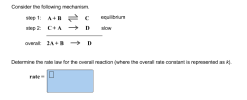 Consider the following mechanism. step 1: A+B C step 2: C+A → D equilibrium slow overall: 2A+B - D Determine the rate law for the overall reaction (where the overall rate constant is represented as k). rate=
A chemical reaction, A+B → P, has the following mechanism: 2A< Ki>A, (fast to equilibrium) A+B&K, ™C (fast to...
 A chemical reaction, A+B → P, has the following mechanism: 2A< Ki>A, (fast to equilibrium) A+B&K, ™C (fast to equilibrium), A,+C-k>P+ 2A (slow) where Kį and K2 are the equilibrium constants for the first two reactions, respectively. k3 is the rate constant for the third reaction. (a) [5 points] Based on this mechanism, show that the rate of product (P) formation is: d[P] – k[A[B], where k is the rate constant of the overall reaction. Write k in terms of...
Consider the mechanism. Step 1: 2A−⇀↽−B+C2A↽−−⇀B+C equilibrium Step 2: B+D⟶EB+D⟶E slow Overall: 2A+D⟶C+E2A+D⟶C+E Determine the rate...
Consider the mechanism. Step 1: 2A−⇀↽−B+C2A↽−−⇀B+C equilibrium Step 2: B+D⟶EB+D⟶E slow Overall: 2A+D⟶C+E2A+D⟶C+E Determine the rate law for the overall reaction, where the overall rate constant is represented as k. rate=
Consider the following mechanism. Step 1: A+B → C slow step 2: A+C→ D fast overall:...
 Consider the following mechanism. Step 1: A+B → C slow step 2: A+C→ D fast overall: 2A+B → D Determine the rate law for the overall reaction (where the overall rate constant is represented as k). rate w
Suppose the reaction: A + 2B - AB2 occurs by the following mechanism: Step 1 A...
 Suppose the reaction: A + 2B - AB2 occurs by the following mechanism: Step 1 A + B - AB slow Step 2AB + B - AB fast The rate law expression for the reaction is
 Below is a mechanism for the reaction A+B- P 5. 2A ? A+C rate constant kl AtC 2A rate constant k B+C Prate constant k2 In this mechanism, C is an intermediate. nd the steady state approximation if necessary, determine the rate law for the reaction. (B) Under what conditions does the rate law become first order in [AJ? (C) Under what conditions does the rate not depend on [B]?
 Consider the mechanism. Step 1: Step 2: Overall: 2A B B+C HD 2A+ C D equilibrium slow Determine the rate law for the overall reaction, where the overall rate constant is represented as k. rate = 1
 Consider the following mechanism. step 1 2A > B slow B+ C D fast step 2 overall: 2A+C D Determine the rate law for the overall reaction (where the overall rate constant is represented as k) rate=
 Consider the mechanism. 2A - B slow Step 1: Step 2: Overall: B + C -→ D fast 2 A + C -- D Determine the rate law for the overall reaction, where the overall rate constant is represented as k.
 Consider the following mechanism. step 1: A+B C step 2: C+A → D equilibrium slow overall: 2A+B - D Determine the rate law for the overall reaction (where the overall rate constant is represented as k). rate=
 A chemical reaction, A+B → P, has the following mechanism: 2A< Ki>A, (fast to equilibrium) A+B&K, ™C (fast to equilibrium), A,+C-k>P+ 2A (slow) where Kį and K2 are the equilibrium constants for the first two reactions, respectively. k3 is the rate constant for the third reaction. (a) [5 points] Based on this mechanism, show that the rate of product (P) formation is: d[P] – k[A[B], where k is the rate constant of the overall reaction. Write k in terms of...
 Consider the following mechanism. Step 1: A+B → C slow step 2: A+C→ D fast overall: 2A+B → D Determine the rate law for the overall reaction (where the overall rate constant is represented as k). rate w
 Suppose the reaction: A + 2B - AB2 occurs by the following mechanism: Step 1 A + B - AB slow Step 2AB + B - AB fast The rate law expression for the reaction is
Most questions answered within 3 hours.
-
Where is the error in this code sequence?
String s1 = "Hello";
String s2 = "ello";...
asked 11 months ago -
Financial data for Joel de Paris, Inc., for last year
follow:
Joel de Paris, Inc.
Balance...
asked 11 months ago -
Consider this reaction:
Al2(SO4)3 (aq)+ BaCl3
(aq) Al2Cl6 (aq)- +
3BaSO4(s) . What is the...
asked 11 months ago -
Suppose that Savneet is considering increasing her
recent random sample from 20 car rentals to 40...
asked 11 months ago -
Trucks arrive at an unloading terminal at an average rate of 120
per hour.
Trucks arrive...
asked 11 months ago -
Why are methanol and ethanol completely soluble in water while
octanol is not very little soluble....
asked 11 months ago -
A facilities manager at a university reads in a research report
that the mean amount of...
asked 11 months ago -
When the CuSO4 is rehydrated by adding water to the anhydrous
compound, is this an endothermic...
asked 11 months ago -
A ray of sunlight is passing from diamond into crown glass; the
angle of incidence is...
asked 11 months ago -
A block of mass 0.249 kg is placed on top of a light, vertical
spring of...
asked 11 months ago -
how do the kidneys compensate in the presences of acidosis
a) trigger hyperventilate
b) reserve acid...
asked 11 months ago -
Question 501 pts
The rental rate of capital to the firm increases. Which of the
following...
asked 11 months ago