Where does the pyruvic acid required for cirtic acid cycle come from ?
Where does the pyruvic acid required for cirtic acid cycle come from ?
Homework Answers
Request Answer!
We need at least 10 more requests to produce the answer.
0 / 10 have requested this problem solution
The more requests, the faster the answer.
Add Answer to:
Where does the pyruvic acid required for cirtic acid cycle come
from ?
Select ALL of the statements that correctly describe the Krebs cycle. A. Pyruvic acid must be...
Select ALL of the statements that correctly describe the Krebs cycle. A. Pyruvic acid must be converted to acetyl CoA prior to entering the cycle B. The molecule oxaloacetic acid picks up the acetyl group from acetylCoA, and in the last step of the cycle, oxaloacetic acid is regenerated. C. Electrons removed during oxidation steps are picked up by NAD or FAD. D. Each turn of the cycle generates one ATP molecule for a total of two per molecule of...
Question 15 of 25 > Attempt 5 The pyruvic acid from glycolysis can be converted to...
 Question 15 of 25 > Attempt 5 The pyruvic acid from glycolysis can be converted to acetic acid, which can enter the citric acid cycle. Because this process is a cycle, the atoms entering the cycle must balance the atoms that leave. Consider carbon balance in the citric acid cycle. How many Co, molecules leave the cycle for each acetic acid molecule that enters? For this question, assume that carbon only enters as acetic acid and exits as CO2. Note...
5) A semi-permeable membrane is used to separate pyruvic acid from an aqueous solution of 0.1...
5) A semi-permeable membrane is used to separate pyruvic acid from an aqueous solution of 0.1 mg/L pyruvic acid solution. a) Calculate the osmotic pressure expected in the solution if pyruvic acid completely dissociates. b) Calculate the osmotic pressure expected in the solution if pyruvic acid does not dissociate. c) What is the pKa of the solution if the observed osmotic pressure of the solution is 4920 Pa. (hint: Use the values from a and b to estimate the dissociation...
1. Where specifically within the cell does the citric acid cycle take place?__________________________________ 2. How many...
1. Where specifically within the cell does the citric acid cycle take place?__________________________________ 2. How many carbons from the original glucose molecule enter each round of the citric acid cycle?________ 3. How many carbons exit out of the citric acid cycle during each round, as a waste product?_________ Where did the carbons in this waste product originally come from (what molecule)? 4. The role of NAD+ in the citric acid cycle is the same as in glycolysis; namely, to taxi...
where does cancer come from?
where does cancer come from?
5) A semi-permeable membrane is used to separate pyruvic acid from an aqueous solution of 0.1...
 5) A semi-permeable membrane is used to separate pyruvic acid from an aqueous solution of 0.1 mg/L pyruvic acid solution. a) Calculate the osmotic pressure expected in the solution, if pyruvic acid completely dissociates. b) Calculate the osmotic pressure expected in the solution if pyruvic acid does not dissociate. c) What is the pka of the solution if the observed osmotic pressure of the solution is 4920 Pa. (hint: Use the values from a and b to estimate the dissociation...
Part D Consider the structure of the following CE-keto carboxylic acid, pyruvic acid, which does not...
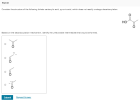 Part D Consider the structure of the following CE-keto carboxylic acid, pyruvic acid, which does not readily undergo decarboxylation: o= Based on the decarboxylation mechanism, identify the unfavorable intermediate that would be formed. ܘ: Eo ܘܒܕ ܘܒ Submit Request Answer
What is the fate of pyruvic acid in an organism that uses aerobic respiration? O A....
 What is the fate of pyruvic acid in an organism that uses aerobic respiration? O A. It is reduced to lactic acid. OB. It is converted into acetyl CoA before the Krebs cycle. OC. It is oxidized in the electron transport chain. OD. It is catabolized in glycolysis. Reset Selection
What is the predominant form of pyruvic acid (pKa =2.50) and lactic acid (pKa = 3.86)...
What is the predominant form of pyruvic acid (pKa =2.50) and lactic acid (pKa = 3.86) at physiological pH (7.4)? Draw the predominant structure of each. In which amino acid does the R group bond to the amino group?
A 0.050 M solution of pyruvic acid, an intermediate in metabolism, has a pH of 1.86....
A 0.050 M solution of pyruvic acid, an intermediate in metabolism, has a pH of 1.86. Calculate K_a for pyruvic acid, a weak monoprotic acid.
 Question 15 of 25 > Attempt 5 The pyruvic acid from glycolysis can be converted to acetic acid, which can enter the citric acid cycle. Because this process is a cycle, the atoms entering the cycle must balance the atoms that leave. Consider carbon balance in the citric acid cycle. How many Co, molecules leave the cycle for each acetic acid molecule that enters? For this question, assume that carbon only enters as acetic acid and exits as CO2. Note...
 5) A semi-permeable membrane is used to separate pyruvic acid from an aqueous solution of 0.1 mg/L pyruvic acid solution. a) Calculate the osmotic pressure expected in the solution, if pyruvic acid completely dissociates. b) Calculate the osmotic pressure expected in the solution if pyruvic acid does not dissociate. c) What is the pka of the solution if the observed osmotic pressure of the solution is 4920 Pa. (hint: Use the values from a and b to estimate the dissociation...
 Part D Consider the structure of the following CE-keto carboxylic acid, pyruvic acid, which does not readily undergo decarboxylation: o= Based on the decarboxylation mechanism, identify the unfavorable intermediate that would be formed. ܘ: Eo ܘܒܕ ܘܒ Submit Request Answer
 What is the fate of pyruvic acid in an organism that uses aerobic respiration? O A. It is reduced to lactic acid. OB. It is converted into acetyl CoA before the Krebs cycle. OC. It is oxidized in the electron transport chain. OD. It is catabolized in glycolysis. Reset Selection
Most questions answered within 3 hours.
-
Where is the error in this code sequence?
String s1 = "Hello";
String s2 = "ello";...
asked 10 months ago -
Financial data for Joel de Paris, Inc., for last year
follow:
Joel de Paris, Inc.
Balance...
asked 10 months ago -
Consider this reaction:
Al2(SO4)3 (aq)+ BaCl3
(aq) Al2Cl6 (aq)- +
3BaSO4(s) . What is the...
asked 10 months ago -
Suppose that Savneet is considering increasing her
recent random sample from 20 car rentals to 40...
asked 10 months ago -
Trucks arrive at an unloading terminal at an average rate of 120
per hour.
Trucks arrive...
asked 10 months ago -
Why are methanol and ethanol completely soluble in water while
octanol is not very little soluble....
asked 10 months ago -
A facilities manager at a university reads in a research report
that the mean amount of...
asked 10 months ago -
When the CuSO4 is rehydrated by adding water to the anhydrous
compound, is this an endothermic...
asked 10 months ago -
A ray of sunlight is passing from diamond into crown glass; the
angle of incidence is...
asked 10 months ago -
A block of mass 0.249 kg is placed on top of a light, vertical
spring of...
asked 10 months ago -
how do the kidneys compensate in the presences of acidosis
a) trigger hyperventilate
b) reserve acid...
asked 10 months ago -
Question 501 pts
The rental rate of capital to the firm increases. Which of the
following...
asked 10 months ago