1. The University of Canterbury wants information on whether full-time undergraduate students at Canterbury use certain...
1. The University of Canterbury wants information on whether full-time undergraduate students at Canterbury use certain facilities (e.g. gym, library).
(a) Define the target population in terms of how it differs from the general population.
(b) The proposed method to collect the data is to place students at three places on campus and ask everyone passing by to fill in the questionnaire. It is intended to do this between 12 and 1pm on the Monday to Friday of the last week of semester one (29 May to 2 June 2017). Assume that everyone asked to fill in a questionnaire does so and the results tabulated. Describe how the results from the sample population may not be representative of the target population.
(c) Ultimately the university samples 500 students from the official list of 10,000 full-time undergraduate students at Canterbury. The questionnaire consists of a set of yes / no questions and assume all 500 students responded. If for one yes / no question the percentage of students answering yes was 40%, what is the sample error at 95% confidence level of this sample estimate? Show the formula you have used and your working.
Homework Answers
a) The target population is the full time undergraduate students at Canterbury which is different from the general population which could be the full time undergraduate students in any university. The focus is only on the university students.
b) The proposed method to collect the data between 12 and 1 PM on Monday to Friday of the last week of semester one could potentially leave a section of the students who would not be able to fill in the questionnaire. These students could be those who might have classes at this time OR section of students who don't have any classes at this time & didn't pass through the designated areas. Hence, the sample might not be representative of the target population as not all the students might be able to take the survey.
c) The margin of Error is calculated by the following formula:
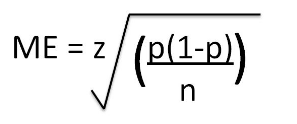
z = 1.96 at 95% confidence level, p = 0.40, n = 500
Hence, Sample Error = 0.04294 = 4.29%
Add Answer to:
1. The University of Canterbury wants information on whether
full-time undergraduate students at Canterbury use certain...
4. Cluster sampling: The registrar of a university with a population of N=4000 full-time students is...
 4. Cluster sampling: The registrar of a university with a population of N=4000 full-time students is asked by the president to conduct a survey to measure satisfaction with the quality of life on campus. The registrar intends to take a probability sample of n=200 students and project the results from the sample to the entire population. Suppose that each of the n=4000 registered full-time students lived in one of the 10 campus dormitories. Each dormitory can accommodate 400 students. It...
1. When conducting a survey, it is important to use a random sample: to get a...
1. When conducting a survey, it is important to use a random sample: to get a significant result. to avoid bias and to get a representative sample. so that we can make causal conclusions. to ensure truthful answers to the survey's questions. none of the above. 2. In order to obtain a sample of undergraduate students in the United States, a simple random sample of 10 states is selected. From each of the selected states, 10 colleges or universities are...
Collect a convenience sample (n = 100) of Oakland University undergraduate students on the following demographics...
 Collect a convenience sample (n = 100) of Oakland University
undergraduate students on the following demographics
information:
Gender (Female, Male)
Status (Full-Time, Part-Time)
County (Oakland, Other)
Major (SBA, Non-SBA).
You may get this data by asking any OU students that you know, in
person, phone, email, text, etc. Then, compare this nonprobability
sample you obtained with the known characteristics of the
population (see the Sampling OU Students PowerPoint on Moodle) on
each of the four demographic variables: Is this a...
Collect a convenience sample (n = 100) of Oakland University
undergraduate students on the following demographics
information:
Gender (Female, Male)
Status (Full-Time, Part-Time)
County (Oakland, Other)
Major (SBA, Non-SBA).
You may get this data by asking any OU students that you know, in
person, phone, email, text, etc. Then, compare this nonprobability
sample you obtained with the known characteristics of the
population (see the Sampling OU Students PowerPoint on Moodle) on
each of the four demographic variables: Is this a...
 4. Cluster sampling: The registrar of a university with a population of N=4000 full-time students is asked by the president to conduct a survey to measure satisfaction with the quality of life on campus. The registrar intends to take a probability sample of n=200 students and project the results from the sample to the entire population. Suppose that each of the n=4000 registered full-time students lived in one of the 10 campus dormitories. Each dormitory can accommodate 400 students. It...
 Collect a convenience sample (n = 100) of Oakland University
undergraduate students on the following demographics
information:
Gender (Female, Male)
Status (Full-Time, Part-Time)
County (Oakland, Other)
Major (SBA, Non-SBA).
You may get this data by asking any OU students that you know, in
person, phone, email, text, etc. Then, compare this nonprobability
sample you obtained with the known characteristics of the
population (see the Sampling OU Students PowerPoint on Moodle) on
each of the four demographic variables: Is this a...
Collect a convenience sample (n = 100) of Oakland University
undergraduate students on the following demographics
information:
Gender (Female, Male)
Status (Full-Time, Part-Time)
County (Oakland, Other)
Major (SBA, Non-SBA).
You may get this data by asking any OU students that you know, in
person, phone, email, text, etc. Then, compare this nonprobability
sample you obtained with the known characteristics of the
population (see the Sampling OU Students PowerPoint on Moodle) on
each of the four demographic variables: Is this a...
Most questions answered within 3 hours.
-
Where is the error in this code sequence?
String s1 = "Hello";
String s2 = "ello";...
asked 11 months ago -
Financial data for Joel de Paris, Inc., for last year
follow:
Joel de Paris, Inc.
Balance...
asked 11 months ago -
Consider this reaction:
Al2(SO4)3 (aq)+ BaCl3
(aq) Al2Cl6 (aq)- +
3BaSO4(s) . What is the...
asked 11 months ago -
Suppose that Savneet is considering increasing her
recent random sample from 20 car rentals to 40...
asked 11 months ago -
Trucks arrive at an unloading terminal at an average rate of 120
per hour.
Trucks arrive...
asked 11 months ago -
Why are methanol and ethanol completely soluble in water while
octanol is not very little soluble....
asked 11 months ago -
A facilities manager at a university reads in a research report
that the mean amount of...
asked 11 months ago -
When the CuSO4 is rehydrated by adding water to the anhydrous
compound, is this an endothermic...
asked 11 months ago -
A ray of sunlight is passing from diamond into crown glass; the
angle of incidence is...
asked 11 months ago -
A block of mass 0.249 kg is placed on top of a light, vertical
spring of...
asked 11 months ago -
how do the kidneys compensate in the presences of acidosis
a) trigger hyperventilate
b) reserve acid...
asked 11 months ago -
Question 501 pts
The rental rate of capital to the firm increases. Which of the
following...
asked 11 months ago