Outline of procedure: Dilute bleach solution A 1/10. Prepare analyte for titration by adding 10mL of...
Outline of procedure:
Dilute bleach solution A 1/10.
Prepare analyte for titration by adding 10mL of diluted bleach solution, starch indicator and 5mL of 2 M HCl.
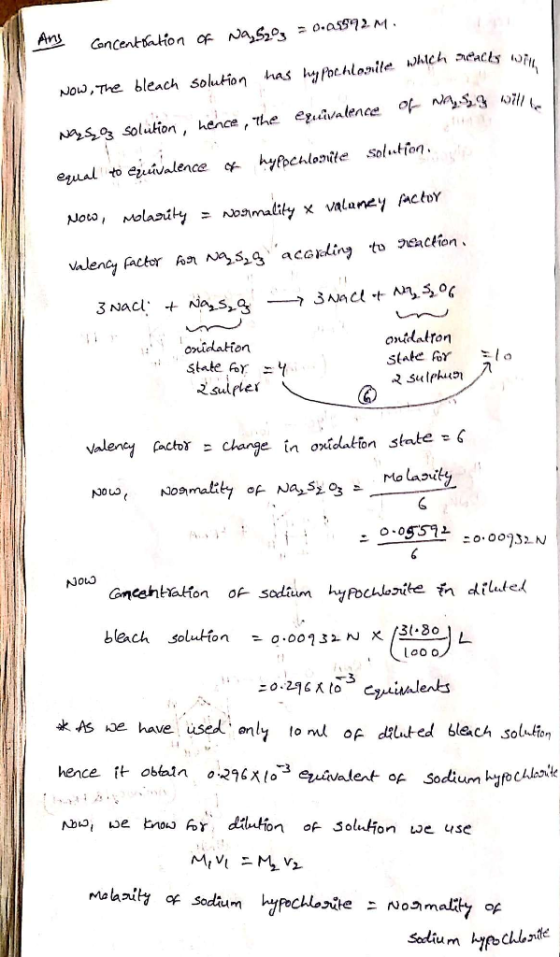
Titrate the analyte with 0.05592 M Na2S2O3.
Average volume of Na2S2O3 added for Solution A = 31.80 mL
Average Volume of Na2S2O3 added for Solution B = 19.40 mL
Question: Calculate the percent of sodium hypochlorite in the original bleach bottle using your averaged result. Show the calculation for solution A and only give the answer for solution B. Which bleach solution is the more potent cleaning agent A or B?
Homework Answers
 i hope this helps if you find
any problem.please comment on below. don't forget to give a thumbs
up if you liked it.
i hope this helps if you find
any problem.please comment on below. don't forget to give a thumbs
up if you liked it.
Add Answer to:
Outline of procedure:
Dilute bleach solution A 1/10.
Prepare analyte for titration by adding 10mL of...
please I need help with this one question. Titration Procedure Prepare your starch solution by dissolving...
please I need help with this one question. Titration Procedure Prepare your starch solution by dissolving 0.040g of vitex starch in 20 mL of water. Prepare your 3%diluted commercial bleach solution (3% of the concentration of the commercial bleach, by volume.) Do not discard as you will use this solution for each of your trials. Dependingonyourinstructor’schosenmethod;deliverexactly3mLofcommercialbleach solution to a 100mL volumetric flask using the burette that contains the class’s supply of bleach, or pour some from the bottle into a...
A sample of a new cleaning product, "Joe's Famous Bleach Cleaner," with a mass of 54.0...
A sample of a new cleaning product, "Joe's Famous Bleach Cleaner," with a mass of 54.0 g , was diluted with an acetic acid solution containing excess I−. A small amount of starch indicator solution was then added, turning the solution a deep bluish-purple. The solution was then titrated with 0.180 M sodium thiosulfate, Na2S2O3, containing the ion S2O32−. A volume of 41.0 mL of sodium thiosulfate, the titrant, was needed to turn the solution colorless. What is the percentage...
A sample of a new cleaning product, "Joe's Famous Bleach Cleaner," with a mass of 42.0...
A sample of a new cleaning product, "Joe's Famous Bleach Cleaner," with a mass of 42.0 g , was diluted with an acetic acid solution containing excess I−. A small amount of starch indicator solution was then added, turning the solution a deep bluish-purple. The solution was then titrated with 0.410 M sodium thiosulfate, Na2S2O3, containing the ion S2O32−. A volume of 41.0 mL of sodium thiosulfate, the titrant, was needed to turn the solution colorless. What is the percentage...
Analysis of bleach involves two sequential redox reactions: First, bleach is reacted in acid solution with...
 Analysis of bleach involves two sequential redox reactions: First, bleach is reacted in acid solution with excess iodide anion to produce yellow-colored iodine A sample of a new cleaning product, "Joe's Famous Bleach Cleaner," with a mass of 57.0 g, was diluted with an acetic acid solution containing excess I". A small amount of starch indicator solution was then added, turning the solution a deep bluish-purple. The solution was then titrated with 0.470 M sodium thiosulfate, Na2S203, containing the ion...
just need help with questions 3. a & b always rate!!! Introduction Titration is a common...
 just need help with questions 3. a & b
always rate!!!
Introduction Titration is a common analytical technique that is used to verify the concentrations of chemicals before they are sold as commercial products, in a process known as quality control. In this lab, you will be using a redox titration to find the concentration of the strong oxidizing agent hypochlorite (CIO) which is the active ingredient in bleach. Oxidizing and reducing agents are often determined using a redox titration....
just need help with questions 3. a & b
always rate!!!
Introduction Titration is a common analytical technique that is used to verify the concentrations of chemicals before they are sold as commercial products, in a process known as quality control. In this lab, you will be using a redox titration to find the concentration of the strong oxidizing agent hypochlorite (CIO) which is the active ingredient in bleach. Oxidizing and reducing agents are often determined using a redox titration....
1) What chemical is the titrant in this experiment? What chemical is the analyte in this experiment? Experi...
 1) What chemical is the titrant in this experiment? What
chemical is the analyte in this
experiment?
Experiment #8: Measuring the Vitamin C Content of Emergen-C™ Objectives: • Students will learn how to use a burette. • Students will learn how to use the iodine starch indicator system to monitor oxidation/reduction reactions. Students will learn how to conduct a titration to determine the amount of analyte in an unknown solution. • Students will learn about ascorbic acid's role as a...
1) What chemical is the titrant in this experiment? What
chemical is the analyte in this
experiment?
Experiment #8: Measuring the Vitamin C Content of Emergen-C™ Objectives: • Students will learn how to use a burette. • Students will learn how to use the iodine starch indicator system to monitor oxidation/reduction reactions. Students will learn how to conduct a titration to determine the amount of analyte in an unknown solution. • Students will learn about ascorbic acid's role as a...
Experimental Procedure, Part B.1. What is the purpose of adding NaHCO, to the reaction mixture? Explain....
 Experimental Procedure, Part B.1. What is the purpose of adding NaHCO, to the reaction mixture? Explain. Write a balanced equation for its reaction. a. Experimental Procedure, Part C. What is the oxidizing agent in the titration? b. What is the color change of the starch indicator that signals the stoichiometric point in Part C? (1. Vitamin C is a reducing agent and antioxidant. What ion does it reduce in this experiment? Explain. Desk No. IOS- Experimental Procedure, Part A.1. Determine...
(1 pts) Concentration of standard HCl solution (M) Table view List view Trial 1 Trial 2...
 (1 pts) Concentration of standard HCl solution (M) Table view List view Trial 1 Trial 2 Initial burette reading (ml) Final burette reading (mL) Volume of HCl added (mL) Solution temperature (°C) (1pts) Average volume HCl added (mL) (2pts) Concentration of OH (M) (2pts) Concentration of Ca2+ (M) I (2pts) Value of Ksp for Ca(OH)2 An HCl solution has a concentration of 0.09714 M. Then 10.00 mL of this solution was then diluted to 250.00 mL in a volumetric flask....
I need it right now, please help me?? PROCEDURE PART I: DILUTING THE VINEGAR SOLUTION The...
 I
need it right now, please help me??
PROCEDURE PART I: DILUTING THE VINEGAR SOLUTION The vinegar solution must be diluted by a factor of 5 to be suitable for titration. 1. Obtain - 20 ml of the stock vinegar solution from the fume hood. 2. Using the 10-ml. pipet, pipet" 10 mL of the stock solution to a 50-ml volumetric flask. 3. Fill the volumetric flask to the calibration line with distilled water. Be sure not to go over...
I
need it right now, please help me??
PROCEDURE PART I: DILUTING THE VINEGAR SOLUTION The vinegar solution must be diluted by a factor of 5 to be suitable for titration. 1. Obtain - 20 ml of the stock vinegar solution from the fume hood. 2. Using the 10-ml. pipet, pipet" 10 mL of the stock solution to a 50-ml volumetric flask. 3. Fill the volumetric flask to the calibration line with distilled water. Be sure not to go over...
1. What is the definition of an 'equivalence point' in an acid/base titration? (1 point) 2....
 1. What is the definition of an 'equivalence point' in an acid/base titration? (1 point) 2. In part one of the experiment, you will prepare the acid solutions being titrated from a stock solution. Describe how you will accurately prepare 10.00 mL of 0.100 M HCl solution using a 1.00 M HCl stock solution. In your response to this question, be very specific about the quantities of stock solution and deionized water to be used in the dilution and the...
 Analysis of bleach involves two sequential redox reactions: First, bleach is reacted in acid solution with excess iodide anion to produce yellow-colored iodine A sample of a new cleaning product, "Joe's Famous Bleach Cleaner," with a mass of 57.0 g, was diluted with an acetic acid solution containing excess I". A small amount of starch indicator solution was then added, turning the solution a deep bluish-purple. The solution was then titrated with 0.470 M sodium thiosulfate, Na2S203, containing the ion...
 just need help with questions 3. a & b
always rate!!!
Introduction Titration is a common analytical technique that is used to verify the concentrations of chemicals before they are sold as commercial products, in a process known as quality control. In this lab, you will be using a redox titration to find the concentration of the strong oxidizing agent hypochlorite (CIO) which is the active ingredient in bleach. Oxidizing and reducing agents are often determined using a redox titration....
just need help with questions 3. a & b
always rate!!!
Introduction Titration is a common analytical technique that is used to verify the concentrations of chemicals before they are sold as commercial products, in a process known as quality control. In this lab, you will be using a redox titration to find the concentration of the strong oxidizing agent hypochlorite (CIO) which is the active ingredient in bleach. Oxidizing and reducing agents are often determined using a redox titration....
 1) What chemical is the titrant in this experiment? What
chemical is the analyte in this
experiment?
Experiment #8: Measuring the Vitamin C Content of Emergen-C™ Objectives: • Students will learn how to use a burette. • Students will learn how to use the iodine starch indicator system to monitor oxidation/reduction reactions. Students will learn how to conduct a titration to determine the amount of analyte in an unknown solution. • Students will learn about ascorbic acid's role as a...
1) What chemical is the titrant in this experiment? What
chemical is the analyte in this
experiment?
Experiment #8: Measuring the Vitamin C Content of Emergen-C™ Objectives: • Students will learn how to use a burette. • Students will learn how to use the iodine starch indicator system to monitor oxidation/reduction reactions. Students will learn how to conduct a titration to determine the amount of analyte in an unknown solution. • Students will learn about ascorbic acid's role as a...
 Experimental Procedure, Part B.1. What is the purpose of adding NaHCO, to the reaction mixture? Explain. Write a balanced equation for its reaction. a. Experimental Procedure, Part C. What is the oxidizing agent in the titration? b. What is the color change of the starch indicator that signals the stoichiometric point in Part C? (1. Vitamin C is a reducing agent and antioxidant. What ion does it reduce in this experiment? Explain. Desk No. IOS- Experimental Procedure, Part A.1. Determine...
 (1 pts) Concentration of standard HCl solution (M) Table view List view Trial 1 Trial 2 Initial burette reading (ml) Final burette reading (mL) Volume of HCl added (mL) Solution temperature (°C) (1pts) Average volume HCl added (mL) (2pts) Concentration of OH (M) (2pts) Concentration of Ca2+ (M) I (2pts) Value of Ksp for Ca(OH)2 An HCl solution has a concentration of 0.09714 M. Then 10.00 mL of this solution was then diluted to 250.00 mL in a volumetric flask....
 I
need it right now, please help me??
PROCEDURE PART I: DILUTING THE VINEGAR SOLUTION The vinegar solution must be diluted by a factor of 5 to be suitable for titration. 1. Obtain - 20 ml of the stock vinegar solution from the fume hood. 2. Using the 10-ml. pipet, pipet" 10 mL of the stock solution to a 50-ml volumetric flask. 3. Fill the volumetric flask to the calibration line with distilled water. Be sure not to go over...
I
need it right now, please help me??
PROCEDURE PART I: DILUTING THE VINEGAR SOLUTION The vinegar solution must be diluted by a factor of 5 to be suitable for titration. 1. Obtain - 20 ml of the stock vinegar solution from the fume hood. 2. Using the 10-ml. pipet, pipet" 10 mL of the stock solution to a 50-ml volumetric flask. 3. Fill the volumetric flask to the calibration line with distilled water. Be sure not to go over...
 1. What is the definition of an 'equivalence point' in an acid/base titration? (1 point) 2. In part one of the experiment, you will prepare the acid solutions being titrated from a stock solution. Describe how you will accurately prepare 10.00 mL of 0.100 M HCl solution using a 1.00 M HCl stock solution. In your response to this question, be very specific about the quantities of stock solution and deionized water to be used in the dilution and the...
Most questions answered within 3 hours.
-
Where is the error in this code sequence?
String s1 = "Hello";
String s2 = "ello";...
asked 10 months ago -
Financial data for Joel de Paris, Inc., for last year
follow:
Joel de Paris, Inc.
Balance...
asked 10 months ago -
Consider this reaction:
Al2(SO4)3 (aq)+ BaCl3
(aq) Al2Cl6 (aq)- +
3BaSO4(s) . What is the...
asked 10 months ago -
Suppose that Savneet is considering increasing her
recent random sample from 20 car rentals to 40...
asked 10 months ago -
Trucks arrive at an unloading terminal at an average rate of 120
per hour.
Trucks arrive...
asked 10 months ago -
Why are methanol and ethanol completely soluble in water while
octanol is not very little soluble....
asked 10 months ago -
A facilities manager at a university reads in a research report
that the mean amount of...
asked 10 months ago -
When the CuSO4 is rehydrated by adding water to the anhydrous
compound, is this an endothermic...
asked 10 months ago -
A ray of sunlight is passing from diamond into crown glass; the
angle of incidence is...
asked 10 months ago -
A block of mass 0.249 kg is placed on top of a light, vertical
spring of...
asked 10 months ago -
how do the kidneys compensate in the presences of acidosis
a) trigger hyperventilate
b) reserve acid...
asked 10 months ago -
Question 501 pts
The rental rate of capital to the firm increases. Which of the
following...
asked 10 months ago