A 0.60 kg block rests on a frictionless horizontal countertop, where it is attached to a...
A 0.60 kg block rests on a frictionless horizontal countertop, where it is attached to a massless spring whose k-value equals 18.0 N/m. Let x be the displacement, where x = 0 is the equilibrium position and x > 0 when the spring is stretched. The block is pushed, and the spring compressed, until xi = −4.00 cm. It then is released from rest and undergoes simple harmonic motion.
(a)What is the block's maximum speed (in m/s) after it is released?
(b)How fast is the block moving (in m/s) when the spring is momentarily compressed by 2.50 cm (that is, when x = −2.50 cm)? m/s
(c)How fast is the block moving (in m/s) whenever the spring is extended by 2.50 cm (that is, when passing through x = +2.50 cm)? m/s
(d)Find the magnitude of the displacement (in cm) at which the block moves with one-half of the maximum speed. |x| = cm
Homework Answers
 plz upvote
Add Answer to:
A 0.60 kg block rests on a frictionless horizontal countertop,
where it is attached to a...
A 0.45 kg object rests on a frictionless horizontal surface, where it is attached to a...
 A 0.45 kg object rests on a frictionless horizontal surface, where it is attached to a massless spring whose k-value equals 24.0 N/m. Let x be the displacement, where x = 0 is the equilibrium position and x > 0 when the spring is stretched. The object is pushed, and the spring compressed, until x, =-4.00 cm. It then is released from rest and undergoes simple harmonic motion. (a) What is the object's maximum speed (in m/s) after it is...
A 0.45 kg object rests on a frictionless horizontal surface, where it is attached to a...
 A 0.45 kg object rests on a frictionless horizontal surface, where it is attached to a massless spring whose k-value equals 24.0 N/m. Let x be the displacement, where x = o is the equilibrium position and x > 0 when the spring is stretched. The object is pushed, and the spring compressed, until хі =-4.00 cm. It then is released from rest and undergoes simple harmonic motion. (a) What is the object's maximum speed (in m/s) after it is...
A block with mass 0.400 kg is on a horizontal frictionless surface and is attached to...
A block with mass 0.400 kg is on a horizontal frictionless surface and is attached to a horizontal compressed spring that has force constant k=200 N/m. The other end of the spring is attached to a wall. The block is released, and it moves back and forth on the end of the spring. During this motion the block has speed 3.00 m/s when the spring is stretched 0.160 m. (a) During the motion of the block, what is its maximum...
A block of mass 300 g rests on a smooth horizontal table and can slide freely...
A block of mass 300 g rests on a smooth horizontal table and can slide freely without any friction. The block is attached to a spring of spring constant 100 N/m, whose other end is fixed to a wall. The block is pushed horizontally till the spring compresses by 12 cm, and then the block is released from rest. (a) Determine the speed of the block as it crosses the equilibrium point of the spring (i.e, where the spring is...
A block of mass mis attached to a horizontal spring and rests on a flat, smooth...
 A block of mass mis attached to a horizontal spring and rests on a flat, smooth surface as seen in the figure. The block can be pushed in the negative x- direction to compress the spring or pulled in the positive x-direction to stretch the spring. Where along the x-axis does the block have to be for the spring to have zero potential energy? Marked out of Flag estion ix=0 0 Select one: O a. The spring has zero potential...
sing where w e ro is the equilibrium pouco are the place where simple harmonie moon...
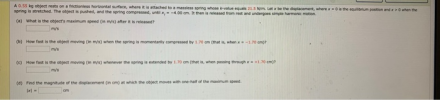 sing where w e ro is the equilibrium pouco are the place where simple harmonie moon de when n d d e A 0.55 kg object rests on a frictionless horizontal surface, where it is attached to spring is stretched. The object is pushed, and the compressed -400 (a) What is the sam e d ) er is released m's when x 1.0 cm (b) How fast is the object moving (in m/s) when the spring is momentary compressed by...
A block of mass 100.0 g rests on a frictionless, horizontal plane. It is pressed firmly...
A block of mass 100.0 g rests on a frictionless, horizontal plane. It is pressed firmly against a horizontal spring with spring constant 2000.0 N/m (assume that the spring is massless). The object is held in position such that the spring is compressed 1.00 cm shorter than its undisturbed length. If the block is suddenly released, at what speed will it be traveling when it is free of the spring?
A 0.500 kg block rests (at x = 0) on a horizontal, frictionless surface as in...
A 0.500 kg block rests (at x = 0) on a horizontal, frictionless surface as in the figure. The block is pressed back against a spring having a constant of k = 625 N/m, compressing the spring to xi = - 10.0 cm. Then the block is released, and it travels a distance d up an incline with ? = 300 from the horizontal. (10 points) a)What is the potential energy when the spring is fully compressed? b)What is the...
A block of mass 1.8 kg is attached to a horizontal spring that has a force constant 900 N/m as shown in the figure below
 A block of mass 1.8 kg is attached to a horizontal spring that has a force constant 900 N/m as shown in the figure below. The spring is compressed 2.0 cm and is then released from rest. (a) A constant friction force of 3.4 N retards the block's motion from the moment it is released. How much is the spring compressed when the speed of the block is a maximum. (b) What is the maximum speed?
A block of 2 kg of mass is attached to a horizontal spring. The spring is...
A block of 2 kg of mass is attached to a horizontal spring. The spring is stretched 10 cm and at t = 0 it is released from rest. The next time where the speed is zero is 0.5 s later. Calculate: a) The spring force constant k b) The maximum speed of the block c) the displacement equation d) the total energy of the system. Thank you.
 A 0.45 kg object rests on a frictionless horizontal surface, where it is attached to a massless spring whose k-value equals 24.0 N/m. Let x be the displacement, where x = 0 is the equilibrium position and x > 0 when the spring is stretched. The object is pushed, and the spring compressed, until x, =-4.00 cm. It then is released from rest and undergoes simple harmonic motion. (a) What is the object's maximum speed (in m/s) after it is...
 A 0.45 kg object rests on a frictionless horizontal surface, where it is attached to a massless spring whose k-value equals 24.0 N/m. Let x be the displacement, where x = o is the equilibrium position and x > 0 when the spring is stretched. The object is pushed, and the spring compressed, until хі =-4.00 cm. It then is released from rest and undergoes simple harmonic motion. (a) What is the object's maximum speed (in m/s) after it is...
 A block of mass mis attached to a horizontal spring and rests on a flat, smooth surface as seen in the figure. The block can be pushed in the negative x- direction to compress the spring or pulled in the positive x-direction to stretch the spring. Where along the x-axis does the block have to be for the spring to have zero potential energy? Marked out of Flag estion ix=0 0 Select one: O a. The spring has zero potential...
 sing where w e ro is the equilibrium pouco are the place where simple harmonie moon de when n d d e A 0.55 kg object rests on a frictionless horizontal surface, where it is attached to spring is stretched. The object is pushed, and the compressed -400 (a) What is the sam e d ) er is released m's when x 1.0 cm (b) How fast is the object moving (in m/s) when the spring is momentary compressed by...
Most questions answered within 3 hours.
-
Where is the error in this code sequence?
String s1 = "Hello";
String s2 = "ello";...
asked 10 months ago -
Financial data for Joel de Paris, Inc., for last year
follow:
Joel de Paris, Inc.
Balance...
asked 10 months ago -
Consider this reaction:
Al2(SO4)3 (aq)+ BaCl3
(aq) Al2Cl6 (aq)- +
3BaSO4(s) . What is the...
asked 10 months ago -
Suppose that Savneet is considering increasing her
recent random sample from 20 car rentals to 40...
asked 10 months ago -
Trucks arrive at an unloading terminal at an average rate of 120
per hour.
Trucks arrive...
asked 10 months ago -
Why are methanol and ethanol completely soluble in water while
octanol is not very little soluble....
asked 10 months ago -
A facilities manager at a university reads in a research report
that the mean amount of...
asked 10 months ago -
When the CuSO4 is rehydrated by adding water to the anhydrous
compound, is this an endothermic...
asked 10 months ago -
A ray of sunlight is passing from diamond into crown glass; the
angle of incidence is...
asked 10 months ago -
A block of mass 0.249 kg is placed on top of a light, vertical
spring of...
asked 10 months ago -
how do the kidneys compensate in the presences of acidosis
a) trigger hyperventilate
b) reserve acid...
asked 10 months ago -
Question 501 pts
The rental rate of capital to the firm increases. Which of the
following...
asked 10 months ago