A drop test is performed on a particle free-falling through air. The theoretical y-coordinate of a...
A drop test is performed on a particle free-falling through air. The theoretical y-coordinate of a particle dropped from an initial height is
? = ?? − 0.5??2
where, y = height above the ground
yi = initial height above the ground
g = gravity (386.4 in/s2)
t = time after particle release.
Your task is to create a program that prompt user to input initial height above the ground (yi). Then call a function (that you create) to calculate the time when the particle reaches the ground.
Display your result.
Exemplary input/output format:
Enter initial height above the ground (in inch):
Time to reach ground (in second):
Homework Answers
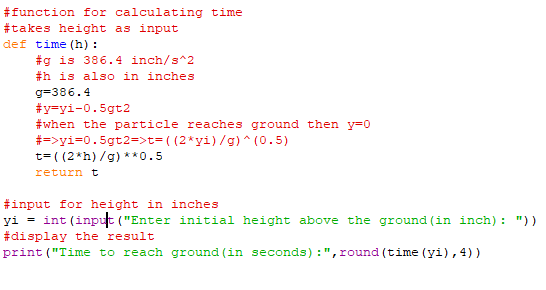
Python 3.6 Code:
***refer to the attached snapshot for indentation***
================================================================
#function for calculating time
#takes height as input
def time(h):
#g is 386.4 inch/s^2
#h is also in inches
g=386.4
#y=yi-0.5gt2
#when the particle reaches ground then y=0
#=>yi=0.5gt2=>t=((2*yi)/g)^(0.5)
t=((2*h)/g)**0.5
return t
#input for height in inches
yi = int(input("Enter initial height above the ground(in inch):
"))
#display the result
print("Time to reach ground(in seconds):",round(time(yi),4))
===========================================================================
Sanpshot
Sample OUTPUT

Add Answer to:
A drop test is performed on a particle free-falling through air.
The theoretical y-coordinate of a...
9). A small bag of sand is released from an ascending hot‑air balloon whose constant, upward...
9). A small bag of sand is released from an ascending hot‑air balloon whose constant, upward velocity is ?0=2.75 m/s. Knowing that at the time of the release the balloon was 58.3 m above the ground, determine the time ? it takes for the bag to reach the ground from the moment of its release. Use ?=9.81 m/s2. r= 10) You throw a baseball directly upward at time ?=0 at an initial speed of 14.1 m/s. What is the maximum height...
a. An attacker at the base of a castle wall 3.65 m high throws a rock...
a. An attacker at the base of a castle wall 3.65 m high throws a rock straight up with speed 7.40 m/s from a height of 1.55 m above the ground. Will the rock reach the top of the wall? If so, how fast is it moving when it reaches the top. If not, what initial speed must it have to reach the top? b. To defend the castle, a rock is thrown downwards from the top of the wall...
An attacker at the base of a castle wall 3.65 m high throws a rock straight up with speed 7.40 m/s from a height of 1.55 m above the ground.
a. An attacker at the base of a castle wall 3.65 m high throws a rock straight up with speed 7.40 m/s from a height of 1.55 m above the ground. Will the rock reach the top of the wall? If so, how fast is it moving when it reaches the top. If not, what initial speed must it have to reach the top? b. To defend the castle, a rock is thrown downwards from the top of the wall with...
EXPLORE A projectile is launched with a launch angle of 30° with respect to the horizontal...
EXPLORE A projectile is launched with a launch angle of 30° with respect to the horizontal direction and with an initial speed of 40 m/s. (A) How do the vertical and horizontal components of the projectile's velocity vary with time? (B) How long does it remain in flight? (C) For a given launch speed, what launch angle produces the longest time of flight? CONCEPTUALIZE Consider the projectile to be a point mass that starts with an initial velocity, upward and...
How do I answer these questions Chapter 2-Kinematies in One Dimension Free-fall motion . A ball...
 How
do I answer these questions
Chapter 2-Kinematies in One Dimension Free-fall motion . A ball is thrown vertically upward at an initial speed of 4of K to be the ground; leaves the hand when it is 15 m above the ground (about the that the effects of air resistance can be ignored. Choose your landm then att-0, y.-+15 m, V +49 m/s speed in mph? Do you think this is a realistic possibility? b. (10 pts) What is the...
How
do I answer these questions
Chapter 2-Kinematies in One Dimension Free-fall motion . A ball is thrown vertically upward at an initial speed of 4of K to be the ground; leaves the hand when it is 15 m above the ground (about the that the effects of air resistance can be ignored. Choose your landm then att-0, y.-+15 m, V +49 m/s speed in mph? Do you think this is a realistic possibility? b. (10 pts) What is the...
Example 4.3 A Bull's-Eye Every Time In a popular lecture demonstration, a projectile is fired at...
 Example 4.3 A Bull's-Eye Every Time In a popular lecture demonstration, a projectile is fired at a target in such a way that the projectile leaves the gun at the same time the target is dropped from rest. Show that if the gun is initially aimed at the stationary target, the projectile hits the falling target as shown in figure (a). The velocity of the projectile (red arrows) changes in direction and magnitude, but its acceleration (purple arrows) remains constant....
EXPLORE A projectile is launched with a launch angle of 30° with respect to the horizontal...
 EXPLORE A projectile is launched with a launch angle of 30° with respect to the horizontal direction and with an initial speed of 10 m/s. s0 (A) How do the vertical and horizontal components of the projectile's velocity vary with time? 40 35 (B) How long does it remain in flight? 25 (C) For a given launch speed, what launch angle produces the longest time of flight? 15 10 toy CONCEPTUALIZE Consider the projectile to be a point mass that...
(1) An object moves with constant acceleration 3.26 m/s and over a time interval reaches a...
 (1) An object moves with constant acceleration 3.26 m/s and over a time interval reaches a final velocity of 10.8 m/s. a. If its initial velocity 5.39 m/s, what is its displacement during the time interval? Submit Answer Tries 0/10 b. What is the distance it travels during this interval? Submit Answer Tries 0/10 c. If its initial velocity is -5.39 m/s, what is its displacement during the time interval? Submit Answer Tries 0/10 d. What is the total distance...
Homework-2 – Working with a class. Problem: Attached with this homework is code for a class...
Homework-2 – Working with a class. Problem: Attached with this homework is code for a class called DroppedObject. This class is used to to store the state of a falling object. The problem this class/object can be used to solve is detailed below. Your task for this homework is to read and understand the attached class. Note this class is formatted like all classes should be with private variables, constructors, a toString method, getter and setter methods, and other relevant...
Write a MATLAB Graphical User Interface (GUI) to simulate and plot the projectile motion – the...
Write a MATLAB Graphical User Interface (GUI) to simulate and plot the projectile motion – the motion of an object projected into the air at an angle. The object flies in the air until the projectile returns to the horizontal axis (x-axis), where y=0. This MATLAB program should allow the user to try to hit a 2-m diameter target on the x-axis (y=0) by varying conditions, including the lunch direction, the speed of the lunch, the projectile’s size, and the...
 How
do I answer these questions
Chapter 2-Kinematies in One Dimension Free-fall motion . A ball is thrown vertically upward at an initial speed of 4of K to be the ground; leaves the hand when it is 15 m above the ground (about the that the effects of air resistance can be ignored. Choose your landm then att-0, y.-+15 m, V +49 m/s speed in mph? Do you think this is a realistic possibility? b. (10 pts) What is the...
How
do I answer these questions
Chapter 2-Kinematies in One Dimension Free-fall motion . A ball is thrown vertically upward at an initial speed of 4of K to be the ground; leaves the hand when it is 15 m above the ground (about the that the effects of air resistance can be ignored. Choose your landm then att-0, y.-+15 m, V +49 m/s speed in mph? Do you think this is a realistic possibility? b. (10 pts) What is the...
 Example 4.3 A Bull's-Eye Every Time In a popular lecture demonstration, a projectile is fired at a target in such a way that the projectile leaves the gun at the same time the target is dropped from rest. Show that if the gun is initially aimed at the stationary target, the projectile hits the falling target as shown in figure (a). The velocity of the projectile (red arrows) changes in direction and magnitude, but its acceleration (purple arrows) remains constant....
 EXPLORE A projectile is launched with a launch angle of 30° with respect to the horizontal direction and with an initial speed of 10 m/s. s0 (A) How do the vertical and horizontal components of the projectile's velocity vary with time? 40 35 (B) How long does it remain in flight? 25 (C) For a given launch speed, what launch angle produces the longest time of flight? 15 10 toy CONCEPTUALIZE Consider the projectile to be a point mass that...
 (1) An object moves with constant acceleration 3.26 m/s and over a time interval reaches a final velocity of 10.8 m/s. a. If its initial velocity 5.39 m/s, what is its displacement during the time interval? Submit Answer Tries 0/10 b. What is the distance it travels during this interval? Submit Answer Tries 0/10 c. If its initial velocity is -5.39 m/s, what is its displacement during the time interval? Submit Answer Tries 0/10 d. What is the total distance...
Most questions answered within 3 hours.
-
Where is the error in this code sequence?
String s1 = "Hello";
String s2 = "ello";...
asked 10 months ago -
Financial data for Joel de Paris, Inc., for last year
follow:
Joel de Paris, Inc.
Balance...
asked 10 months ago -
Consider this reaction:
Al2(SO4)3 (aq)+ BaCl3
(aq) Al2Cl6 (aq)- +
3BaSO4(s) . What is the...
asked 10 months ago -
Suppose that Savneet is considering increasing her
recent random sample from 20 car rentals to 40...
asked 10 months ago -
Trucks arrive at an unloading terminal at an average rate of 120
per hour.
Trucks arrive...
asked 10 months ago -
Why are methanol and ethanol completely soluble in water while
octanol is not very little soluble....
asked 10 months ago -
A facilities manager at a university reads in a research report
that the mean amount of...
asked 10 months ago -
When the CuSO4 is rehydrated by adding water to the anhydrous
compound, is this an endothermic...
asked 10 months ago -
A ray of sunlight is passing from diamond into crown glass; the
angle of incidence is...
asked 10 months ago -
A block of mass 0.249 kg is placed on top of a light, vertical
spring of...
asked 10 months ago -
how do the kidneys compensate in the presences of acidosis
a) trigger hyperventilate
b) reserve acid...
asked 10 months ago -
Question 501 pts
The rental rate of capital to the firm increases. Which of the
following...
asked 10 months ago