Explain the specific challenges for planning with domestic partners who have children.
Explain the specific challenges for planning with domestic partners who have children.
Homework Answers
A domestic partnership is a special provision in law provide right to two unmarried person to live together and lead a common domestic life. They are not legally same as Common law of marriage ,but person are free to live together as contract. But the domestic partnership doesn’t provide a clear clause on parental right. Parental rights are supported by state legislation only , which may varies from state to state. In most of the cases, unmarried parents have comparatively lesser rights. Seven states still consider illegal of living together of unmarried couples. A couple in domestic partnership may raise a child , biologically belong to either of them. In such condition, the biological unrelated parent has no parental rights without proper adoption. In the case of division, a non-biological parent has no right of custody. They have to take some extra steps for child's future in situation of death of biological parent as partner cannot be consider as the legal guardian.
Add Answer to:
Explain the specific challenges for planning with domestic
partners who have children.
What does the research on attachment indicate? Children who had secure attachments to caregivers generally grow...
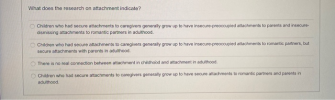 What does the research on attachment indicate? Children who had secure attachments to caregivers generally grow up to have insecure-preoccupied attachments to parents and insecure- dismissing attachments to romantic partners in adulthood. Children who had secure attachments to caregivers generally grow up to have insecure-preoccupied attachments to romantic partners, but secure attachments with parents in adulthood. There is no real connection between attachment in childhood and attachment in adulthood. Children who had secure attachments to caregivers generally grow up to...
Risks for Children Who Specialize Too Early; How to Set Age-Specific Time Limits
Risks for Children Who Specialize Too Early; How to Set Age-Specific Time Limits
Is there a specific age at which children can truly be said to have capacity about...
Is there a specific age at which children can truly be said to have capacity about life-altering medical decisions? Is it 18? Is it before or after? Explain your reasoning. On the same note, to what extent should parents be allowed to make life-altering medical decisions for their children? Should the religious preferences of the parents impact the care of the child? Why or why not?
3. Explain some of the major challenges financial accountants are facing today. Can these challenges have...
 3. Explain some of the major challenges financial accountants are facing today. Can these challenges have an effect in the accounting professionals' ethical decisions?
You have identified the fact that a few children in your class and some who are...
You have identified the fact that a few children in your class and some who are yet to be enrolled have positively deviated from the norm. There is therefore the need for you to plan separate programmes so that these children can as well, be accommodated for them to benefit from teaching and learning. Identify and explain any five (5) programmes you can put in place for such children to also benefit from teaching and learning.
A realistic assessment of the challenges facing the new venture. The new venture is planning to...
A realistic assessment of the challenges facing the new venture. The new venture is planning to open the retail store and it has already has one retail store.So,the store is planning to have two store. 250 words and no plagiarism please.
1. Define strategic planning. How is strategic planning different for international marketing than domestic marketing? 2....
1. Define strategic planning. How is strategic planning different for international marketing than domestic marketing? 2. Discuss the benefits to an MNC of accepting the global market concept. Explain three points that define a global approach to international marketing. 3. Discuss the effect of shorter product life cycles on a company’s planning process. 4. What is the importance of collaborative relationships to competition?
Which of the following is good advice for managers who are planning? a. View planning as...
Which of the following is good advice for managers who are planning? a. View planning as an important event. b. Allow flexibility in the planning and in the plan. c. Base the plan on hard data and past history. d. Stick to a specific, orderly, sequential approach.
Children who live in chronic poverty have: Better health but worse education than other children Worse...
 Children who live in chronic poverty have: Better health but worse education than other children Worse health and education than other children Worse health but better resilience than other children Worse health but better social networks than other children
Explain the circumstances under which children should be prescribed drugs for off-label use. Be specific and...
Explain the circumstances under which children should be prescribed drugs for off-label use. Be specific and provide examples. Describe strategies to make the off-label use and dosage of drugs safer for children from infancy to adolescence. Include descriptions and names of off-label drugs that require extra care and attention when used in pediatrics.
 What does the research on attachment indicate? Children who had secure attachments to caregivers generally grow up to have insecure-preoccupied attachments to parents and insecure- dismissing attachments to romantic partners in adulthood. Children who had secure attachments to caregivers generally grow up to have insecure-preoccupied attachments to romantic partners, but secure attachments with parents in adulthood. There is no real connection between attachment in childhood and attachment in adulthood. Children who had secure attachments to caregivers generally grow up to...
 3. Explain some of the major challenges financial accountants are facing today. Can these challenges have an effect in the accounting professionals' ethical decisions?
 Children who live in chronic poverty have: Better health but worse education than other children Worse health and education than other children Worse health but better resilience than other children Worse health but better social networks than other children
Most questions answered within 3 hours.
-
Where is the error in this code sequence?
String s1 = "Hello";
String s2 = "ello";...
asked 10 months ago -
Financial data for Joel de Paris, Inc., for last year
follow:
Joel de Paris, Inc.
Balance...
asked 10 months ago -
Consider this reaction:
Al2(SO4)3 (aq)+ BaCl3
(aq) Al2Cl6 (aq)- +
3BaSO4(s) . What is the...
asked 10 months ago -
Suppose that Savneet is considering increasing her
recent random sample from 20 car rentals to 40...
asked 10 months ago -
Trucks arrive at an unloading terminal at an average rate of 120
per hour.
Trucks arrive...
asked 10 months ago -
Why are methanol and ethanol completely soluble in water while
octanol is not very little soluble....
asked 10 months ago -
A facilities manager at a university reads in a research report
that the mean amount of...
asked 10 months ago -
When the CuSO4 is rehydrated by adding water to the anhydrous
compound, is this an endothermic...
asked 10 months ago -
A ray of sunlight is passing from diamond into crown glass; the
angle of incidence is...
asked 10 months ago -
A block of mass 0.249 kg is placed on top of a light, vertical
spring of...
asked 10 months ago -
how do the kidneys compensate in the presences of acidosis
a) trigger hyperventilate
b) reserve acid...
asked 10 months ago -
Question 501 pts
The rental rate of capital to the firm increases. Which of the
following...
asked 10 months ago