The inverse demand function for grapes is described by the equation p = 518 - 5q,...
The inverse demand function for grapes is described by the equation p = 518 - 5q, where p is the price in dollars per crate and q is the number of crates of grapes demanded per week. When p = $38 per crate, what is the price elasticity of demand for grapes?
Homework Answers
Answer
Elasticity of demand = (dq/dp)(p/q)
Inverse demand is given by :
p = 518 - 5q => q = (1/5)(518 - p) => dq/dp = -1/5
It is given that p = 38 => q = q = (1/5)(518 - p) = q = (1/5)(518 - 38) = 96
Thus, we have p = 38 , q = 96 and dq/dp = -1/5
So, Elasticity of demand = (dq/dp)(p/q) = -(1/5)(38/96) = -0.0792
Hence, the price elasticity of demand for grapes = -0.0792
Add Answer to:
The inverse demand function for grapes is described by the
equation p = 518 - 5q,...
7. Suppose the inverse demand equation for rental apartments is P = 2000 – Q and...
 7. Suppose the inverse demand equation for rental apartments is P = 2000 – Q and the inverse supply equation for rental apartments is P=Q. Suppose there's a policy that restricts the price (monthly rental) to not exceed $1200. Which of the following statement is correct? A. The market equilibrium price will be $1200. B. There will be no excess demand or excess supply. C. There will be an excess demand of 400 units. D. There will be an excess...
a monopolist has a total cost function TC= 5Q^2- 2Q+ 100. the inverse demand function for...
a monopolist has a total cost function TC= 5Q^2- 2Q+ 100. the inverse demand function for the monopolist is P= 10 - Q. what is the optimal price for the monopolist. a. 6 b.7 c.8 d.9
1. If the demand curve is written as Q = 670 – P/3, then the inverse...
1. If the demand curve is written as Q = 670 – P/3, then the inverse demand function is 670-(P/3)=Q Q=2010-3P P=670-(Q/3) Q=670-(P/3) P=2010-3Q None of the Above The demand function for Widgets is given by: QD=6000-15y-20p-8pG, where QD is the quantity of widgets demanded, y is the per capital income, and pG is the price of Gizmos. If y is 47 (measured in thousands of dollars) and the price of Gizmos (pG) is $56, what is the intercept for...
The demand function for a Christmas music CD is given by q=D(p)=0.25(225−p2) where qq (measured in...
The demand function for a Christmas music CD is given by q=D(p)=0.25(225−p2) where qq (measured in units of a hundred) is the quantity demanded per week and pp is the unit price in dollars. (a) Find the elasticity function E(p)= (b) Evaluate the elasticity at 10. E(10)= (c) Should the unit price be lowered slightly from 10 in order to increase revenue? ? yes no (d) Use the elasticity of demand to find the price which maximizes revenue for this product. p= dollars...
A monopolist faces the inverse demand function described by p = 100-2q
 A monopolist faces the inverse demand function described by p = 100-2q, where q is output. The monopolist has no fixed cost and his marginal cost is $20 at all levels of output. What is the monopolist's profit as a function of his output?
The demand function for an oligopolistic market is given by the equation, Q = 275 – 4P, where Q is quantity demanded and P is price (Note: inverse demand for the dominant firm here is P = 50 - .2Q). T...
The demand function for an oligopolistic market is given by the equation, Q = 275 – 4P, where Q is quantity demanded and P is price (Note: inverse demand for the dominant firm here is P = 50 - .2Q). The industry has one dominant firm whose marginal cost function is: MC = 12 + 0.7QD, and many small firms, with a total supply function: QS = 25 + P. In equilibrium, the total output of all small firms is
A firm with market power has an inverse demand curve of P = 450 - 5Q...
 A firm with market power has an inverse demand curve of P = 450 - 5Q and marginal cost of MC = 400, where Q is measured in thousands. What is the deadweight loss from market power at the firm's profit-maximizing output level? $15,000 $280,000 $22.500 $9.400
Question 17 1 pts Consider a competitive market where demand is described by the equation P...
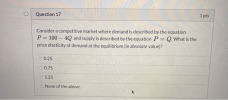 Question 17 1 pts Consider a competitive market where demand is described by the equation P = 100 - 4Q and supply is described by the equation P=Q. What is the price elasticity of demand at the equilibrium (in absolute value)? 0.25 0.75 1.25 None of the above.
wherdemand is described as q - Note: An alternate notation for this equation is E(p)- f(p), in other words, quantity is a function of price. You may use whichever form of this equation for elasti...
 wherdemand is described as q - Note: An alternate notation for this equation is E(p)- f(p), in other words, quantity is a function of price. You may use whichever form of this equation for elasticity that you like the best, but I will use this notation in this assignment. f(p) Fill in the blank: 3. , the elasticity of demand is less than the relative change in price, and the a. If demand is called the elasticity of demand is...
 7. Suppose the inverse demand equation for rental apartments is P = 2000 – Q and the inverse supply equation for rental apartments is P=Q. Suppose there's a policy that restricts the price (monthly rental) to not exceed $1200. Which of the following statement is correct? A. The market equilibrium price will be $1200. B. There will be no excess demand or excess supply. C. There will be an excess demand of 400 units. D. There will be an excess...
 A firm with market power has an inverse demand curve of P = 450 - 5Q and marginal cost of MC = 400, where Q is measured in thousands. What is the deadweight loss from market power at the firm's profit-maximizing output level? $15,000 $280,000 $22.500 $9.400
 Question 17 1 pts Consider a competitive market where demand is described by the equation P = 100 - 4Q and supply is described by the equation P=Q. What is the price elasticity of demand at the equilibrium (in absolute value)? 0.25 0.75 1.25 None of the above.
 wherdemand is described as q - Note: An alternate notation for this equation is E(p)- f(p), in other words, quantity is a function of price. You may use whichever form of this equation for elasticity that you like the best, but I will use this notation in this assignment. f(p) Fill in the blank: 3. , the elasticity of demand is less than the relative change in price, and the a. If demand is called the elasticity of demand is...
Most questions answered within 3 hours.
-
Where is the error in this code sequence?
String s1 = "Hello";
String s2 = "ello";...
asked 1 year ago -
Financial data for Joel de Paris, Inc., for last year
follow:
Joel de Paris, Inc.
Balance...
asked 1 year ago -
Consider this reaction:
Al2(SO4)3 (aq)+ BaCl3
(aq) Al2Cl6 (aq)- +
3BaSO4(s) . What is the...
asked 1 year ago -
Suppose that Savneet is considering increasing her
recent random sample from 20 car rentals to 40...
asked 1 year ago -
Trucks arrive at an unloading terminal at an average rate of 120
per hour.
Trucks arrive...
asked 1 year ago -
Why are methanol and ethanol completely soluble in water while
octanol is not very little soluble....
asked 1 year ago -
A facilities manager at a university reads in a research report
that the mean amount of...
asked 1 year ago -
When the CuSO4 is rehydrated by adding water to the anhydrous
compound, is this an endothermic...
asked 1 year ago -
A ray of sunlight is passing from diamond into crown glass; the
angle of incidence is...
asked 1 year ago -
A block of mass 0.249 kg is placed on top of a light, vertical
spring of...
asked 1 year ago -
how do the kidneys compensate in the presences of acidosis
a) trigger hyperventilate
b) reserve acid...
asked 1 year ago -
Question 501 pts
The rental rate of capital to the firm increases. Which of the
following...
asked 1 year ago