why is g value small in atwood machine (pulley)? detailed answer pls
Homework Answers
Dear student,
Find this solution, and RATE IT ,If you find it is helpful .your rating is very important to me.If any incorrectness ,kindly let me know I will rectify them soon.
Thanks for asking ..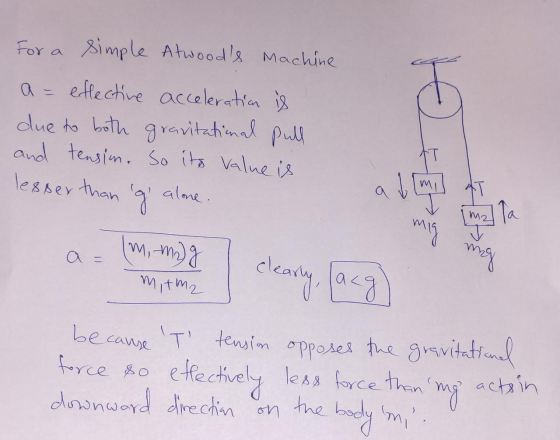
Add Answer to:
why
is g value small in atwood machine (pulley)?
detailed answer pls
An Atwood Machine is composed of a frictionless pulley with two cubes connected by a string'...
An Atwood Machine is composed of a frictionless pulley with two cubes connected by a string' Cube A, on the left, has a mass of 4.0kg and cube B, on the right has a mass of 6.0kg. The pulley has a rotational inertia of 1/2 MR2. How does that affect the acceleration of the masses. Would tension A be the same as tension B? Why or why not?
1. An Atwood Machine consists of weights attached to the two ends of a pulley. For...
 1. An Atwood Machine consists of weights attached to the two ends of a pulley. For this machine, the pulley is a thin disk which has a radius of 2m, mass 1 is 8 kg and mass 2 is 5 kg, and both masses start at 5 meters above the ground. When we release the system from rest: How fast will mass 1 be moving right before it hits the ground? b. How fast will mass 2 be moving right...
In the Atwood machine shown in (Figure 1) , the pulley radius is 0.10 m ,...
 In the Atwood machine shown in (Figure 1) , the pulley radius is
0.10 m , and the rotational inertia of the pulley is 0.17 kg?m2 .
Ignore the cord's inertia.
A)Calculate the acceleration of the
blocks.
B)Calculate the tension in the cord on the left
C)Calculate the tension in the
cord on the right.
In the Atwood machine shown in (Figure 1) , the pulley radius is
0.10 m , and the rotational inertia of the pulley is 0.17 kg?m2 .
Ignore the cord's inertia.
A)Calculate the acceleration of the
blocks.
B)Calculate the tension in the cord on the left
C)Calculate the tension in the
cord on the right.
an atwood machine with massless string and frictionless pulley has masses m1= 0.480 kg and m2=0.720...
an atwood machine with massless string and frictionless pulley has masses m1= 0.480 kg and m2=0.720 kg attached to it. derive the equations for and calculate the acceleration of the masses and the tension in the string
Problem 9.38 10 of 19 > Review Constants Periodic Table In an Atwood machine, block 1 with mass mi and a loss ma...
 Problem 9.38 10 of 19 > Review Constants Periodic Table In an Atwood machine, block 1 with mass mi and a loss massive block 2 with mass are connected by a string that passes over a solid cylindrical pulley of mass M and radius R. Usemi 0.20 k m 0.16 kg. M = 0.50 kg, and R-0.10 m. (Figure 1) Determine the rotational inertia of the pulley Express your answer with the appropriate units. 1. Value Units Figure Submit Rest...
Page 5 Atwood's Machine Problem 2: Setup an Atwood machine using a pulley, string and two...
 Page 5 Atwood's Machine Problem 2: Setup an Atwood machine using a pulley, string and two masses. Measure the acceleration of the masses when released from rest and compare to the theoretical value as calculated in Lesson notes. By measuring the elapsed time, and the vertical displacement Ay, the acceleration y, t ep is determined usingAact Compare the measured and theoretical values of a using the percent error formula (see Lesson 6 for aeory). y2 t Table 1: Experimental Data...
The Atwood machine consists of two masses hanging from the ends of a rope that passes...
 The Atwood machine consists of two masses hanging from the ends of a rope that passes over a pulley Assume that the rope and pulley are massless, and that there is no friction in the pulley. If the masses have the values m 19.7 kg and m2 12.7 kg, find the magnitude of their acceleration a and the tension T in the rope. Use g 9.81 m/s2. Number a- m/s Number
The Atwood machine consists of two masses hanging from the ends of a rope that passes...
 The Atwood machine consists of two masses hanging from the ends
of a rope that passes over a pulley. Assume that the rope and
pulley are massless, and that there is no friction in the pulley.
If the masses have the values m1 = 20.3 kg and m2 = 12.5 kg, find
the magnitude of their acceleration a and the tension T in the
rope. Use g = 9.81 m/s2.
2 answers
in the rope. Use g 9.81 m/s Number...
The Atwood machine consists of two masses hanging from the ends
of a rope that passes over a pulley. Assume that the rope and
pulley are massless, and that there is no friction in the pulley.
If the masses have the values m1 = 20.3 kg and m2 = 12.5 kg, find
the magnitude of their acceleration a and the tension T in the
rope. Use g = 9.81 m/s2.
2 answers
in the rope. Use g 9.81 m/s Number...
A device known as Atwoods machine consists of two masses hanging from the ends of a...
 A device known as Atwoods machine consists of two masses hanging from the ends of a vertical rope that passes over a pulley. Assume the rope and pulley are massless and there is no friction in the pulley. Mass mA is greater than mass me. Find expressions for the magnitude of their acceleration, a, and the tension in the rope, T. Express your answers in terms of the masses and g, the acceleration due to gravity.
An Atwood machine is constructed of a solid-disk frictionless pulley of mass m3 and radius R....
An Atwood machine is constructed of a solid-disk frictionless pulley of mass m3 and radius R. On the left side is hung a mass m1, and on the right the string is wound around a hollow cylinder of mass m2 and radius r (like a yoyo.) 1) For what mass ratio m2/m1 will mass m1 remain stationary, and what will the acceleration of mass m2 be? 2) Suppose m2 = 2*m1. For what mass m3 will the masses m1 and...
 1. An Atwood Machine consists of weights attached to the two ends of a pulley. For this machine, the pulley is a thin disk which has a radius of 2m, mass 1 is 8 kg and mass 2 is 5 kg, and both masses start at 5 meters above the ground. When we release the system from rest: How fast will mass 1 be moving right before it hits the ground? b. How fast will mass 2 be moving right...
 In the Atwood machine shown in (Figure 1) , the pulley radius is
0.10 m , and the rotational inertia of the pulley is 0.17 kg?m2 .
Ignore the cord's inertia.
A)Calculate the acceleration of the
blocks.
B)Calculate the tension in the cord on the left
C)Calculate the tension in the
cord on the right.
In the Atwood machine shown in (Figure 1) , the pulley radius is
0.10 m , and the rotational inertia of the pulley is 0.17 kg?m2 .
Ignore the cord's inertia.
A)Calculate the acceleration of the
blocks.
B)Calculate the tension in the cord on the left
C)Calculate the tension in the
cord on the right.
 Problem 9.38 10 of 19 > Review Constants Periodic Table In an Atwood machine, block 1 with mass mi and a loss massive block 2 with mass are connected by a string that passes over a solid cylindrical pulley of mass M and radius R. Usemi 0.20 k m 0.16 kg. M = 0.50 kg, and R-0.10 m. (Figure 1) Determine the rotational inertia of the pulley Express your answer with the appropriate units. 1. Value Units Figure Submit Rest...
 Page 5 Atwood's Machine Problem 2: Setup an Atwood machine using a pulley, string and two masses. Measure the acceleration of the masses when released from rest and compare to the theoretical value as calculated in Lesson notes. By measuring the elapsed time, and the vertical displacement Ay, the acceleration y, t ep is determined usingAact Compare the measured and theoretical values of a using the percent error formula (see Lesson 6 for aeory). y2 t Table 1: Experimental Data...
 The Atwood machine consists of two masses hanging from the ends of a rope that passes over a pulley Assume that the rope and pulley are massless, and that there is no friction in the pulley. If the masses have the values m 19.7 kg and m2 12.7 kg, find the magnitude of their acceleration a and the tension T in the rope. Use g 9.81 m/s2. Number a- m/s Number
 The Atwood machine consists of two masses hanging from the ends
of a rope that passes over a pulley. Assume that the rope and
pulley are massless, and that there is no friction in the pulley.
If the masses have the values m1 = 20.3 kg and m2 = 12.5 kg, find
the magnitude of their acceleration a and the tension T in the
rope. Use g = 9.81 m/s2.
2 answers
in the rope. Use g 9.81 m/s Number...
The Atwood machine consists of two masses hanging from the ends
of a rope that passes over a pulley. Assume that the rope and
pulley are massless, and that there is no friction in the pulley.
If the masses have the values m1 = 20.3 kg and m2 = 12.5 kg, find
the magnitude of their acceleration a and the tension T in the
rope. Use g = 9.81 m/s2.
2 answers
in the rope. Use g 9.81 m/s Number...
 A device known as Atwoods machine consists of two masses hanging from the ends of a vertical rope that passes over a pulley. Assume the rope and pulley are massless and there is no friction in the pulley. Mass mA is greater than mass me. Find expressions for the magnitude of their acceleration, a, and the tension in the rope, T. Express your answers in terms of the masses and g, the acceleration due to gravity.
Most questions answered within 3 hours.
-
Where is the error in this code sequence?
String s1 = "Hello";
String s2 = "ello";...
asked 10 months ago -
Financial data for Joel de Paris, Inc., for last year
follow:
Joel de Paris, Inc.
Balance...
asked 10 months ago -
Consider this reaction:
Al2(SO4)3 (aq)+ BaCl3
(aq) Al2Cl6 (aq)- +
3BaSO4(s) . What is the...
asked 10 months ago -
Suppose that Savneet is considering increasing her
recent random sample from 20 car rentals to 40...
asked 10 months ago -
Trucks arrive at an unloading terminal at an average rate of 120
per hour.
Trucks arrive...
asked 10 months ago -
Why are methanol and ethanol completely soluble in water while
octanol is not very little soluble....
asked 10 months ago -
A facilities manager at a university reads in a research report
that the mean amount of...
asked 10 months ago -
When the CuSO4 is rehydrated by adding water to the anhydrous
compound, is this an endothermic...
asked 10 months ago -
A ray of sunlight is passing from diamond into crown glass; the
angle of incidence is...
asked 10 months ago -
A block of mass 0.249 kg is placed on top of a light, vertical
spring of...
asked 10 months ago -
how do the kidneys compensate in the presences of acidosis
a) trigger hyperventilate
b) reserve acid...
asked 10 months ago -
Question 501 pts
The rental rate of capital to the firm increases. Which of the
following...
asked 10 months ago