Write a MIPS assembly code that corresponds to the following C code. Note: use the stack...
Write a MIPS assembly code that corresponds to the following C code. Note: use the stack to store all register values that you use in the procedures.
int aver(int * array, int N){
int i, sum = 0;
for ( i=0;i i<N; i++)
sum += array[i];
return sum/N;}
int Max( int * array, int N){
int i, Maximum = array[i];
for ( i = 1; i< N; i++)
if ( array[i] > Maximum)
Maximum = array[i];
return Maximum; }
int main ( ){
int average=0, max =0;
int A[10]; // suppose A is initialized
average = aver(A);
max = max(A);
return 0; }
Homework Answers
PROGRAM:
.data
A: .word 2, 8, 64, 57, 29, 75, 61, 97, 34, 20
out1: .asciiz "Average of array elements is: "
out2: .asciiz "\nMaximum number in array is: "
.text
.globl main
main:
li $v0,4 # 4 is the
print string syscall
la $a0,out1 # Load the
address of string to be printed
syscall
# Print the string
la $a0,A # Load the
address of array
li $a1,10 # Load the
size of array
jal aver # Call the
function aver
# store the return value from function
move $a0,$v0 # Load $a0
with integer to be printed
li $v0,1 # 1 is the
print integer syscall
syscall
# Print the integer
li $v0,4 # 4 is the
print string syscall
la $a0,out2 # Load the
address of string to be printed
syscall
# Print the string
la $a0,A # Load the
address of array
li $a1,10 # Load the
size of array
jal max
# Call the function max
# store the return value from function
move $a0,$v0 # Load $a0
with integer to be printed
li $v0,1 # 1 is the
print integer syscall
syscall
# Print the integer
li $v0,10 # 10 is the
exit program syscall
syscall
# Exit the program
# Definition of average function
aver:
# Adjust the stack pointer
addi $sp,$sp,-8
sw $s1,4($sp) # Store
$s1 on stack
sw $ra,0($sp) # Store
return address on stack
li $t0,0 # Loop counter
(i = 0)
li $t3,0 # Accumulator
(sum = 0)
for1: bge $t0,$a1,end1 # If loop counter
>= size of array, jump to label end1
mul $t1,$t0,4 #
Calculate the offset index i
add $t1,$a0,$t1 # $t1 =
&A[i]
lw $t2,0($t1) # $t2 =
A[i]
add $t3,$t3,$t2 # sum =
sum + A[i]
addi $t0,$t0,1 #
Increment loop counter
b for1
# Repeat the loop
end1: div $v0,$t3,$a1 #
$v0 = sum/N
lw $s1,4($sp) # Restore
$s1 from stack
lw $ra,0($sp) # Restore
$ra from stack
addi $sp,$sp,-8 #
Readjust stack pointer to its original position
jr $ra
# Jump to return address (i.e., to calling
function, main)
# Definition of max function
max:
# Adjust the stack pointer
addi $sp,$sp,-8
sw $s1,4($sp) # Store
$s1 on stack
sw $ra,0($sp) # Store
return address on stack
li $t0,1 # Loop counter
(i = 0)
lw $t1,0($a0) #
$t1(max) = A[0]
for2: bge $t0,$a1,end2 # If loop counter
>= size of array, jump to label end1
mul $t2,$t0,4 #
Calculate the offset index i
add $t2,$a0,$t2 # $t2 =
&A[i]
lw $t3,0($t2) # $t3 =
A[i]
ble $t3,$t1,next # If A[i] <= max, jump
to label next
move $t1,$t3 # Else max
= A[i]
next: addi $t0,$t0,1 #
Increment loop counter
b for2
# Repeat the loop
end2: move $v0,$t1 #
return the value of max
lw $s1,4($sp) # Restore
$s1 from stack
lw $ra,0($sp) # Restore
$ra from stack
addi $sp,$sp,-8 #
Readjust stack pointer to its original position
jr $ra
# Jump to return address (i.e., to calling
function, main)
Please refer to the following screenshot of the program for indentation of the code:
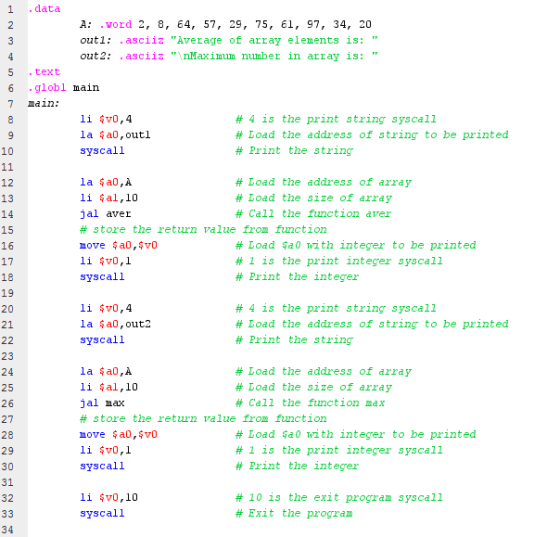
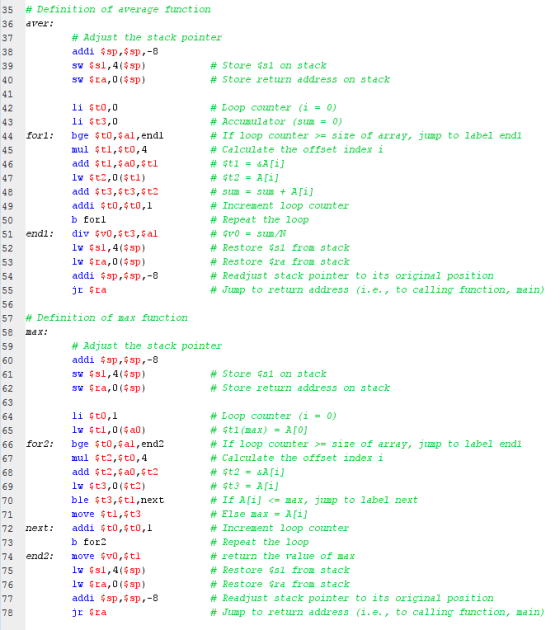
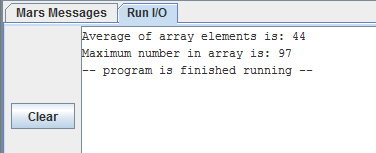
OUTPUT:
Add Answer to:
Write a MIPS assembly code that corresponds to the following C
code. Note: use the stack...
How can I convert the following C code to MIPS Assembly? +++++++++++++++++++++++++++++++++ MIPS main program ++++++++++++++++++++++++++++++++...
How can I convert the following C code to MIPS Assembly? +++++++++++++++++++++++++++++++++ MIPS main program ++++++++++++++++++++++++++++++++ .data # Defines variable section of an assembly routine. array: .word x, x, x, x, x, x, x, x, x, x # Define a variable named array as a word (integer) array # with 10 unsorted integer numbers of your own. # After your program has run, the integers in this array # should be sorted. .text # Defines the start of the code...
MIPS assembly language Implement the following code in MIPS int array [ ] {2, 3, 4,...
 MIPS assembly language
Implement the following code in MIPS int array [ ] {2, 3, 4, 5, 6); int main) int num, position; scanf("%d",&num) ; position search(array, printf("The position is: num, 5); %d\n",positio int search(int array, int num, int size int position =-1; for(int i-0;i<size; i++) if(array [i]=num) { position-i; break; return position; Register map $s1: position $a0: array address $a1: num . $a2: size . $VO: return value
MIPS assembly language
Implement the following code in MIPS int array [ ] {2, 3, 4, 5, 6); int main) int num, position; scanf("%d",&num) ; position search(array, printf("The position is: num, 5); %d\n",positio int search(int array, int num, int size int position =-1; for(int i-0;i<size; i++) if(array [i]=num) { position-i; break; return position; Register map $s1: position $a0: array address $a1: num . $a2: size . $VO: return value
its brr[8] (40%) Convert the following C-pseudo code into MIPS assembly code as a standalone program...
 its
brr[8]
(40%) Convert the following C-pseudo code into MIPS assembly code as a standalone program (including main and all the required directives). You can use any register. You must comply, however, with the convention of register usage. Before writing your code perform an explicit register allocation phase. Note that the C snippet is int arr[8]; int brr[4]-{1, 2, 3, 4, 5, 6, 7, 8) int i-8; while (i>-0) arrli]-brr[i-); (40%) Convert the following C-pseudo code into MIPS assembly code...
its
brr[8]
(40%) Convert the following C-pseudo code into MIPS assembly code as a standalone program (including main and all the required directives). You can use any register. You must comply, however, with the convention of register usage. Before writing your code perform an explicit register allocation phase. Note that the C snippet is int arr[8]; int brr[4]-{1, 2, 3, 4, 5, 6, 7, 8) int i-8; while (i>-0) arrli]-brr[i-); (40%) Convert the following C-pseudo code into MIPS assembly code...
what is the corresponding MIPS assembly code for the statements shown below that written in C....
what is the corresponding MIPS assembly code for the statements shown below that written in C. Assume that the variables sum and n assigned to register $t1 and $t2 respectively, and the base address of the array A is in register $t0. int sum = 0 for(n=100 ; n>=0; n=n-5) { if(A[n]>0 sum = a[n] +3 }
IN MIPS AND MUST RUN IN QTSPIM Translate the following C code to MIPS assembly code....
 IN MIPS AND MUST RUN IN QTSPIM
Translate the following C code to MIPS assembly code. Use a minimum number of instructions. Assume that the values of a, b, i and j are stored in registers Ss0, Ss1, St0 and Stl, respectively. Also assume that register Ss2 holds the base address of the array D. for (i=0; i<a; itt) for (i-0j<b:jt+)
IN MIPS AND MUST RUN IN QTSPIM
Translate the following C code to MIPS assembly code. Use a minimum number of instructions. Assume that the values of a, b, i and j are stored in registers Ss0, Ss1, St0 and Stl, respectively. Also assume that register Ss2 holds the base address of the array D. for (i=0; i<a; itt) for (i-0j<b:jt+)
7. Translate the following C code to MIPS assembly code. Use a minimum number of instructions....
 7. Translate the following C code to MIPS assembly code. Use a minimum number of instructions. Assume that the values of a,b, i and j are in registers Ss0, Ss1, St0, and St1, respectively. Also, assume that register SS2 holds the base address of the array D. for(i-0; i<a; i++) for(j=0 ; j<b; j++)
B2. Convert the C code to MIPS assembly with only 2 efficient instructions: Register assignment: ...
 B2. Convert the C code to MIPS assembly with only 2 efficient instructions: Register assignment: timer-v0 int timer = 0x0AC8 0001; B3. Write MIPS assembly code segment for the following C code snippet for (i - 0, i < 100; i++) -array Register assignment: i-) $ao Base of array -> $s0 array [ i+1] [i] / 2;
B2. Convert the C code to MIPS assembly with only 2 efficient instructions: Register assignment: timer-v0 int timer = 0x0AC8 0001; B3. Write...
B2. Convert the C code to MIPS assembly with only 2 efficient instructions: Register assignment: timer-v0 int timer = 0x0AC8 0001; B3. Write MIPS assembly code segment for the following C code snippet for (i - 0, i < 100; i++) -array Register assignment: i-) $ao Base of array -> $s0 array [ i+1] [i] / 2;
B2. Convert the C code to MIPS assembly with only 2 efficient instructions: Register assignment: timer-v0 int timer = 0x0AC8 0001; B3. Write...
In mips code please Implement the following C code in MAL and develop a small main...
 In mips code please
Implement the following C code in MAL and develop a small main program that tests your implementation on an integer array. You must use nested procedures in your implementation. int getArrAvg (int Arr) int sum0 for (int i = 0; i < 10; i += 1) sum-addfn (sum, Arr[i]) return sum/10; int addfn (int a, int b) return ab;
In mips code please
Implement the following C code in MAL and develop a small main program that tests your implementation on an integer array. You must use nested procedures in your implementation. int getArrAvg (int Arr) int sum0 for (int i = 0; i < 10; i += 1) sum-addfn (sum, Arr[i]) return sum/10; int addfn (int a, int b) return ab;
C3. Convert the following C-code to MIPS code. [Use register $al for the variable i, temporary re...
 C3. Convert the following C-code to MIPS code. [Use register $al for the variable i, temporary registers for other values, and load the base memory address of the array OxA0000080 to Şao] int i i int array [101; for (i= 0; i<5 ; i=i+1 ) { [i+1] [i] 8; * array = array
C3. Convert the following C-code to MIPS code. [Use register $al for the variable i, temporary registers for other values, and load the base memory address of...
C3. Convert the following C-code to MIPS code. [Use register $al for the variable i, temporary registers for other values, and load the base memory address of the array OxA0000080 to Şao] int i i int array [101; for (i= 0; i<5 ; i=i+1 ) { [i+1] [i] 8; * array = array
C3. Convert the following C-code to MIPS code. [Use register $al for the variable i, temporary registers for other values, and load the base memory address of...
6. Write the MIPS assembly code that corresponds to the pseudo code below. Assume that the...
 6. Write the MIPS assembly code that corresponds to the pseudo code below. Assume that the address for integer i is baseaddress+4 and the address for a[0] is baseaddress+8. Assume that the baseaddress is stored in $gp. The code initializes i to O; it then iterates from i-0 to i-9, setting a4i in each iteration. To make your code efficient, i must be loaded into a register at the start, and it must be updated in memory only after you've...
 MIPS assembly language
Implement the following code in MIPS int array [ ] {2, 3, 4, 5, 6); int main) int num, position; scanf("%d",&num) ; position search(array, printf("The position is: num, 5); %d\n",positio int search(int array, int num, int size int position =-1; for(int i-0;i<size; i++) if(array [i]=num) { position-i; break; return position; Register map $s1: position $a0: array address $a1: num . $a2: size . $VO: return value
MIPS assembly language
Implement the following code in MIPS int array [ ] {2, 3, 4, 5, 6); int main) int num, position; scanf("%d",&num) ; position search(array, printf("The position is: num, 5); %d\n",positio int search(int array, int num, int size int position =-1; for(int i-0;i<size; i++) if(array [i]=num) { position-i; break; return position; Register map $s1: position $a0: array address $a1: num . $a2: size . $VO: return value
 its
brr[8]
(40%) Convert the following C-pseudo code into MIPS assembly code as a standalone program (including main and all the required directives). You can use any register. You must comply, however, with the convention of register usage. Before writing your code perform an explicit register allocation phase. Note that the C snippet is int arr[8]; int brr[4]-{1, 2, 3, 4, 5, 6, 7, 8) int i-8; while (i>-0) arrli]-brr[i-); (40%) Convert the following C-pseudo code into MIPS assembly code...
its
brr[8]
(40%) Convert the following C-pseudo code into MIPS assembly code as a standalone program (including main and all the required directives). You can use any register. You must comply, however, with the convention of register usage. Before writing your code perform an explicit register allocation phase. Note that the C snippet is int arr[8]; int brr[4]-{1, 2, 3, 4, 5, 6, 7, 8) int i-8; while (i>-0) arrli]-brr[i-); (40%) Convert the following C-pseudo code into MIPS assembly code...
 IN MIPS AND MUST RUN IN QTSPIM
Translate the following C code to MIPS assembly code. Use a minimum number of instructions. Assume that the values of a, b, i and j are stored in registers Ss0, Ss1, St0 and Stl, respectively. Also assume that register Ss2 holds the base address of the array D. for (i=0; i<a; itt) for (i-0j<b:jt+)
IN MIPS AND MUST RUN IN QTSPIM
Translate the following C code to MIPS assembly code. Use a minimum number of instructions. Assume that the values of a, b, i and j are stored in registers Ss0, Ss1, St0 and Stl, respectively. Also assume that register Ss2 holds the base address of the array D. for (i=0; i<a; itt) for (i-0j<b:jt+)
 7. Translate the following C code to MIPS assembly code. Use a minimum number of instructions. Assume that the values of a,b, i and j are in registers Ss0, Ss1, St0, and St1, respectively. Also, assume that register SS2 holds the base address of the array D. for(i-0; i<a; i++) for(j=0 ; j<b; j++)
 B2. Convert the C code to MIPS assembly with only 2 efficient instructions: Register assignment: timer-v0 int timer = 0x0AC8 0001; B3. Write MIPS assembly code segment for the following C code snippet for (i - 0, i < 100; i++) -array Register assignment: i-) $ao Base of array -> $s0 array [ i+1] [i] / 2;
B2. Convert the C code to MIPS assembly with only 2 efficient instructions: Register assignment: timer-v0 int timer = 0x0AC8 0001; B3. Write...
B2. Convert the C code to MIPS assembly with only 2 efficient instructions: Register assignment: timer-v0 int timer = 0x0AC8 0001; B3. Write MIPS assembly code segment for the following C code snippet for (i - 0, i < 100; i++) -array Register assignment: i-) $ao Base of array -> $s0 array [ i+1] [i] / 2;
B2. Convert the C code to MIPS assembly with only 2 efficient instructions: Register assignment: timer-v0 int timer = 0x0AC8 0001; B3. Write...
 In mips code please
Implement the following C code in MAL and develop a small main program that tests your implementation on an integer array. You must use nested procedures in your implementation. int getArrAvg (int Arr) int sum0 for (int i = 0; i < 10; i += 1) sum-addfn (sum, Arr[i]) return sum/10; int addfn (int a, int b) return ab;
In mips code please
Implement the following C code in MAL and develop a small main program that tests your implementation on an integer array. You must use nested procedures in your implementation. int getArrAvg (int Arr) int sum0 for (int i = 0; i < 10; i += 1) sum-addfn (sum, Arr[i]) return sum/10; int addfn (int a, int b) return ab;
 C3. Convert the following C-code to MIPS code. [Use register $al for the variable i, temporary registers for other values, and load the base memory address of the array OxA0000080 to Şao] int i i int array [101; for (i= 0; i<5 ; i=i+1 ) { [i+1] [i] 8; * array = array
C3. Convert the following C-code to MIPS code. [Use register $al for the variable i, temporary registers for other values, and load the base memory address of...
C3. Convert the following C-code to MIPS code. [Use register $al for the variable i, temporary registers for other values, and load the base memory address of the array OxA0000080 to Şao] int i i int array [101; for (i= 0; i<5 ; i=i+1 ) { [i+1] [i] 8; * array = array
C3. Convert the following C-code to MIPS code. [Use register $al for the variable i, temporary registers for other values, and load the base memory address of...
 6. Write the MIPS assembly code that corresponds to the pseudo code below. Assume that the address for integer i is baseaddress+4 and the address for a[0] is baseaddress+8. Assume that the baseaddress is stored in $gp. The code initializes i to O; it then iterates from i-0 to i-9, setting a4i in each iteration. To make your code efficient, i must be loaded into a register at the start, and it must be updated in memory only after you've...
Most questions answered within 3 hours.
-
Where is the error in this code sequence?
String s1 = "Hello";
String s2 = "ello";...
asked 11 months ago -
Financial data for Joel de Paris, Inc., for last year
follow:
Joel de Paris, Inc.
Balance...
asked 11 months ago -
Consider this reaction:
Al2(SO4)3 (aq)+ BaCl3
(aq) Al2Cl6 (aq)- +
3BaSO4(s) . What is the...
asked 11 months ago -
Suppose that Savneet is considering increasing her
recent random sample from 20 car rentals to 40...
asked 11 months ago -
Trucks arrive at an unloading terminal at an average rate of 120
per hour.
Trucks arrive...
asked 11 months ago -
Why are methanol and ethanol completely soluble in water while
octanol is not very little soluble....
asked 11 months ago -
A facilities manager at a university reads in a research report
that the mean amount of...
asked 11 months ago -
When the CuSO4 is rehydrated by adding water to the anhydrous
compound, is this an endothermic...
asked 11 months ago -
A ray of sunlight is passing from diamond into crown glass; the
angle of incidence is...
asked 11 months ago -
A block of mass 0.249 kg is placed on top of a light, vertical
spring of...
asked 11 months ago -
how do the kidneys compensate in the presences of acidosis
a) trigger hyperventilate
b) reserve acid...
asked 11 months ago -
Question 501 pts
The rental rate of capital to the firm increases. Which of the
following...
asked 11 months ago