At what distance from Planet X (mass = mX) will an astronaut on the way to...
Homework Answers


Add Answer to:
At
what distance from Planet X (mass = mX) will an astronaut on the
way to...
An Astronaut on Planet-X observes that a rock dropped from rest falls a distance of 11...
An Astronaut on Planet-X observes that a rock dropped from rest falls a distance of 11 meters in 2 seconds. what is the acceleration due to gravity on Planet-X?
Part A Astronaut Spud Nick is space-travelling from planet X to planet Y at a speed...
Part A Astronaut Spud Nick is space-travelling from planet X to planet Y at a speed of 0.84c. When he is precisely halfway between the planets, a distance of 1 light-hour from each in the planets' frame, nuclear devices are detonated. The explosions are simultaneous in the frame of the planets. What is the difference in time of arrival of the flashes from the explosions as observed by Spud? Astronaut Spud Nick is space-travelling from planet X to planet Y...
Q14. A planet of mass m is a distance d from Earth. Another planet of mass...
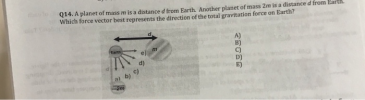 Q14. A planet of mass m is a distance d from Earth. Another planet of mass 2m is a distance d from Earth. Which force vector best represents the direction of the total gravitation force on Earth? A) B) C) D) E) d) c) al b)
An astronaut weighs 850 N on the Earth’s surface. When the astronaut lands on Planet X,...
An astronaut weighs 850 N on the Earth’s surface. When the astronaut lands on Planet X, she weighs 190 N. To the nearest tenth of a m/s2, what is the acceleration of gravity on Planet X? (hint: first find her mass!) An elevator car loaded with two passengers has a mass of 1200 kg. What tension must be applied by the elevator cable to give the car an acceleration of 1 m/s2 upward? Round your answer to the nearest newton....
A planet of mass 5 x 1024 kg is at location <5 x 10¹¹, -4 x...
 A planet of mass 5 x 1024 kg is at location <5 x 10¹¹, -4 x 10¹¹, 0> m. A star of mass 9 x 1030 kg is at location <-6 x 10¹¹, 9 1011, 0> m. It will be useful to draw a diagram of the situation, including the relevant vectors. (a) What is the relative position vector pointing from the planet to the star? (b) What is the distance between the planet and the star? (c) what is...
Planet X of mass mx = 6.3 × 1024 kg orbits S in uniform circular motion...
 Planet X of mass mx = 6.3 × 1024 kg orbits
S in uniform circular motion at a distance rx and with a
period Px = 1.5 years (=4.7304 × 10⁷ s). The
mass of the star S is MS = 2 × 1031
kg and its radius is RS = 4.2 × 10⁸ m, as
shown in the figure.
1) What is rx, the orbital radius of Planet X around
the Sun?
a) rx = 4.21 × 10⁹ m...
Planet X of mass mx = 6.3 × 1024 kg orbits
S in uniform circular motion at a distance rx and with a
period Px = 1.5 years (=4.7304 × 10⁷ s). The
mass of the star S is MS = 2 × 1031
kg and its radius is RS = 4.2 × 10⁸ m, as
shown in the figure.
1) What is rx, the orbital radius of Planet X around
the Sun?
a) rx = 4.21 × 10⁹ m...
Problem 3.13 A planet of mass 3 x 10⁴ kg is at location <6 x 101,...
 Problem 3.13 A planet of mass 3 x 10⁴ kg is at location <6 x 101, s 101, 0 m. A star of mass 9 x 100 kg is at location <3 x 10¹¹ 8 x 10, 0> m. wil be useful to draw a diagram of the situation, including the relevant vectors (a) What is the relative position vector 7 pointing from the planet to the star? (b) What is the distance between the planet and the star? 1기...
Two perfectly matched athletes on level ground are pulling opposite ends of a rope in a...
Two perfectly matched athletes on level ground are pulling opposite ends of a rope in a tug of war. Each athlete can pull with a force of 200 pounds. The rope is not accelerating because to have the required strength the mass of the rope is very large each athlete is only able to apply a tiny force on the rope the athletes apply equal and opposite forces on the rope and the net force on the rope is zero
Consider two celestial bodies separated by a distance of 7.05x10⁹ meters. The mass of one body...
Consider two celestial bodies separated by a distance of 7.05x10⁹ meters. The mass of one body is 4.28x10⁶ kg and the mass of the other body is 7.82x10⁶ kg. Determine the distance (in meters) from the 4.28x10⁶-kg body at which the net gravitational force on an object will be zero. Consider entering your answer using scientific notation.
Put two point charges on the same x (or y) axis, some distance apart, but fixed...
Put two point charges on the same x (or y) axis, some distance apart, but fixed in place (immovable). One is positive, the other is negative, but their magnitudes are unequal. No other charges are nearby these two. There are two positions the same x (or y) axis where the net electric potential due to these two charges is zero. The question below can be answered for either position, but doesn't have to be answered for both. Question: choose one...
 Q14. A planet of mass m is a distance d from Earth. Another planet of mass 2m is a distance d from Earth. Which force vector best represents the direction of the total gravitation force on Earth? A) B) C) D) E) d) c) al b)
 A planet of mass 5 x 1024 kg is at location <5 x 10¹¹, -4 x 10¹¹, 0> m. A star of mass 9 x 1030 kg is at location <-6 x 10¹¹, 9 1011, 0> m. It will be useful to draw a diagram of the situation, including the relevant vectors. (a) What is the relative position vector pointing from the planet to the star? (b) What is the distance between the planet and the star? (c) what is...
 Planet X of mass mx = 6.3 × 1024 kg orbits
S in uniform circular motion at a distance rx and with a
period Px = 1.5 years (=4.7304 × 10⁷ s). The
mass of the star S is MS = 2 × 1031
kg and its radius is RS = 4.2 × 10⁸ m, as
shown in the figure.
1) What is rx, the orbital radius of Planet X around
the Sun?
a) rx = 4.21 × 10⁹ m...
Planet X of mass mx = 6.3 × 1024 kg orbits
S in uniform circular motion at a distance rx and with a
period Px = 1.5 years (=4.7304 × 10⁷ s). The
mass of the star S is MS = 2 × 1031
kg and its radius is RS = 4.2 × 10⁸ m, as
shown in the figure.
1) What is rx, the orbital radius of Planet X around
the Sun?
a) rx = 4.21 × 10⁹ m...
 Problem 3.13 A planet of mass 3 x 10⁴ kg is at location <6 x 101, s 101, 0 m. A star of mass 9 x 100 kg is at location <3 x 10¹¹ 8 x 10, 0> m. wil be useful to draw a diagram of the situation, including the relevant vectors (a) What is the relative position vector 7 pointing from the planet to the star? (b) What is the distance between the planet and the star? 1기...
Most questions answered within 3 hours.
-
Where is the error in this code sequence?
String s1 = "Hello";
String s2 = "ello";...
asked 10 months ago -
Financial data for Joel de Paris, Inc., for last year
follow:
Joel de Paris, Inc.
Balance...
asked 10 months ago -
Consider this reaction:
Al2(SO4)3 (aq)+ BaCl3
(aq) Al2Cl6 (aq)- +
3BaSO4(s) . What is the...
asked 10 months ago -
Suppose that Savneet is considering increasing her
recent random sample from 20 car rentals to 40...
asked 10 months ago -
Trucks arrive at an unloading terminal at an average rate of 120
per hour.
Trucks arrive...
asked 10 months ago -
Why are methanol and ethanol completely soluble in water while
octanol is not very little soluble....
asked 10 months ago -
A facilities manager at a university reads in a research report
that the mean amount of...
asked 10 months ago -
When the CuSO4 is rehydrated by adding water to the anhydrous
compound, is this an endothermic...
asked 10 months ago -
A ray of sunlight is passing from diamond into crown glass; the
angle of incidence is...
asked 10 months ago -
A block of mass 0.249 kg is placed on top of a light, vertical
spring of...
asked 10 months ago -
how do the kidneys compensate in the presences of acidosis
a) trigger hyperventilate
b) reserve acid...
asked 10 months ago -
Question 501 pts
The rental rate of capital to the firm increases. Which of the
following...
asked 10 months ago