A horizontal metal bar of mass mm and length LL is vertically suspended from two conducting...
A horizontal metal bar of mass mm and length LL is vertically suspended from two conducting wires, as shown in the figure(Figure 1). A uniform magnetic field of magnitude BB points vertically downward.
Find the angle θθ the suspending wires make with the vertical when the bar carries a current II
Express your answer in terms of the variables m, L, B, I
Theta=
Homework Answers

Add Answer to:
A horizontal metal bar of mass mm and length LL is vertically
suspended from two conducting...
A Bar Suspended by Two Wires Part A A nonuniform, horizontal bar of mass m is...
 A Bar Suspended by Two Wires Part A A nonuniform, horizontal bar of mass m is supported by two massless wires against gravity. The left wire makes an angle φ1 with the horizontal, and the right wire makes an angle φ2 The bar has length L (Figure 1) Find the position of the center of mass of the bar, , measured from the bar's left end. Express the center of mass in terms of L, φ1 , and φ2 Hints...
A conducting bar of mass m is placed on two long conducting rails
A conducting bar of mass m is placed on two long conducting rails a distance l apart. The rails are inclined at an angle theta with respect to the horizontal, andthe bar is able to slide on the rails with negligible friction. The bar and rails are in a uniform and constant magnetic field of magnitude B orientedperpendicular to the incline. A resistor of resistance R connects the upper ends of the rails and completes the circuit as shown. The...
A conducting bar, having a mass per unit length of 0.0400 kg/m, is suspended by two...
 A conducting bar, having a mass per unit length of 0.0400 kg/m, is suspended by two flexible conductive wires of negligible mass, hanging from the ceiling (insulated) as shown below, What is the magnitude and direction of the current, I, that must exist in the conductor for the tension in the supporting wires to be zero when the magnetic field is 3.60 T into the page? If the resistance of the conductor is 0.200 ohm, what is the emf in...
A mobile consisting of a horizontal bar of length 70cm and negligible mass from which two...
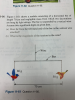 A mobile consisting of a horizontal bar of length 70cm and
negligible mass from which two decorations are hung up by light
strings. The bar is suspended by a vertical wire. Assume two
significant digits in the given data.
a) How far from the left-hand end of the wire is the vertical
wire attached?
b) What is the magnitude of the tension in the wire?
Figure 11-60 Question 11-55. 1-56 Figure 11-61 shows a mobile consisting of a horizontal bar...
A mobile consisting of a horizontal bar of length 70cm and
negligible mass from which two decorations are hung up by light
strings. The bar is suspended by a vertical wire. Assume two
significant digits in the given data.
a) How far from the left-hand end of the wire is the vertical
wire attached?
b) What is the magnitude of the tension in the wire?
Figure 11-60 Question 11-55. 1-56 Figure 11-61 shows a mobile consisting of a horizontal bar...
A metal crossbar of mass m=1kg rides on a parallel pair of long horizontal conducting rails...
 A metal crossbar of mass m=1kg rides on a parallel pair of long
horizontal conducting rails separated by a distance L=1m and
connected to a device that supplies constant current I=1A to the
circuit. The rails are frictionless but tilted upward so that they
make an angle ?=30 with the horizontal. The magnetic field is
directed vertically downward. What minimum value of B is needed to
keep the bar from sliding down the rails? (Hint: consider the
gravity of the...
A metal crossbar of mass m=1kg rides on a parallel pair of long
horizontal conducting rails separated by a distance L=1m and
connected to a device that supplies constant current I=1A to the
circuit. The rails are frictionless but tilted upward so that they
make an angle ?=30 with the horizontal. The magnetic field is
directed vertically downward. What minimum value of B is needed to
keep the bar from sliding down the rails? (Hint: consider the
gravity of the...
A uniform rod of mass M and length 2l stands vertically on a rough horizontal floor...
 A uniform rod of mass M and length 2l stands vertically on a
rough horizontal floor and is allowed to fall. Assuming that
slipping has not occured, evaluate the angular speed of the rod
when the rod makes an angle of theta with the vertical. if the
slipping occurs when the rod is at theta=30 degrees with respect to
vertical, calculate the value of the coefficient of static
friction.
A uniform rod of mass Mand length 21 stands vertically on...
A uniform rod of mass M and length 2l stands vertically on a
rough horizontal floor and is allowed to fall. Assuming that
slipping has not occured, evaluate the angular speed of the rod
when the rod makes an angle of theta with the vertical. if the
slipping occurs when the rod is at theta=30 degrees with respect to
vertical, calculate the value of the coefficient of static
friction.
A uniform rod of mass Mand length 21 stands vertically on...
A conducting rod with length L, is to slide without friction on horizontal infinitely long metal...
 A conducting rod with length L, is to slide without friction on horizontal infinitely long metal rails connected through resistance R as show in Fig. uniform magnetic field B is directed out of the plane of the figure. What is the applied force F required to move the bar to the right with a constant speed At what rate is energy dissipated in the resistor R?
A conducting rod of length script i moves on two horizontal frictionless rails, as in the...
A conducting rod of length script i moves on two horizontal frictionless rails, as in the figure below. A constant force of magnitude 3.00 N moves the bar at a uniform speed of 9.00 m/s through a magnetic field vector B that is directed into the page.
An Electromagnetic Rail Gun. A conducting bar with mass m and length L slides over horizontal...
An Electromagnetic Rail Gun. A conducting bar with mass m and length L slides over horizontal rails that are connected to a voltage source. The voltage source maintains a constant current I in the rails and bar, and a constant, uniform, vertical magnetic field B fills the region between the rails (see the figure Part C It has been suggested that rail guns based on this principle could accelerate payloads into earth orbit or beyond. Find the distance the bar...
As shown in the figure, two frictionless conducting rails (#1 and #2) are attached to a...
 As shown in the figure, two frictionless conducting rails (#1 and #2) are attached to a 20.0° incline such that the inside edges are 80.0 cm apart. A copper bar with a mass of 0.237 kg slides (without friction) at a constant speed down the conducting rails. Sliding bar Conducting rails If there is a vertical magnetic field of 0.0406 T in magnitude in the region of the incline, determine the magnitude of the current I that flows through the...
 A Bar Suspended by Two Wires Part A A nonuniform, horizontal bar of mass m is supported by two massless wires against gravity. The left wire makes an angle φ1 with the horizontal, and the right wire makes an angle φ2 The bar has length L (Figure 1) Find the position of the center of mass of the bar, , measured from the bar's left end. Express the center of mass in terms of L, φ1 , and φ2 Hints...
 A conducting bar, having a mass per unit length of 0.0400 kg/m, is suspended by two flexible conductive wires of negligible mass, hanging from the ceiling (insulated) as shown below, What is the magnitude and direction of the current, I, that must exist in the conductor for the tension in the supporting wires to be zero when the magnetic field is 3.60 T into the page? If the resistance of the conductor is 0.200 ohm, what is the emf in...
 A mobile consisting of a horizontal bar of length 70cm and
negligible mass from which two decorations are hung up by light
strings. The bar is suspended by a vertical wire. Assume two
significant digits in the given data.
a) How far from the left-hand end of the wire is the vertical
wire attached?
b) What is the magnitude of the tension in the wire?
Figure 11-60 Question 11-55. 1-56 Figure 11-61 shows a mobile consisting of a horizontal bar...
A mobile consisting of a horizontal bar of length 70cm and
negligible mass from which two decorations are hung up by light
strings. The bar is suspended by a vertical wire. Assume two
significant digits in the given data.
a) How far from the left-hand end of the wire is the vertical
wire attached?
b) What is the magnitude of the tension in the wire?
Figure 11-60 Question 11-55. 1-56 Figure 11-61 shows a mobile consisting of a horizontal bar...
 A metal crossbar of mass m=1kg rides on a parallel pair of long
horizontal conducting rails separated by a distance L=1m and
connected to a device that supplies constant current I=1A to the
circuit. The rails are frictionless but tilted upward so that they
make an angle ?=30 with the horizontal. The magnetic field is
directed vertically downward. What minimum value of B is needed to
keep the bar from sliding down the rails? (Hint: consider the
gravity of the...
A metal crossbar of mass m=1kg rides on a parallel pair of long
horizontal conducting rails separated by a distance L=1m and
connected to a device that supplies constant current I=1A to the
circuit. The rails are frictionless but tilted upward so that they
make an angle ?=30 with the horizontal. The magnetic field is
directed vertically downward. What minimum value of B is needed to
keep the bar from sliding down the rails? (Hint: consider the
gravity of the...
 A uniform rod of mass M and length 2l stands vertically on a
rough horizontal floor and is allowed to fall. Assuming that
slipping has not occured, evaluate the angular speed of the rod
when the rod makes an angle of theta with the vertical. if the
slipping occurs when the rod is at theta=30 degrees with respect to
vertical, calculate the value of the coefficient of static
friction.
A uniform rod of mass Mand length 21 stands vertically on...
A uniform rod of mass M and length 2l stands vertically on a
rough horizontal floor and is allowed to fall. Assuming that
slipping has not occured, evaluate the angular speed of the rod
when the rod makes an angle of theta with the vertical. if the
slipping occurs when the rod is at theta=30 degrees with respect to
vertical, calculate the value of the coefficient of static
friction.
A uniform rod of mass Mand length 21 stands vertically on...
 A conducting rod with length L, is to slide without friction on horizontal infinitely long metal rails connected through resistance R as show in Fig. uniform magnetic field B is directed out of the plane of the figure. What is the applied force F required to move the bar to the right with a constant speed At what rate is energy dissipated in the resistor R?
 As shown in the figure, two frictionless conducting rails (#1 and #2) are attached to a 20.0° incline such that the inside edges are 80.0 cm apart. A copper bar with a mass of 0.237 kg slides (without friction) at a constant speed down the conducting rails. Sliding bar Conducting rails If there is a vertical magnetic field of 0.0406 T in magnitude in the region of the incline, determine the magnitude of the current I that flows through the...
Most questions answered within 3 hours.
-
Where is the error in this code sequence?
String s1 = "Hello";
String s2 = "ello";...
asked 11 months ago -
Financial data for Joel de Paris, Inc., for last year
follow:
Joel de Paris, Inc.
Balance...
asked 11 months ago -
Consider this reaction:
Al2(SO4)3 (aq)+ BaCl3
(aq) Al2Cl6 (aq)- +
3BaSO4(s) . What is the...
asked 11 months ago -
Suppose that Savneet is considering increasing her
recent random sample from 20 car rentals to 40...
asked 11 months ago -
Trucks arrive at an unloading terminal at an average rate of 120
per hour.
Trucks arrive...
asked 11 months ago -
Why are methanol and ethanol completely soluble in water while
octanol is not very little soluble....
asked 11 months ago -
A facilities manager at a university reads in a research report
that the mean amount of...
asked 11 months ago -
When the CuSO4 is rehydrated by adding water to the anhydrous
compound, is this an endothermic...
asked 11 months ago -
A ray of sunlight is passing from diamond into crown glass; the
angle of incidence is...
asked 11 months ago -
A block of mass 0.249 kg is placed on top of a light, vertical
spring of...
asked 11 months ago -
how do the kidneys compensate in the presences of acidosis
a) trigger hyperventilate
b) reserve acid...
asked 11 months ago -
Question 501 pts
The rental rate of capital to the firm increases. Which of the
following...
asked 11 months ago