Graphically depict the long-run graph for a purely competitive structure. Graphs and explanation required
Graphically depict the long-run graph for a purely competitive structure. Graphs and explanation required
Homework Answers
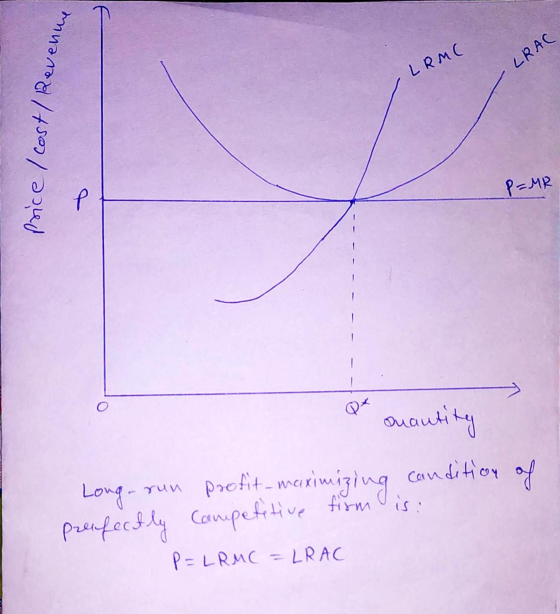
The long-run average total cost curve will be horizontal at the profit-maximizing condition because 5long-run profit-maximizing condition of perfectly competitive firm is
P=LRMC=LRATC
Since in perfect competition there is free entry and exit in long-run.
The LRAC is U shaped and LRMC cuts LRATC curve at its minimum point and LRATC curve is tangent on the price line.
As it can be seen in the diagram that LRMC, ATC curve and current price P are equal at this point and therefore profit-maximizing quantity in the long-run is Q* units.
All has been shown in the below diagram.
Add Answer to:
Graphically depict the long-run graph for a purely competitive
structure. Graphs and explanation required
Graphically depict the long-run graph for a purely competitive structure. Graphs and explanation required.
Graphically depict the long-run graph for a purely competitive structure. Graphs and explanation required.
MC 0 Firm Industry The accompanying graphs are for a purely competitive market in the short run. The graphs suggest tha...
 MC 0 Firm Industry The accompanying graphs are for a purely competitive market in the short run. The graphs suggest that in the long run, as automatic market adjustments occur, the demand curve facing the individual firm will Multiple Choice shift up. shift down. not shift. slope downward.
MC 0 Firm Industry The accompanying graphs are for a purely competitive market in the short run. The graphs suggest that in the long run, as automatic market adjustments occur, the demand...
MC 0 Firm Industry The accompanying graphs are for a purely competitive market in the short run. The graphs suggest that in the long run, as automatic market adjustments occur, the demand curve facing the individual firm will Multiple Choice shift up. shift down. not shift. slope downward.
MC 0 Firm Industry The accompanying graphs are for a purely competitive market in the short run. The graphs suggest that in the long run, as automatic market adjustments occur, the demand...
1) Compare the characteristics of the monopolistically competitive structure to the purely competitive structure? What is...
1) Compare the characteristics of the monopolistically competitive structure to the purely competitive structure? What is the result of the differences in the long run? Why?
Long-Run economics: graphically represent long run curves: LMC, LAC in perfectly competitive product market and imperfect...
Long-Run economics: graphically represent long run curves: LMC, LAC in perfectly competitive product market and imperfect product market. Show the economies of scale and diseconomies of scale graphically.
Question: Why in the long run, the purely competitive firm in a constant cost industry achieves...
Question: Why in the long run, the purely competitive firm in a constant cost industry achieves only normal profits? Select one: a. New firms entering the industry increase supply, reduce price and squeeze out the the economic profit. b. In the long run, normal profit is not the only situation that can face a purely competitive firm . c. New firms entering the industry do not affect supply since they divide up the existinng market, but costs to the firm...
The accompanying graphs represent the market for soybeans, a perfectly (purely) competitive market, and Roy's Soys,...
 The accompanying graphs represent the market for soybeans, a perfectly (purely) competitive market, and Roy's Soys, an individual firm in the market for soybeans. The market and the firm are currently in long-run equilibrium at point A. Soybean market Roy's Soys 20 20 Price 2 B Price 3T Short-run supply 18- 17 16 15 17 15 13 12 13 12 Average total cost ng-run supply Price 4 4 3- 3- Demand 0 1 2 3 4 5 67 8 9...
Below is a graph of an individual firm in a perfectly (purely) competitive industry. Adjust the...
 Below is a graph of an individual firm in a perfectly (purely) competitive industry. Adjust the horizontal Price line to show the market's long-run equilibrium price, Place the black dot labeled E at the price and quantity the firm will produce.For the firm in perfect competition, several variables converge and are equal at long-run equilibrium Place in the bin everything that is equal at point E
What's wrong with the following statements? Long run equilibrium for a purely competitive firm shows that...
What's wrong with the following statements? Long run equilibrium for a purely competitive firm shows that in economics, the profit-maximizing interests of entrepreneurs are more highly valued than the interests of consumers and labor.
Draw the MC, MR, ATC, and long-run ATC curves for a perfectly competitive firm in long-run...
Draw the MC, MR, ATC, and long-run ATC curves for a perfectly competitive firm in long-run equilibrium. Explain the relationship between those curves. Next, draw another graph showing long-run equilibrium for the perfectly competitive market. What is the relationship between the two graphs?
In the long run in a purely competitive industry, (select only one correct answer). entry and...
In the long run in a purely competitive industry, (select only one correct answer). entry and exit of firms can occur. firms do not have sufficient time to liquidate their assets. plant size is fixed. the industry is composed of a specific number of firms.
 MC 0 Firm Industry The accompanying graphs are for a purely competitive market in the short run. The graphs suggest that in the long run, as automatic market adjustments occur, the demand curve facing the individual firm will Multiple Choice shift up. shift down. not shift. slope downward.
MC 0 Firm Industry The accompanying graphs are for a purely competitive market in the short run. The graphs suggest that in the long run, as automatic market adjustments occur, the demand...
MC 0 Firm Industry The accompanying graphs are for a purely competitive market in the short run. The graphs suggest that in the long run, as automatic market adjustments occur, the demand curve facing the individual firm will Multiple Choice shift up. shift down. not shift. slope downward.
MC 0 Firm Industry The accompanying graphs are for a purely competitive market in the short run. The graphs suggest that in the long run, as automatic market adjustments occur, the demand...
 The accompanying graphs represent the market for soybeans, a perfectly (purely) competitive market, and Roy's Soys, an individual firm in the market for soybeans. The market and the firm are currently in long-run equilibrium at point A. Soybean market Roy's Soys 20 20 Price 2 B Price 3T Short-run supply 18- 17 16 15 17 15 13 12 13 12 Average total cost ng-run supply Price 4 4 3- 3- Demand 0 1 2 3 4 5 67 8 9...
 Below is a graph of an individual firm in a perfectly (purely) competitive industry. Adjust the horizontal Price line to show the market's long-run equilibrium price, Place the black dot labeled E at the price and quantity the firm will produce.For the firm in perfect competition, several variables converge and are equal at long-run equilibrium Place in the bin everything that is equal at point E
Most questions answered within 3 hours.
-
Where is the error in this code sequence?
String s1 = "Hello";
String s2 = "ello";...
asked 10 months ago -
Financial data for Joel de Paris, Inc., for last year
follow:
Joel de Paris, Inc.
Balance...
asked 10 months ago -
Consider this reaction:
Al2(SO4)3 (aq)+ BaCl3
(aq) Al2Cl6 (aq)- +
3BaSO4(s) . What is the...
asked 10 months ago -
Suppose that Savneet is considering increasing her
recent random sample from 20 car rentals to 40...
asked 10 months ago -
Trucks arrive at an unloading terminal at an average rate of 120
per hour.
Trucks arrive...
asked 10 months ago -
Why are methanol and ethanol completely soluble in water while
octanol is not very little soluble....
asked 10 months ago -
A facilities manager at a university reads in a research report
that the mean amount of...
asked 10 months ago -
When the CuSO4 is rehydrated by adding water to the anhydrous
compound, is this an endothermic...
asked 10 months ago -
A ray of sunlight is passing from diamond into crown glass; the
angle of incidence is...
asked 10 months ago -
A block of mass 0.249 kg is placed on top of a light, vertical
spring of...
asked 10 months ago -
how do the kidneys compensate in the presences of acidosis
a) trigger hyperventilate
b) reserve acid...
asked 10 months ago -
Question 501 pts
The rental rate of capital to the firm increases. Which of the
following...
asked 10 months ago