Determine the real amplitude A such that 4 cos(70πt + 2π/3) + A cos(70πt − π/6)...
Determine the real amplitude A such that 4 cos(70πt + 2π/3) + A cos(70πt − π/6) = C cos(70πt)
Homework Answers

Add Answer to:
Determine the real amplitude A such that 4 cos(70πt + 2π/3) + A
cos(70πt − π/6)...
Solve 2cos0+4 = -6cOs 6 on the interval 0<θ< Σπ. π π. 2π 0, π. 2π...
 Solve 2cos0+4 = -6cOs 6 on the interval 0<θ< Σπ. π π. 2π 0, π. 2π π3Τ 2 4
Supposez1 =4 cos 3 +isin 3 andz2 =2 cos 6 +isin 6 . Computez1z2. (a) 8(cos?π?+isin?π?)...
 Supposez1 =4 cos 3 +isin 3 andz2 =2 cos 6 +isin 6 .
Computez1z2.
(a) 8(cos?π?+isin?π?) 22
(b) 4(cos?4π?+isin?4π?) 66
(c) 2(cos?π?+isin?π?) 66
(d) cos(π)+isin(π)
(e) 8(cos?π?+isin?π?)
66
17. Suppose z1 = 4 (cos (1) + i sin (5)) and z2 = 2 (cos () + i sin (7)). Compute z122. (a) 8(cos (7) + i sin (7)) (b) 4(cos (4) + i sin (*)) (c) 2(cos (7) + i sin ()) (d) cos(T) + i sin(TT) (e) 8(cos (7)...
Supposez1 =4 cos 3 +isin 3 andz2 =2 cos 6 +isin 6 .
Computez1z2.
(a) 8(cos?π?+isin?π?) 22
(b) 4(cos?4π?+isin?4π?) 66
(c) 2(cos?π?+isin?π?) 66
(d) cos(π)+isin(π)
(e) 8(cos?π?+isin?π?)
66
17. Suppose z1 = 4 (cos (1) + i sin (5)) and z2 = 2 (cos () + i sin (7)). Compute z122. (a) 8(cos (7) + i sin (7)) (b) 4(cos (4) + i sin (*)) (c) 2(cos (7) + i sin ()) (d) cos(T) + i sin(TT) (e) 8(cos (7)...
3. An amplitude-modulated (AM) signal is given by s(t)-[12+7cos(π-π/3)]cos(13m). (a) Express s(t) in the form of...
 3. An amplitude-modulated (AM) signal is given by s(t)-[12+7cos(π-π/3)]cos(13m). (a) Express s(t) in the form of A cos( +4)-A, cos(o,t + φ2) + A3 cos(wyt + φ3). (b) Sketch the amplitude and phase spectra of s(t)
Problem 4 -π/3) in quadrature form. 2π A) Express the function Y1 = (2 m) sin(...
 Problem 4 -π/3) in quadrature form. 2π A) Express the function Y1 = (2 m) sin( 5-x B) Express the function y3=(4m)cos(10-)-(2m) sin( nx) incosine form. 10 in sine form. C) Express the function y3= (4 m) cos(nz)-(2 m) sin(nz) in sine form. C) Express the function y3= (4 m) cos(-x )-(2 m) sin(-x
2. Set n 100 and generate and plot the time series xt 2 cos(2π.06t) + 3 sin(2π.06t) Ý,-4 cos(2n. ...
 Time series analysis
2. Set n 100 and generate and plot the time series xt 2 cos(2π.06t) + 3 sin(2π.06t) Ý,-4 cos(2n. 10t) + 5 sin(2m10) z, 6 cos(2π·40t) + 7 sin(2π·40t) (a) Use the periodogram function in R to plot the periodogram of Vi. Can you explain the spikes? (b) Now let wi ~ N(0, 25) be iid and plot the periodogram of the series V +w. Does it still pick out the periodic components?
2. Set n 100...
Time series analysis
2. Set n 100 and generate and plot the time series xt 2 cos(2π.06t) + 3 sin(2π.06t) Ý,-4 cos(2n. 10t) + 5 sin(2m10) z, 6 cos(2π·40t) + 7 sin(2π·40t) (a) Use the periodogram function in R to plot the periodogram of Vi. Can you explain the spikes? (b) Now let wi ~ N(0, 25) be iid and plot the periodogram of the series V +w. Does it still pick out the periodic components?
2. Set n 100...
Decompose the signal s(t) = 5cos(2t) • cos(3t + π/4) into a linear combination and determine...
Decompose the signal s(t) = 5cos(2t) • cos(3t + π/4) into a linear combination and determine the amplitude, frequency, and phase shift of each component after decomposition. (Show all work and explain why.) Be Neat Please.
Properties of Damped Oscillations For Problems 1-4, determine the damped amplitude, the damped na...
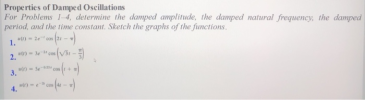 Question 4 please!
Properties of Damped Oscillations For Problems 1-4, determine the damped amplitude, the damped natural frequency, the damped period, and the time constant. Sketch the graphs of the functions. 1. m(t)-5e-oas , cos (r + π 3. 4.
Properties of Damped Oscillations For Problems 1-4, determine the damped amplitude, the damped natural frequency, the damped period, and the time constant. Sketch the graphs of the functions. 1. m(t)-5e-oas , cos (r + π 3. 4.
Question 4 please!
Properties of Damped Oscillations For Problems 1-4, determine the damped amplitude, the damped natural frequency, the damped period, and the time constant. Sketch the graphs of the functions. 1. m(t)-5e-oas , cos (r + π 3. 4.
Properties of Damped Oscillations For Problems 1-4, determine the damped amplitude, the damped natural frequency, the damped period, and the time constant. Sketch the graphs of the functions. 1. m(t)-5e-oas , cos (r + π 3. 4.
For each of the periodic signals in Fig. P3.4-3, find the exponential Fourier series and sketch the corresponding spectra. 3.5-1 4 Fig. P3.4-3 /2 1 x(t) 1/ 2 0l -2π -π 2π Fig. P3.4-4 II x(t) -2π 0l...
 For each of the periodic signals in Fig. P3.4-3, find the exponential Fourier series and sketch the corresponding spectra. 3.5-1 4 Fig. P3.4-3 /2 1 x(t) 1/ 2 0l -2π -π 2π Fig. P3.4-4 II x(t) -2π 0l t/2
For each of the periodic signals in Fig. P3.4-3, find the exponential Fourier series and sketch the corresponding spectra. 3.5-1
4 Fig. P3.4-3 /2 1 x(t) 1/ 2 0l -2π -π 2π Fig. P3.4-4 II x(t) -2π 0l t/2
For each of the periodic signals in Fig. P3.4-3, find the exponential Fourier series and sketch the corresponding spectra. 3.5-1 4 Fig. P3.4-3 /2 1 x(t) 1/ 2 0l -2π -π 2π Fig. P3.4-4 II x(t) -2π 0l t/2
For each of the periodic signals in Fig. P3.4-3, find the exponential Fourier series and sketch the corresponding spectra. 3.5-1
4 Fig. P3.4-3 /2 1 x(t) 1/ 2 0l -2π -π 2π Fig. P3.4-4 II x(t) -2π 0l t/2
The following equation describes a wave due to the interference of two waves with the same...
The following equation describes a wave due to the interference of two waves with the same amplitude and wave number, but offset by a phase difference ϕ. D(x,t)=2A cos(ϕ/2)sin(kx−ωt+ϕ/2) What is the phase difference if the amplitude of the resultant wave is A? A. π/6 B. π/4 C. π/3 D. π/2 E. 2π/3 F. π G. 2π
Q1) Given an analog signal X(t) = 3 cos (2π . 2000t) + 2 cos (2π...
Q1) Given an analog signal X(t) = 3 cos (2π . 2000t) + 2 cos (2π . 5500t) sampled at a rate of 10,000 Hz, a. Sketch the spectrum of the sampled signal up to 20 kHz; b. Sketch the recovered analog signal spectrum if an ideal lowpass filter with a cutoff frequency of 4 kHz is used to filter the sampled signal in order to recover the original signal ; c. Determine the frequency/frequencies of aliasing noise . Q2)...
 Solve 2cos0+4 = -6cOs 6 on the interval 0<θ< Σπ. π π. 2π 0, π. 2π π3Τ 2 4
 Supposez1 =4 cos 3 +isin 3 andz2 =2 cos 6 +isin 6 .
Computez1z2.
(a) 8(cos?π?+isin?π?) 22
(b) 4(cos?4π?+isin?4π?) 66
(c) 2(cos?π?+isin?π?) 66
(d) cos(π)+isin(π)
(e) 8(cos?π?+isin?π?)
66
17. Suppose z1 = 4 (cos (1) + i sin (5)) and z2 = 2 (cos () + i sin (7)). Compute z122. (a) 8(cos (7) + i sin (7)) (b) 4(cos (4) + i sin (*)) (c) 2(cos (7) + i sin ()) (d) cos(T) + i sin(TT) (e) 8(cos (7)...
Supposez1 =4 cos 3 +isin 3 andz2 =2 cos 6 +isin 6 .
Computez1z2.
(a) 8(cos?π?+isin?π?) 22
(b) 4(cos?4π?+isin?4π?) 66
(c) 2(cos?π?+isin?π?) 66
(d) cos(π)+isin(π)
(e) 8(cos?π?+isin?π?)
66
17. Suppose z1 = 4 (cos (1) + i sin (5)) and z2 = 2 (cos () + i sin (7)). Compute z122. (a) 8(cos (7) + i sin (7)) (b) 4(cos (4) + i sin (*)) (c) 2(cos (7) + i sin ()) (d) cos(T) + i sin(TT) (e) 8(cos (7)...
 3. An amplitude-modulated (AM) signal is given by s(t)-[12+7cos(π-π/3)]cos(13m). (a) Express s(t) in the form of A cos( +4)-A, cos(o,t + φ2) + A3 cos(wyt + φ3). (b) Sketch the amplitude and phase spectra of s(t)
 Problem 4 -π/3) in quadrature form. 2π A) Express the function Y1 = (2 m) sin( 5-x B) Express the function y3=(4m)cos(10-)-(2m) sin( nx) incosine form. 10 in sine form. C) Express the function y3= (4 m) cos(nz)-(2 m) sin(nz) in sine form. C) Express the function y3= (4 m) cos(-x )-(2 m) sin(-x
 Time series analysis
2. Set n 100 and generate and plot the time series xt 2 cos(2π.06t) + 3 sin(2π.06t) Ý,-4 cos(2n. 10t) + 5 sin(2m10) z, 6 cos(2π·40t) + 7 sin(2π·40t) (a) Use the periodogram function in R to plot the periodogram of Vi. Can you explain the spikes? (b) Now let wi ~ N(0, 25) be iid and plot the periodogram of the series V +w. Does it still pick out the periodic components?
2. Set n 100...
Time series analysis
2. Set n 100 and generate and plot the time series xt 2 cos(2π.06t) + 3 sin(2π.06t) Ý,-4 cos(2n. 10t) + 5 sin(2m10) z, 6 cos(2π·40t) + 7 sin(2π·40t) (a) Use the periodogram function in R to plot the periodogram of Vi. Can you explain the spikes? (b) Now let wi ~ N(0, 25) be iid and plot the periodogram of the series V +w. Does it still pick out the periodic components?
2. Set n 100...
 Question 4 please!
Properties of Damped Oscillations For Problems 1-4, determine the damped amplitude, the damped natural frequency, the damped period, and the time constant. Sketch the graphs of the functions. 1. m(t)-5e-oas , cos (r + π 3. 4.
Properties of Damped Oscillations For Problems 1-4, determine the damped amplitude, the damped natural frequency, the damped period, and the time constant. Sketch the graphs of the functions. 1. m(t)-5e-oas , cos (r + π 3. 4.
Question 4 please!
Properties of Damped Oscillations For Problems 1-4, determine the damped amplitude, the damped natural frequency, the damped period, and the time constant. Sketch the graphs of the functions. 1. m(t)-5e-oas , cos (r + π 3. 4.
Properties of Damped Oscillations For Problems 1-4, determine the damped amplitude, the damped natural frequency, the damped period, and the time constant. Sketch the graphs of the functions. 1. m(t)-5e-oas , cos (r + π 3. 4.
 For each of the periodic signals in Fig. P3.4-3, find the exponential Fourier series and sketch the corresponding spectra. 3.5-1 4 Fig. P3.4-3 /2 1 x(t) 1/ 2 0l -2π -π 2π Fig. P3.4-4 II x(t) -2π 0l t/2
For each of the periodic signals in Fig. P3.4-3, find the exponential Fourier series and sketch the corresponding spectra. 3.5-1
4 Fig. P3.4-3 /2 1 x(t) 1/ 2 0l -2π -π 2π Fig. P3.4-4 II x(t) -2π 0l t/2
For each of the periodic signals in Fig. P3.4-3, find the exponential Fourier series and sketch the corresponding spectra. 3.5-1 4 Fig. P3.4-3 /2 1 x(t) 1/ 2 0l -2π -π 2π Fig. P3.4-4 II x(t) -2π 0l t/2
For each of the periodic signals in Fig. P3.4-3, find the exponential Fourier series and sketch the corresponding spectra. 3.5-1
4 Fig. P3.4-3 /2 1 x(t) 1/ 2 0l -2π -π 2π Fig. P3.4-4 II x(t) -2π 0l t/2
Most questions answered within 3 hours.
-
Where is the error in this code sequence?
String s1 = "Hello";
String s2 = "ello";...
asked 10 months ago -
Financial data for Joel de Paris, Inc., for last year
follow:
Joel de Paris, Inc.
Balance...
asked 10 months ago -
Consider this reaction:
Al2(SO4)3 (aq)+ BaCl3
(aq) Al2Cl6 (aq)- +
3BaSO4(s) . What is the...
asked 10 months ago -
Suppose that Savneet is considering increasing her
recent random sample from 20 car rentals to 40...
asked 10 months ago -
Trucks arrive at an unloading terminal at an average rate of 120
per hour.
Trucks arrive...
asked 10 months ago -
Why are methanol and ethanol completely soluble in water while
octanol is not very little soluble....
asked 10 months ago -
A facilities manager at a university reads in a research report
that the mean amount of...
asked 10 months ago -
When the CuSO4 is rehydrated by adding water to the anhydrous
compound, is this an endothermic...
asked 10 months ago -
A ray of sunlight is passing from diamond into crown glass; the
angle of incidence is...
asked 10 months ago -
A block of mass 0.249 kg is placed on top of a light, vertical
spring of...
asked 10 months ago -
how do the kidneys compensate in the presences of acidosis
a) trigger hyperventilate
b) reserve acid...
asked 10 months ago -
Question 501 pts
The rental rate of capital to the firm increases. Which of the
following...
asked 10 months ago