Most appropriate method for syntheses cyclopentanol --> 1-ethylcyclopentanol 1-methylcyclohexanol --> 2 methylcyclohexanone
Most appropriate method for syntheses
cyclopentanol --> 1-ethylcyclopentanol
1-methylcyclohexanol --> 2 methylcyclohexanone
Homework Answers

Add Answer to:
Most appropriate method for syntheses
cyclopentanol --> 1-ethylcyclopentanol
1-methylcyclohexanol --> 2 methylcyclohexanone
Which unknown from the list represents the NMR below: -cycloheptanol -1-methylcyclohexanol -cyclohexanol -cyclopentanol -4-methylcyclohexanol 0 0....
 Which unknown from the list represents the NMR below:
-cycloheptanol
-1-methylcyclohexanol
-cyclohexanol
-cyclopentanol
-4-methylcyclohexanol
0 0. 8 0.7 UK-D 0.6 0.5 0.4 0.3 0.2 abundance 0.1 0 90.0 80.0 70.0 60.0 50.0 10.0 190.0 180.0 170.0 160.0 150.0 140.0 130.0 120.0 110.0 100.0 132.3 X: parts per Million : 13C 40.0 323 30.0 20.0 298 27.5
Which unknown from the list represents the NMR below:
-cycloheptanol
-1-methylcyclohexanol
-cyclohexanol
-cyclopentanol
-4-methylcyclohexanol
0 0. 8 0.7 UK-D 0.6 0.5 0.4 0.3 0.2 abundance 0.1 0 90.0 80.0 70.0 60.0 50.0 10.0 190.0 180.0 170.0 160.0 150.0 140.0 130.0 120.0 110.0 100.0 132.3 X: parts per Million : 13C 40.0 323 30.0 20.0 298 27.5
8. Describe the best method for each of the following laboratory syntheses, given a single reactant....
 8. Describe the best method for each of the following laboratory syntheses, given a single reactant. Include why you chose this method in your description. a) 1-butanol converted to butanal b) 1-butanol converted to butanoic acid c) 2-butanol converted to 2-butanone d) 2-butene-1-ol converted to 2-butenal e) 2-butene-1-ol converted to 2-butenoic acid f) 1-methylcyclohexanol converted to 2-methlycyclohexanone (this is a multi-reaction process)
Which of the following compounds DO NOT contain a plane of symmetry? (i) cis-1,2-difluorocyclobutane (ii) (R)2-bromo-2-methylcyclohexanone...
Which of the following compounds DO NOT contain a plane of symmetry? (i) cis-1,2-difluorocyclobutane (ii) (R)2-bromo-2-methylcyclohexanone (iii) 4-bromocyclohexanol (iv) cis-3,4-dimethylcyclopentanone (v) 4-methylcyclohexanol
Construct a three-step synthesis of 1,2-epoxycyclopentane from cyclopentanol by dragging the appropriate formulas into the bins....
 Construct a three-step synthesis of 1,2-epoxycyclopentane from cyclopentanol by dragging the appropriate formulas into the bins. Note that each bin will hold only one item, and not all of the given reagents or structures will be used. Reactant Final Product (cyclopentanol) Reagent 1rightarrow Step 1 Product Reagent 2rightarrow Step 2 Product Reagent 3rightarrow (1,2-epoxycyclopentane)
Experiments Dehydration of 2-methylcyclohexanol Questions 1. Please answer this question on notebook paper, not in the...
 Experiments Dehydration of 2-methylcyclohexanol Questions 1. Please answer this question on notebook paper, not in the lab sometimes dimicult to read.) tebook (carbon copies are Consider the phosphoric acid-catalyzed dehydration of the following list of nine alcohols. Give the structure of each alcohol and that of the resultant alese. If a MIXTURE of alenes is anticipated. give both products and circle the major product (a) Cyclohexanol: (b) 1-methylcyclohexanol (c)2-methylcobecnold 3-methylcyclohexanol: (e) 4-methylcyclohexanol: (cyclopentanol (R) 3- canotth) 2-pentano: 0) 3-pentanol. 2....
Part 1: Predict which compound in each pair is more acidic. Explain your answers. a) cyclopentanol...
Part 1: Predict which compound in each pair is more acidic. Explain your answers. a) cyclopentanol or 3-clorophenol b) cyclohexanol or cyclohexantiol c) cyclohexanol or cyclohexanecarboxylic acid d) 2,2-dichlorobutan-1-ol or butan-1-ol Part 2: Predict which compound in each group is more soluble in water. Explain your answers. a) butan-1-ol, pentan-1-ol or propan-2-ol b) chlorocyclohexane, cyclohexanol or cyclohexane-1,2-diol c) phenol, cyclohexanol or 4-methylcyclohexanol
1. starting with 1-methylcyclohexene show synthesis of 2-methylcyclohexanone 2. show the major product for the reaction...
1. starting with 1-methylcyclohexene show synthesis of 2-methylcyclohexanone 2. show the major product for the reaction between Br2/FeBr3 and benzene. Additionally outline a detailed mechanism for the formation of the product.
For 1 - 3, design reasonable syntheses of each of the target molecules using the provided...
 For 1 - 3, design reasonable syntheses of each of the target molecules using the provided starting material and organic and inorganic reagents of your choice. Show the reagents needed for each step and the product of each step. Do not show any mechanisms. Please put all your answers on this sheet. Write your answers like this (actual number of starting steps may vary)material reagent(s) reagent(s) ABCD target Two equally reasonable routes are possible Can you find them both? (For...
PROBLEM 5 Show how you would convert 1-methylcyclopentanol to 2-methyl cyclopentanol
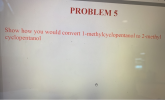 PROBLEM 5 Show how you would convert 1-methylcyclopentanol to 2-methyl cyclopentanol
syntheses 7-12. Syntheses: provide the product(s): он РСС , но* CH,Cl2 Brz 1. Brz/PBrg OH 2....
 syntheses
7-12. Syntheses: provide the product(s): он РСС , но* CH,Cl2 Brz 1. Brz/PBrg OH 2. H20 NaOH/HO 1. NaOCH2CH3 2. H307 1. (CH3CH2CH2)2Culi 2. Hz0
syntheses
7-12. Syntheses: provide the product(s): он РСС , но* CH,Cl2 Brz 1. Brz/PBrg OH 2. H20 NaOH/HO 1. NaOCH2CH3 2. H307 1. (CH3CH2CH2)2Culi 2. Hz0
 Which unknown from the list represents the NMR below:
-cycloheptanol
-1-methylcyclohexanol
-cyclohexanol
-cyclopentanol
-4-methylcyclohexanol
0 0. 8 0.7 UK-D 0.6 0.5 0.4 0.3 0.2 abundance 0.1 0 90.0 80.0 70.0 60.0 50.0 10.0 190.0 180.0 170.0 160.0 150.0 140.0 130.0 120.0 110.0 100.0 132.3 X: parts per Million : 13C 40.0 323 30.0 20.0 298 27.5
Which unknown from the list represents the NMR below:
-cycloheptanol
-1-methylcyclohexanol
-cyclohexanol
-cyclopentanol
-4-methylcyclohexanol
0 0. 8 0.7 UK-D 0.6 0.5 0.4 0.3 0.2 abundance 0.1 0 90.0 80.0 70.0 60.0 50.0 10.0 190.0 180.0 170.0 160.0 150.0 140.0 130.0 120.0 110.0 100.0 132.3 X: parts per Million : 13C 40.0 323 30.0 20.0 298 27.5
 8. Describe the best method for each of the following laboratory syntheses, given a single reactant. Include why you chose this method in your description. a) 1-butanol converted to butanal b) 1-butanol converted to butanoic acid c) 2-butanol converted to 2-butanone d) 2-butene-1-ol converted to 2-butenal e) 2-butene-1-ol converted to 2-butenoic acid f) 1-methylcyclohexanol converted to 2-methlycyclohexanone (this is a multi-reaction process)
 Construct a three-step synthesis of 1,2-epoxycyclopentane from cyclopentanol by dragging the appropriate formulas into the bins. Note that each bin will hold only one item, and not all of the given reagents or structures will be used. Reactant Final Product (cyclopentanol) Reagent 1rightarrow Step 1 Product Reagent 2rightarrow Step 2 Product Reagent 3rightarrow (1,2-epoxycyclopentane)
 Experiments Dehydration of 2-methylcyclohexanol Questions 1. Please answer this question on notebook paper, not in the lab sometimes dimicult to read.) tebook (carbon copies are Consider the phosphoric acid-catalyzed dehydration of the following list of nine alcohols. Give the structure of each alcohol and that of the resultant alese. If a MIXTURE of alenes is anticipated. give both products and circle the major product (a) Cyclohexanol: (b) 1-methylcyclohexanol (c)2-methylcobecnold 3-methylcyclohexanol: (e) 4-methylcyclohexanol: (cyclopentanol (R) 3- canotth) 2-pentano: 0) 3-pentanol. 2....
 For 1 - 3, design reasonable syntheses of each of the target molecules using the provided starting material and organic and inorganic reagents of your choice. Show the reagents needed for each step and the product of each step. Do not show any mechanisms. Please put all your answers on this sheet. Write your answers like this (actual number of starting steps may vary)material reagent(s) reagent(s) ABCD target Two equally reasonable routes are possible Can you find them both? (For...
 PROBLEM 5 Show how you would convert 1-methylcyclopentanol to 2-methyl cyclopentanol
 syntheses
7-12. Syntheses: provide the product(s): он РСС , но* CH,Cl2 Brz 1. Brz/PBrg OH 2. H20 NaOH/HO 1. NaOCH2CH3 2. H307 1. (CH3CH2CH2)2Culi 2. Hz0
syntheses
7-12. Syntheses: provide the product(s): он РСС , но* CH,Cl2 Brz 1. Brz/PBrg OH 2. H20 NaOH/HO 1. NaOCH2CH3 2. H307 1. (CH3CH2CH2)2Culi 2. Hz0
Most questions answered within 3 hours.
-
Where is the error in this code sequence?
String s1 = "Hello";
String s2 = "ello";...
asked 10 months ago -
Financial data for Joel de Paris, Inc., for last year
follow:
Joel de Paris, Inc.
Balance...
asked 10 months ago -
Consider this reaction:
Al2(SO4)3 (aq)+ BaCl3
(aq) Al2Cl6 (aq)- +
3BaSO4(s) . What is the...
asked 10 months ago -
Suppose that Savneet is considering increasing her
recent random sample from 20 car rentals to 40...
asked 10 months ago -
Trucks arrive at an unloading terminal at an average rate of 120
per hour.
Trucks arrive...
asked 10 months ago -
Why are methanol and ethanol completely soluble in water while
octanol is not very little soluble....
asked 10 months ago -
A facilities manager at a university reads in a research report
that the mean amount of...
asked 10 months ago -
When the CuSO4 is rehydrated by adding water to the anhydrous
compound, is this an endothermic...
asked 10 months ago -
A ray of sunlight is passing from diamond into crown glass; the
angle of incidence is...
asked 10 months ago -
A block of mass 0.249 kg is placed on top of a light, vertical
spring of...
asked 10 months ago -
how do the kidneys compensate in the presences of acidosis
a) trigger hyperventilate
b) reserve acid...
asked 10 months ago -
Question 501 pts
The rental rate of capital to the firm increases. Which of the
following...
asked 10 months ago