20.4 The mean free path of molecules in a gas is 360 nm. Part A What...
20.4 The mean free path of molecules in a gas is 360 nm.
Part A
What will be the mean free path if the pressure is doubled while all other state variables are held constant?
Par A: What will be the mean free path if the absolute temperature is doubled while all other state variables are held constant?
Homework Answers


Add Answer to:
20.4 The mean free path of molecules in a gas is 360 nm.
Part A
What...
Problem 4: The mean free path of a gas, 2, is defined as the average distance...
 Problem 4: The mean free path of a gas, 2, is defined as the average distance traveled by molecules between collisions. A commonly used formula for estimating 2 of an ideal gas is: where џ is the viscosity of the gas, is the density of air. T is the temperature in Kelvin, and C is an experimentally determined constant. Calculate the mean free path of air (in units of nm) at 25 °C and standard atmospheric pressure if the viscosity...
Problem 2. Find the mean free path of nitrogen gas at pressure p = 2.5 atm...
 Problem 2. Find the mean free path of nitrogen gas at pressure p = 2.5 atm and temperature T = 56.5°F. The diameter of a nitrogen molecule is d= 0.3 nm. What is the average rate of collisions?
What would the pressure, P , of an ideal gas be if the mean free path...
What would the pressure, P , of an ideal gas be if the mean free path was 115 cm ? Assume the gas is at room temperature, T = 20.0 ∘ C , and the diameter of the molecule is d = 1.50 × 10 − 10 m
In a certain particle accelerator, protons travel around a circular path of diameter D in an evacuated chamber, whose residual gas is at temperature T and pressure p. Assuming T is given in Kelvin an...
 In a certain particle accelerator, protons travel around a circular path of diameter D in an evacuated chamber, whose residual gas is at temperature T and pressure p. Assuming T is given in Kelvin and p in pascals, calculate the number n of gas molecules per cubic meter under these conditions, what is the mean free path λ of the gas molecules if the molecular diameter is d. State your answers in terms of the given variables, using the Boltzmann...
A nitrogen molecule has a diameter of about 0.29 nm. The mean free path of a...
A nitrogen molecule has a diameter of about 0.29 nm. The mean free path of a nitrogen molecule in a tank of dry nitrogen at room temperature (293 K) and standard pressure (1 atm) is about 0.10 µm. A tank containing nitrogen at standard temperature (273 K) and pressure has volume V. If the tank is compressed by means of a piston to 20% of its original volume, what is the mean free path for a nitrogen molecule under the...
(a) Show that for a gas, the mean free path between collisions is related to the...
 (a) Show that for a gas, the mean free path between collisions is related to the mean distance between nearest neighbors r by the approximate relation 1 r(r2/0) where o is the collision cross- section. (b) Given that the molecular radius of a gas molecule such as O2, N2, or CO2 is about 0.15 nm, estimate the value of r and for air at STP (standard temperature and pressure, T = 273 K, p = 1.00 atm = 1.01 X...
Calculate the mean free path of air molecules at a pressure of 4.00×10⁻¹³ atm and a...
Calculate the mean free path of air molecules at a pressure of 4.00×10⁻¹³ atm and a temperature of 298 K . (This pressure is readily attainable in the laboratory.) Model the air molecules as spheres with a radius of 2.00×10⁻¹⁰ m .
Calculate the mean free path of air molecules at a pressure of 4.50×10⁻¹³ atm and a...
Calculate the mean free path of air molecules at a pressure of 4.50×10⁻¹³ atm and a temperature of 292 K. (This pressure is readily attainable in the laboratory.) Model the air molecules as spheres with a radius of 2.00×10⁻¹⁰ m. λλ = m
Assuming gas molecules in a container with a movable end (a piston), what effect will each...
Assuming gas molecules in a container with a movable end (a piston), what effect will each of following changes have on the specified variable? 1-The effect on pressure when more gas molecules are added with the volume and temperature held constant. 2-The effect on pressure when the temperature is increased with the volume and number of molecules of gas held constant. 3- The effect on pressure when the volume is increased with the temperature and number of molecules of gas...
4) Look again at Equation 4.79. Assume light passes through a gas that has no free...
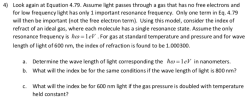 4) Look again at Equation 4.79. Assume light passes through a gas that has no free electrons and for low frequency light has only 1 important resonance frequency. Only one term in Eq. 4.79 will then be important (not the free electron term). Using this model, consider the index of refract of an ideal gas, where each molecule has a single resonance state. Assume the only resonance frequency is hw-leV.For gas at standard temperature and pressure and for wave length...
 Problem 4: The mean free path of a gas, 2, is defined as the average distance traveled by molecules between collisions. A commonly used formula for estimating 2 of an ideal gas is: where џ is the viscosity of the gas, is the density of air. T is the temperature in Kelvin, and C is an experimentally determined constant. Calculate the mean free path of air (in units of nm) at 25 °C and standard atmospheric pressure if the viscosity...
 Problem 2. Find the mean free path of nitrogen gas at pressure p = 2.5 atm and temperature T = 56.5°F. The diameter of a nitrogen molecule is d= 0.3 nm. What is the average rate of collisions?
 In a certain particle accelerator, protons travel around a circular path of diameter D in an evacuated chamber, whose residual gas is at temperature T and pressure p. Assuming T is given in Kelvin and p in pascals, calculate the number n of gas molecules per cubic meter under these conditions, what is the mean free path λ of the gas molecules if the molecular diameter is d. State your answers in terms of the given variables, using the Boltzmann...
 (a) Show that for a gas, the mean free path between collisions is related to the mean distance between nearest neighbors r by the approximate relation 1 r(r2/0) where o is the collision cross- section. (b) Given that the molecular radius of a gas molecule such as O2, N2, or CO2 is about 0.15 nm, estimate the value of r and for air at STP (standard temperature and pressure, T = 273 K, p = 1.00 atm = 1.01 X...
 4) Look again at Equation 4.79. Assume light passes through a gas that has no free electrons and for low frequency light has only 1 important resonance frequency. Only one term in Eq. 4.79 will then be important (not the free electron term). Using this model, consider the index of refract of an ideal gas, where each molecule has a single resonance state. Assume the only resonance frequency is hw-leV.For gas at standard temperature and pressure and for wave length...
Most questions answered within 3 hours.
-
Where is the error in this code sequence?
String s1 = "Hello";
String s2 = "ello";...
asked 11 months ago -
Financial data for Joel de Paris, Inc., for last year
follow:
Joel de Paris, Inc.
Balance...
asked 11 months ago -
Consider this reaction:
Al2(SO4)3 (aq)+ BaCl3
(aq) Al2Cl6 (aq)- +
3BaSO4(s) . What is the...
asked 11 months ago -
Suppose that Savneet is considering increasing her
recent random sample from 20 car rentals to 40...
asked 11 months ago -
Trucks arrive at an unloading terminal at an average rate of 120
per hour.
Trucks arrive...
asked 11 months ago -
Why are methanol and ethanol completely soluble in water while
octanol is not very little soluble....
asked 11 months ago -
A facilities manager at a university reads in a research report
that the mean amount of...
asked 11 months ago -
When the CuSO4 is rehydrated by adding water to the anhydrous
compound, is this an endothermic...
asked 11 months ago -
A ray of sunlight is passing from diamond into crown glass; the
angle of incidence is...
asked 11 months ago -
A block of mass 0.249 kg is placed on top of a light, vertical
spring of...
asked 11 months ago -
how do the kidneys compensate in the presences of acidosis
a) trigger hyperventilate
b) reserve acid...
asked 11 months ago -
Question 501 pts
The rental rate of capital to the firm increases. Which of the
following...
asked 11 months ago