Suppose a static charge of 0.22 μC moves from your finger to a metal doorknob in...
Suppose a static charge of 0.22 μC moves from your finger to a metal doorknob in 0.95 ms. What is the current, in amperes?
Homework Answers
Given charge,
time, 
Current is rate of flow of electric charge

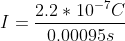
ANSWER: 
========================
Add Answer to:
Suppose a static charge of 0.22 μC moves from your finger to a
metal doorknob in...
What is the current (in A) when a typical static charge of 0.420 µC moves from...
What is the current (in A) when a typical static charge of 0.420 µC moves from your finger to a metal doorknob in 4.60 µs?
What is the current (in A) when a typical static charge of 0490 ue moves rrom...
 What is the current (in A) when a typical static charge of 0490 ue moves rrom your finger to a metal doorknob in 2.70 μι? -11 points 0 16 20.1.P The 17SA current through a spark plug moves 0 270 mC of Charge. How long (in ㎍ does the spark last? us
A 7.2 N force acts on a 3.65 μC charge as the charge moves from x...
A 7.2 N force acts on a 3.65 μC charge as the charge moves from x = 0 to x = 35 cm. a) What is the change in the potential energy of the charge? b) What is the electric potential difference between x = 0 to x = 35 cm? (give the absolute value)
A point charge q = +39.0 μC moves from A to B separated by a distance...
 A point charge q = +39.0 μC
moves from A to B separated by a distance d = 0.171 m in the
presence of an external electric field E with arrow of magnitude
300 N/C directed toward the right as in the following figure.
4. +-22 points SerCP11 16 P.006 My Notes Ask Your Teacher a distance d -0.171 m in the presence of an external electric field E of magnitude 300 N/C directed toward the right as in A...
A point charge q = +39.0 μC
moves from A to B separated by a distance d = 0.171 m in the
presence of an external electric field E with arrow of magnitude
300 N/C directed toward the right as in the following figure.
4. +-22 points SerCP11 16 P.006 My Notes Ask Your Teacher a distance d -0.171 m in the presence of an external electric field E of magnitude 300 N/C directed toward the right as in A...
How much electric potential energy does 1.9 μC of charge gain as it moves from the...
How much electric potential energy does 1.9 μC of charge gain as it moves from the negative terminal to the positive terminal of a 1.6 V battery? Express your answer with the appropriate units.
Suppose the end of your finger is charged. Estimate the breakdown voltage in air for your...
 Suppose the end of your finger is charged. Estimate the breakdown voltage in air for your finger. Assume The width of the end of a finger is about 1 cm. Express your answer to one significant figure and include the appropriate units. About what surface charge density would have to be on your finger at this voltage? Express your answer to one significant figure and include the appropriate units.
1- How far from a -7.80 μC point charge must a 2.10 μC point charge be...
1- How far from a -7.80 μC point charge must a 2.10 μC point charge be placed in order for the electric potential energy of the pair of charges to be -0.500 J ? (Take the energy to be zero when the charges are infinitely far apart.) d= ------m 2- Two stationary positive point charges, charge 1 of magnitude 3.50 nC and charge 2 of magnitude 2.00 nC , are separated by a distance of 37.0 cm . An electron...
A particle has a charge of +2.8 μC and moves from point A to point B,...
A particle has a charge of +2.8 μC and moves from point A to point B, a distance of 0.26 m. The particle experiences a constant electric force, and its motion is along the line of action of the force. The difference between the particle's electric potential energy at A and B is EPEA - EPEB = +7.8 x 10⁻⁴ J. (a) Find the magnitude of the electric force that acts on the particle. (b) Find the magnitude of the...
A particle has a charge of +3.4 μC and moves from point A to point B,...
A particle has a charge of +3.4 μC and moves from point A to point B, a distance of 0.11 m. The particle experiences a constant electric force, and its motion is along the line of action of the force. The difference between the particle's electric potential energy at A and B is EPEA - EPEB = +9.4 x 10⁻⁴ J. (a) Find the magnitude of the electric force that acts on the particle. (b) Find the magnitude of the...
A particle has a charge of +3.4 μC and moves from point A to point B,...
A particle has a charge of +3.4 μC and moves from point A to point B, a distance of 0.26 m. The particle experiences a constant electric force, and its motion is along the line of action of the force. The difference between the particle's electric potential energy at A and B is EPEA - EPEB = +7.9 x 10⁻⁴ J. (a) Find the magnitude of the electric force that acts on the particle. (b) Find the magnitude of the...
 What is the current (in A) when a typical static charge of 0490 ue moves rrom your finger to a metal doorknob in 2.70 μι? -11 points 0 16 20.1.P The 17SA current through a spark plug moves 0 270 mC of Charge. How long (in ㎍ does the spark last? us
 A point charge q = +39.0 μC
moves from A to B separated by a distance d = 0.171 m in the
presence of an external electric field E with arrow of magnitude
300 N/C directed toward the right as in the following figure.
4. +-22 points SerCP11 16 P.006 My Notes Ask Your Teacher a distance d -0.171 m in the presence of an external electric field E of magnitude 300 N/C directed toward the right as in A...
A point charge q = +39.0 μC
moves from A to B separated by a distance d = 0.171 m in the
presence of an external electric field E with arrow of magnitude
300 N/C directed toward the right as in the following figure.
4. +-22 points SerCP11 16 P.006 My Notes Ask Your Teacher a distance d -0.171 m in the presence of an external electric field E of magnitude 300 N/C directed toward the right as in A...
 Suppose the end of your finger is charged. Estimate the breakdown voltage in air for your finger. Assume The width of the end of a finger is about 1 cm. Express your answer to one significant figure and include the appropriate units. About what surface charge density would have to be on your finger at this voltage? Express your answer to one significant figure and include the appropriate units.
Most questions answered within 3 hours.
-
Where is the error in this code sequence?
String s1 = "Hello";
String s2 = "ello";...
asked 11 months ago -
Financial data for Joel de Paris, Inc., for last year
follow:
Joel de Paris, Inc.
Balance...
asked 11 months ago -
Consider this reaction:
Al2(SO4)3 (aq)+ BaCl3
(aq) Al2Cl6 (aq)- +
3BaSO4(s) . What is the...
asked 11 months ago -
Suppose that Savneet is considering increasing her
recent random sample from 20 car rentals to 40...
asked 11 months ago -
Trucks arrive at an unloading terminal at an average rate of 120
per hour.
Trucks arrive...
asked 11 months ago -
Why are methanol and ethanol completely soluble in water while
octanol is not very little soluble....
asked 11 months ago -
A facilities manager at a university reads in a research report
that the mean amount of...
asked 11 months ago -
When the CuSO4 is rehydrated by adding water to the anhydrous
compound, is this an endothermic...
asked 11 months ago -
A ray of sunlight is passing from diamond into crown glass; the
angle of incidence is...
asked 11 months ago -
A block of mass 0.249 kg is placed on top of a light, vertical
spring of...
asked 11 months ago -
how do the kidneys compensate in the presences of acidosis
a) trigger hyperventilate
b) reserve acid...
asked 11 months ago -
Question 501 pts
The rental rate of capital to the firm increases. Which of the
following...
asked 11 months ago