The product of a Catherine's clothing store and Ashley Stewarts clothing store would you consider the...
The product of a Catherine's clothing store and Ashley Stewarts clothing store would you consider the product of dresses to be elastic, inelastic or unitary elastic?
Homework Answers
I would consider the product of dresses to be elastic because in the above question two clothing lines have been mentioned, both known for their plus size style production. This makes both the lines a clear substitutes of each other and therefore, consumer would have the chance to choose. For example, if price in Catherine's clothing store goes up, consumers can switch to Ashley's clothing for lower price. This makes the demand ELASTIC.
Add Answer to:
The product of a Catherine's clothing store and Ashley Stewarts
clothing store would you consider the...
ELASTICITY OF DEMAND HOMEWORK ASSIGNMENT Pick ten (10) specific items of clothing (“white, button-down, fitted, frilly...
ELASTICITY OF DEMAND HOMEWORK ASSIGNMENT Pick ten (10) specific items of clothing (“white, button-down, fitted, frilly blouses, moderately priced” and not “blouses”) that you regularly purchase and/or have purchased in the last thirty days. [Not shoes, jewelry, or handbags.] For each of the items, describe the item, and then answer the following three questions, explaining your answers in detail. (You should have thirty answers. Please type your answers or write very clearly.) What is your price elasticity of demand for...
The demand equation for a certain product is x = 100 -0.01p. (a) is the demand...
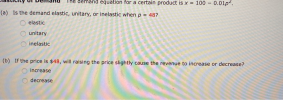 The demand equation for a certain product is x = 100 -0.01p. (a) is the demand elastic, unitary, or inelastic when p = 48? elastic unitary inelastic (b) If the price is $48, will raising the price slightly cause the revenue to increase or decrease? increase ОО decrease
Matrix W Matrix X Matrix Y Matrix Z A women's clothing store has two locations. The...
 Matrix W
Matrix X
Matrix Y
Matrix Z
A women's clothing store has two locations. The stores primarily sell dresses, pants, and blouses. Matrix A represents the monthly sales report for last month, showing the number of dresses, pants, and blouses sold. Matrix B represents the monthly sales report for this month, again, showing the number of dresses, pants, and blouses sold. Which matrix, W, X, Y, or Z, represents the increase/decrease in the number of dresses, pants, and blouses...
Matrix W
Matrix X
Matrix Y
Matrix Z
A women's clothing store has two locations. The stores primarily sell dresses, pants, and blouses. Matrix A represents the monthly sales report for last month, showing the number of dresses, pants, and blouses sold. Matrix B represents the monthly sales report for this month, again, showing the number of dresses, pants, and blouses sold. Which matrix, W, X, Y, or Z, represents the increase/decrease in the number of dresses, pants, and blouses...
part 1 Choose any five products that exist within an economic market then classify and describe...
 part 1
Choose any five products that exist within an economic market then
classify and describe their ‘elasticity’ (relatively inelastic,
relatively elastic, perfectly elastic, perfectly inelastic, unitary
elastic).
In each case, please explain what would occur if:
income increased
loss of job
a substitute was introduced
there was a sudden shortage of the product
Part 2:
Examples of Elasticity
In your own words, please define, describe, and use an example
for each of the following terms using a minimum of...
part 1
Choose any five products that exist within an economic market then
classify and describe their ‘elasticity’ (relatively inelastic,
relatively elastic, perfectly elastic, perfectly inelastic, unitary
elastic).
In each case, please explain what would occur if:
income increased
loss of job
a substitute was introduced
there was a sudden shortage of the product
Part 2:
Examples of Elasticity
In your own words, please define, describe, and use an example
for each of the following terms using a minimum of...
Question 15 (1 point) In which case would producers bear 100% of the tax incidence? a)...
 Question 15 (1 point) In which case would producers bear 100% of the tax incidence? a) an inelastic demand curve and a perfectly elastic supply curve an inelastic demand curve and a unitary elastic supply curve d) a perfectly elastic demand curve with an inelastic supply curve d) a perfectly inelastic demand curve with an elastic supply curve
If a demand curve for a good were completely vertical, it would be considered: Group of...
If a demand curve for a good were completely vertical, it would be considered: Group of answer choices perfectly elastic. perfectly inelastic. of unitary elasticity. relatively inelastic.
For this assignment, choose a product (good or service) that you would like to evaluate for...
For this assignment, choose a product (good or service) that you would like to evaluate for pricing.. Once you have chosen your product, please answer the following questions: 1. Does the price elasticity of demand of this product. Is it elastic or inelastic? Why? 2. What kind of pricing strategy is used for this product (for instance, fixed pricing, high/low pricing, Manufacturer Suggested Retail Price, etc.)? 3. Does the pricing for this product vary among channels (for instance, is the...
Look around your house or apartment and find an item that you would consider elastic, find...
Look around your house or apartment and find an item that you would consider elastic, find another item you think may be unit elastic and another that you would consider inelastic. Using the reading as to support your ideas, discuss why you think the items have the relative elasticity that they do.
The demand for your product fell 66 percent when the price increased by 50 percent. This...
The demand for your product fell 66 percent when the price increased by 50 percent. This is an example of what type of demand? Coefficient New product Unitary Elastic Inelastic
Select a product or service and discuss your subjective estimate of its price elasticity of demand....
Select a product or service and discuss your subjective estimate of its price elasticity of demand. Is it highly elastic or inelastic, unitary elastic, etc.? Does it matter if you select a specific brand of a product, such as Kellogg's corn flakes, versus breakfast cereal or Exxon gasoline versus gasoline in general? What is the relationship between price elasticity and the effect on total revenue if the price of your product or service goes up or down?
 The demand equation for a certain product is x = 100 -0.01p. (a) is the demand elastic, unitary, or inelastic when p = 48? elastic unitary inelastic (b) If the price is $48, will raising the price slightly cause the revenue to increase or decrease? increase ОО decrease
 Matrix W
Matrix X
Matrix Y
Matrix Z
A women's clothing store has two locations. The stores primarily sell dresses, pants, and blouses. Matrix A represents the monthly sales report for last month, showing the number of dresses, pants, and blouses sold. Matrix B represents the monthly sales report for this month, again, showing the number of dresses, pants, and blouses sold. Which matrix, W, X, Y, or Z, represents the increase/decrease in the number of dresses, pants, and blouses...
Matrix W
Matrix X
Matrix Y
Matrix Z
A women's clothing store has two locations. The stores primarily sell dresses, pants, and blouses. Matrix A represents the monthly sales report for last month, showing the number of dresses, pants, and blouses sold. Matrix B represents the monthly sales report for this month, again, showing the number of dresses, pants, and blouses sold. Which matrix, W, X, Y, or Z, represents the increase/decrease in the number of dresses, pants, and blouses...
 part 1
Choose any five products that exist within an economic market then
classify and describe their ‘elasticity’ (relatively inelastic,
relatively elastic, perfectly elastic, perfectly inelastic, unitary
elastic).
In each case, please explain what would occur if:
income increased
loss of job
a substitute was introduced
there was a sudden shortage of the product
Part 2:
Examples of Elasticity
In your own words, please define, describe, and use an example
for each of the following terms using a minimum of...
part 1
Choose any five products that exist within an economic market then
classify and describe their ‘elasticity’ (relatively inelastic,
relatively elastic, perfectly elastic, perfectly inelastic, unitary
elastic).
In each case, please explain what would occur if:
income increased
loss of job
a substitute was introduced
there was a sudden shortage of the product
Part 2:
Examples of Elasticity
In your own words, please define, describe, and use an example
for each of the following terms using a minimum of...
 Question 15 (1 point) In which case would producers bear 100% of the tax incidence? a) an inelastic demand curve and a perfectly elastic supply curve an inelastic demand curve and a unitary elastic supply curve d) a perfectly elastic demand curve with an inelastic supply curve d) a perfectly inelastic demand curve with an elastic supply curve
Most questions answered within 3 hours.
-
Where is the error in this code sequence?
String s1 = "Hello";
String s2 = "ello";...
asked 11 months ago -
Financial data for Joel de Paris, Inc., for last year
follow:
Joel de Paris, Inc.
Balance...
asked 11 months ago -
Consider this reaction:
Al2(SO4)3 (aq)+ BaCl3
(aq) Al2Cl6 (aq)- +
3BaSO4(s) . What is the...
asked 11 months ago -
Suppose that Savneet is considering increasing her
recent random sample from 20 car rentals to 40...
asked 11 months ago -
Trucks arrive at an unloading terminal at an average rate of 120
per hour.
Trucks arrive...
asked 11 months ago -
Why are methanol and ethanol completely soluble in water while
octanol is not very little soluble....
asked 11 months ago -
A facilities manager at a university reads in a research report
that the mean amount of...
asked 11 months ago -
When the CuSO4 is rehydrated by adding water to the anhydrous
compound, is this an endothermic...
asked 11 months ago -
A ray of sunlight is passing from diamond into crown glass; the
angle of incidence is...
asked 11 months ago -
A block of mass 0.249 kg is placed on top of a light, vertical
spring of...
asked 11 months ago -
how do the kidneys compensate in the presences of acidosis
a) trigger hyperventilate
b) reserve acid...
asked 11 months ago -
Question 501 pts
The rental rate of capital to the firm increases. Which of the
following...
asked 11 months ago