A firecracker is pushed so that its slides across frictionless ice at a speed of 15...
A firecracker is pushed so that its slides across frictionless ice at a speed of 15 m/s. While sliding, it explodes into two fragments. The smaller fragment (which is one quarter the mass of the original firecracker) ends up motionless. What is the final speed of the larger fragment? (Use a center-of-mass approach.)
Homework Answers

Add Answer to:
A firecracker is pushed so that its slides across frictionless
ice at a speed of 15...
A student kicks a frictionless puck with initial speed Vo , so that it slides across...
A student kicks a frictionless puck with initial speed Vo , so that it slides across a plane at angle α and the plane is inclined at an angle of θ above the horizontal. a. Determine the maximum height of the puck? b. Determine how far the puck travels horizontally? c. How long will the puck take to return to the ice
A 1.25kg hockey puck (puck A) slides across a frictionless sheet of ice and collides with...
A 1.25kg hockey puck (puck A) slides across a frictionless sheet of ice and collides with a puck of unknown mass (puck B) head on. The collision is completely elastic, which means no kinetic enegy is lost in the collision. After the collision, puck A moves in the opposite direction at half of its initial speed. Find the mass of puck B.
Problem 4 A block of mass m slides at velocity vo across a horizontal frictionless surface...
 Problem 4 A block of mass m slides at velocity vo across a horizontal frictionless surface toward a large curved movable ramp n and has a smooth circular frictionless face up which the block can easily slide. When the block slides up the ramp, it momentarily reaches a maximum height a shown in Figure II, and then slides back down the frictionless surface as shown in Figure III. face to the horizontal (a) Find the velocity of the ramp at...
A 70.0 kg archer, standing on frictionless ice, shoots a 200 g arrow at a speed of 100 m/s. What ...
 A 70.0 kg archer, standing on frictionless ice, shoots a 200 g arrow at a speed of 100 m/s. What is the recoil speed of the archer? A 30 kg beaver is standing on the ice minding his own business. This same arrow travelling at 100 m/s bounces off the beaver, causing the beaverto slide across the ice at 1.2 m/s. What is the rebound velocity ofthe arrow? What percent of kineticenergy was conserved in the collision with the beaver?...
Two boys are sliding toward each other on a frictionless, ice-covered parking lot. Jacob, mass 45...
Two boys are sliding toward each other on a frictionless, ice-covered parking lot. Jacob, mass 45 kg, is gliding to the right at 8.02 m/s, and Ethan, mass 31.0 kg, is gliding to the left at 10.5 m/s along the same line. When they meet, they grab each other and hang on. (a) What is their velocity immediately thereafter? b) What fraction of their original kinetic energy is still mechanical energy after their collision? (c) That was so much fun...
A large sledge of mass 1000 kg slides down a frictionless ice ramp that has length...
A large sledge of mass 1000 kg slides down a frictionless ice ramp that has length ` and an angle of incline θ. (a) Write expressions as functions of θ for i. the acceleration a of the sledge while it is on the ramp ii. the time t for the sled to reach the bottom of the ramp iii. the final speed v of the sled at the bottom of the ramp (b) Assuming the ramp length is ` =...
1- A block slides along a frictionless surface at 2.4 m/s. A second 3.5-kg block, sliding...
1- A block slides along a frictionless surface at 2.4 m/s. A second 3.5-kg block, sliding at a faster 7.5 m/s, collides with the first from behind and sticks to it. The final velocity of the combined blocks is 4.6 m/s. What was the mass of the first block? 2-A 15 g ball of clay traveling west at 4 m/s collides with a 50 g ball of clay traveling 30° north of east at 3.5 m/s. What is the speed...
Block 1, of mass m1, moves across a frictionless surface with speed ui . It collides elastically with block 2, of mas...
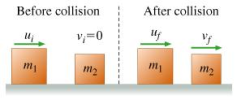 Block 1, of mass m1, moves across a frictionless surface with speed
ui . It collides elastically with block 2, of mass m2, which is at
rest (vi = 0). After the collision, block 1 moves with speed uf ,
while block 2 moves with speed vf . Assume that m1 > m2, so that
after the collision, the two objects move off in the direction of
the first object before the collision.
What is the final speed uf of...
Block 1, of mass m1, moves across a frictionless surface with speed
ui . It collides elastically with block 2, of mass m2, which is at
rest (vi = 0). After the collision, block 1 moves with speed uf ,
while block 2 moves with speed vf . Assume that m1 > m2, so that
after the collision, the two objects move off in the direction of
the first object before the collision.
What is the final speed uf of...
Block 1, of mass m1, moves across a frictionless surface with speed ui. It collides elastically with block 2, of mass m2...
 Block 1, of mass m1,
moves across a frictionless surface with speed ui. It collides
elastically with block 2, of mass m2, which is at rest (vi=0).
(Figure 1) After the collision, block 1 moves with speed uf, while
block 2 moves with speed vf. Assume that m1>m2, so that after
the collision, the two objects move off in the direction of the
first object before the collision.Part
BWhat is the final speed uf of block 1?Express uf in terms...
Block 1, of mass m1,
moves across a frictionless surface with speed ui. It collides
elastically with block 2, of mass m2, which is at rest (vi=0).
(Figure 1) After the collision, block 1 moves with speed uf, while
block 2 moves with speed vf. Assume that m1>m2, so that after
the collision, the two objects move off in the direction of the
first object before the collision.Part
BWhat is the final speed uf of block 1?Express uf in terms...
s odott gi Page 204 Practice Problem 7.10: 53 - O-TOUS Find the skateboard's speed at...
 s odott gi Page 204 Practice Problem 7.10: 53 - O-TOUS Find the skateboard's speed at the bottom of the pipe if he is given a push at the top edge, so that he has an initial downward speed of 2.00 m/s. Answer: 7.93 m/s. EXAMPLE 7.10 Calculating speed along a vertical circle Here we will tackle a circular-motion problem using conservation of energy. Because the acceleration in this problem is not constant, we cannot approach it with the tools...
 Problem 4 A block of mass m slides at velocity vo across a horizontal frictionless surface toward a large curved movable ramp n and has a smooth circular frictionless face up which the block can easily slide. When the block slides up the ramp, it momentarily reaches a maximum height a shown in Figure II, and then slides back down the frictionless surface as shown in Figure III. face to the horizontal (a) Find the velocity of the ramp at...
 A 70.0 kg archer, standing on frictionless ice, shoots a 200 g arrow at a speed of 100 m/s. What is the recoil speed of the archer? A 30 kg beaver is standing on the ice minding his own business. This same arrow travelling at 100 m/s bounces off the beaver, causing the beaverto slide across the ice at 1.2 m/s. What is the rebound velocity ofthe arrow? What percent of kineticenergy was conserved in the collision with the beaver?...
 Block 1, of mass m1, moves across a frictionless surface with speed
ui . It collides elastically with block 2, of mass m2, which is at
rest (vi = 0). After the collision, block 1 moves with speed uf ,
while block 2 moves with speed vf . Assume that m1 > m2, so that
after the collision, the two objects move off in the direction of
the first object before the collision.
What is the final speed uf of...
Block 1, of mass m1, moves across a frictionless surface with speed
ui . It collides elastically with block 2, of mass m2, which is at
rest (vi = 0). After the collision, block 1 moves with speed uf ,
while block 2 moves with speed vf . Assume that m1 > m2, so that
after the collision, the two objects move off in the direction of
the first object before the collision.
What is the final speed uf of...
 Block 1, of mass m1,
moves across a frictionless surface with speed ui. It collides
elastically with block 2, of mass m2, which is at rest (vi=0).
(Figure 1) After the collision, block 1 moves with speed uf, while
block 2 moves with speed vf. Assume that m1>m2, so that after
the collision, the two objects move off in the direction of the
first object before the collision.Part
BWhat is the final speed uf of block 1?Express uf in terms...
Block 1, of mass m1,
moves across a frictionless surface with speed ui. It collides
elastically with block 2, of mass m2, which is at rest (vi=0).
(Figure 1) After the collision, block 1 moves with speed uf, while
block 2 moves with speed vf. Assume that m1>m2, so that after
the collision, the two objects move off in the direction of the
first object before the collision.Part
BWhat is the final speed uf of block 1?Express uf in terms...
 s odott gi Page 204 Practice Problem 7.10: 53 - O-TOUS Find the skateboard's speed at the bottom of the pipe if he is given a push at the top edge, so that he has an initial downward speed of 2.00 m/s. Answer: 7.93 m/s. EXAMPLE 7.10 Calculating speed along a vertical circle Here we will tackle a circular-motion problem using conservation of energy. Because the acceleration in this problem is not constant, we cannot approach it with the tools...
Most questions answered within 3 hours.
-
Where is the error in this code sequence?
String s1 = "Hello";
String s2 = "ello";...
asked 11 months ago -
Financial data for Joel de Paris, Inc., for last year
follow:
Joel de Paris, Inc.
Balance...
asked 11 months ago -
Consider this reaction:
Al2(SO4)3 (aq)+ BaCl3
(aq) Al2Cl6 (aq)- +
3BaSO4(s) . What is the...
asked 11 months ago -
Suppose that Savneet is considering increasing her
recent random sample from 20 car rentals to 40...
asked 11 months ago -
Trucks arrive at an unloading terminal at an average rate of 120
per hour.
Trucks arrive...
asked 11 months ago -
Why are methanol and ethanol completely soluble in water while
octanol is not very little soluble....
asked 11 months ago -
A facilities manager at a university reads in a research report
that the mean amount of...
asked 11 months ago -
When the CuSO4 is rehydrated by adding water to the anhydrous
compound, is this an endothermic...
asked 11 months ago -
A ray of sunlight is passing from diamond into crown glass; the
angle of incidence is...
asked 11 months ago -
A block of mass 0.249 kg is placed on top of a light, vertical
spring of...
asked 11 months ago -
how do the kidneys compensate in the presences of acidosis
a) trigger hyperventilate
b) reserve acid...
asked 11 months ago -
Question 501 pts
The rental rate of capital to the firm increases. Which of the
following...
asked 11 months ago