An anti- tank weapon fires a 3.00 kg rocket with a constant net force of 5400...
An anti- tank weapon fires a 3.00 kg rocket with a constant net force of 5400 N. The rocket travels 190.0 cm in the launching tube. Assuming the rocket is accelerating uniformly in the tube, what is the speed (Vfinal) the rocket exits the tube? Assume the rocket started from rest.
Homework Answers
Force acting on the rocket 
Mass of the rocket 
Distance traveled by rocket 
Initial velocity of rocket 

Using 
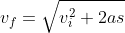
Speed of the rocket when it exits the tube 
Add Answer to:
An anti- tank weapon fires a 3.00 kg rocket with a constant net
force of 5400...
A 1300-kg rocket has a net propulsion force of 40 KN (kiloNewtons). Over a short time...
 A 1300-kg rocket has a net propulsion force of 40 KN (kiloNewtons). Over a short time period, it uniformly speeds up from an initial velocity of 30 m/s to a inal velocity of 55 m/s. Assume that the mass of u rocket is constant during this time pend and that the net force is along the direction of motion. what is the work done on the rocket n knopole Submit Arser Tries 0y3
Please square answers A 1400-kg rocket has a net propulsion force of 30 kN (kiloNewtons). Over...
Please square answers A 1400-kg rocket has a net propulsion force of 30 kN (kiloNewtons). Over a short time period, it uniformly speeds up from an initial velocity of 30 m/s to a final velocity of 55 m/s. Assume that the mass of the rocket is constant during this time period and that the net force is along the direction of motion. What is the change in speed of the rocket in m/s and in mph? m/s mph Tries 0/2...
A 140 kg barrel that is initially at rest is pushed by a constant net force...
 A 140 kg barrel that is initially at rest is pushed by a constant net force of 40N. The barrel travels 200cm in 5 s. The acceleration of the barrel is 0.25 m/s?. Calculate the increase in kinetic energy during the 5 s. 7. Two objects are hung from strings (figure). The top object (ml) has a mass of 15 kg and the bottom object(m2) has a mass of 10 kg. Calculate the tension in each string. [A-5] String A...
A 1300-kg rocket has a net propulsion force of 50 kN (kiloNewtons). Over a short time...
 A 1300-kg rocket has a net propulsion force of 50 kN (kiloNewtons). Over a short time period, it uniformly speeds up from an initial velocity of 35 m/s to a final velocity of 60 m/s. Assume that the mass of the rocket is constant during this time period and that the net force is along the direction of motion. What is the change in speed of the rocket in m/s and in mph? m/s mph Submit Answer Tries 0/2 What...
An electron of mass 9.11×10⁻³¹ kg leaves one end of a TV picture tube with zero...
An electron of mass 9.11×10⁻³¹ kg leaves one end of a TV picture tube with zero initial speed and travels in a straight line to the accelerating grid, which is a distance 1.70 cm away. It reaches the grid with a speed of 2.70×10⁶ m/s . The accelerating force is constant. Find the acceleration. Find the time to reach the grid. Find the net force. (You can ignore the gravitational force on the electron).
An electron of mass 9.11×10⁻³¹ kg leaves one end of a TV picture tube with zero...
An electron of mass 9.11×10⁻³¹ kg leaves one end of a TV picture tube with zero initial speed and travels in a straight line to the accelerating grid, which is a distance 1.65 cm away. It reaches the grid with a speed of 2.90×10⁶ m/s . The accelerating force is constant. A) find the acceleration B) find the tme to reach the grid C) find the net force (ignore gravitational acceleration)
Exercise 4.6: Constants - Part An electron of mass 9.11x10⁻³¹ kg leaves one end of a...
 Exercise 4.6:
Constants - Part An electron of mass 9.11x10⁻³¹ kg leaves one end of a TV picture tube with zero initial speed and travels in a straight line to the accelerating grid, which is a distance 2.50 cm away. It reaches the grid with a speed of 4.10x10⁹ m/s. The accelerating force is constant. Find f Sul Part A eaves one end of a d and travels in a which is a distance th a speed of ce is...
Exercise 4.6:
Constants - Part An electron of mass 9.11x10⁻³¹ kg leaves one end of a TV picture tube with zero initial speed and travels in a straight line to the accelerating grid, which is a distance 2.50 cm away. It reaches the grid with a speed of 4.10x10⁹ m/s. The accelerating force is constant. Find f Sul Part A eaves one end of a d and travels in a which is a distance th a speed of ce is...
An electron of mass 9.11×10⁻³¹ kg leaves one end of a TV picture tube with zero...
An electron of mass 9.11×10⁻³¹ kg leaves one end of a TV picture tube with zero initial speed and travels in a straight line to the accelerating grid, which is a distance 2.75 cm away. It reaches the grid with a speed of 3.60×10⁶ m/s . The accelerating force is constant. Part A Find the acceleration. Part B Find the time to reach the grid. Part C Find the net force. (You can ignore the gravitational force on the electron).
Question 3 On 21 January 2018, Rocket Lab launched a 10 500 kg rocket from the...
 Question 3 On 21 January 2018, Rocket Lab launched a 10 500 kg rocket from the Mahia Penin- sula. It carried a 250 kg payload that included the 8 kg Humanity Star, which is like a large disco ball in size and shape. (a) On the launchpad, the rocket has a mass of 10 500 kg and produces 160 kN of vertical thrust. Assuming that the acceleration is constant and motion is in a straight line, find the speed of...
A 3.00-kg block is connected to two ideal horizontal springs having force constants k1 = 23.0...
A 3.00-kg block is connected to two ideal horizontal springs having force constants k1 = 23.0 N/cm and k2 = 18.0 N/cm. The system is initially in equilibrium on a horizontal, frictionless surface. The block is now pushed 15.0 cm to the right and released from rest. What is the maximum speed of the block?
 A 1300-kg rocket has a net propulsion force of 40 KN (kiloNewtons). Over a short time period, it uniformly speeds up from an initial velocity of 30 m/s to a inal velocity of 55 m/s. Assume that the mass of u rocket is constant during this time pend and that the net force is along the direction of motion. what is the work done on the rocket n knopole Submit Arser Tries 0y3
 A 140 kg barrel that is initially at rest is pushed by a constant net force of 40N. The barrel travels 200cm in 5 s. The acceleration of the barrel is 0.25 m/s?. Calculate the increase in kinetic energy during the 5 s. 7. Two objects are hung from strings (figure). The top object (ml) has a mass of 15 kg and the bottom object(m2) has a mass of 10 kg. Calculate the tension in each string. [A-5] String A...
 A 1300-kg rocket has a net propulsion force of 50 kN (kiloNewtons). Over a short time period, it uniformly speeds up from an initial velocity of 35 m/s to a final velocity of 60 m/s. Assume that the mass of the rocket is constant during this time period and that the net force is along the direction of motion. What is the change in speed of the rocket in m/s and in mph? m/s mph Submit Answer Tries 0/2 What...
 Exercise 4.6:
Constants - Part An electron of mass 9.11x10⁻³¹ kg leaves one end of a TV picture tube with zero initial speed and travels in a straight line to the accelerating grid, which is a distance 2.50 cm away. It reaches the grid with a speed of 4.10x10⁹ m/s. The accelerating force is constant. Find f Sul Part A eaves one end of a d and travels in a which is a distance th a speed of ce is...
Exercise 4.6:
Constants - Part An electron of mass 9.11x10⁻³¹ kg leaves one end of a TV picture tube with zero initial speed and travels in a straight line to the accelerating grid, which is a distance 2.50 cm away. It reaches the grid with a speed of 4.10x10⁹ m/s. The accelerating force is constant. Find f Sul Part A eaves one end of a d and travels in a which is a distance th a speed of ce is...
 Question 3 On 21 January 2018, Rocket Lab launched a 10 500 kg rocket from the Mahia Penin- sula. It carried a 250 kg payload that included the 8 kg Humanity Star, which is like a large disco ball in size and shape. (a) On the launchpad, the rocket has a mass of 10 500 kg and produces 160 kN of vertical thrust. Assuming that the acceleration is constant and motion is in a straight line, find the speed of...
Most questions answered within 3 hours.
-
Where is the error in this code sequence?
String s1 = "Hello";
String s2 = "ello";...
asked 11 months ago -
Financial data for Joel de Paris, Inc., for last year
follow:
Joel de Paris, Inc.
Balance...
asked 11 months ago -
Consider this reaction:
Al2(SO4)3 (aq)+ BaCl3
(aq) Al2Cl6 (aq)- +
3BaSO4(s) . What is the...
asked 11 months ago -
Suppose that Savneet is considering increasing her
recent random sample from 20 car rentals to 40...
asked 11 months ago -
Trucks arrive at an unloading terminal at an average rate of 120
per hour.
Trucks arrive...
asked 11 months ago -
Why are methanol and ethanol completely soluble in water while
octanol is not very little soluble....
asked 11 months ago -
A facilities manager at a university reads in a research report
that the mean amount of...
asked 11 months ago -
When the CuSO4 is rehydrated by adding water to the anhydrous
compound, is this an endothermic...
asked 11 months ago -
A ray of sunlight is passing from diamond into crown glass; the
angle of incidence is...
asked 11 months ago -
A block of mass 0.249 kg is placed on top of a light, vertical
spring of...
asked 11 months ago -
how do the kidneys compensate in the presences of acidosis
a) trigger hyperventilate
b) reserve acid...
asked 11 months ago -
Question 501 pts
The rental rate of capital to the firm increases. Which of the
following...
asked 11 months ago