From each of the following pairs of substances, use data in Appendix E in the textbook...
From each of the following pairs of substances, use data in Appendix E in the textbook to choose the one that is the stronger oxidizing agent.
Match the words in the left column to the appropriate blanks in the sentences on the right. Make certain each sentence is complete before submitting your answer.
|
ResetHelp
|
Homework Answers
Higher the value of standard reduction potential of a compound, it will have strong tendency to get reduced and oxidize the other compound. The compound with higher reduction potential will be stronger oxidizing agent.
Zn2+(aq) + 2e- Zn(s). E° =
-0.76V
Zn(s). E° =
-0.76V
Fe2+(aq) +2e-Fe(s) . E° =
-0.44V
(1) the stronger oxidizing agent is Fe2+(aq). (Answer)
H2O2 +2H+ + 2e-
O2 + 2H2O . E° = 1.78V
O3 + 2H+ + 2e-
O2 + H2O. E° = 2.07V
(2)the stronger oxidizing agent is O3(g). (Answer)
Cl2(g) + 2e-2Cl-(aq).
E° = 1.36V
2HClO(aq) + 2H+ + 2e-
Cl2 + 2H2O. E° = 1.63V
(3) the stronger oxidizing agent is HClO(aq) . (Answer)
F2(g) + 2e-2F-(aq).
E° = 2.87V
I2(s) + 2e-
2I-(aq). E° = 0.54V
(4) the stronger oxidising agent is F2(g) . (Answer)
Add Answer to:
From each of the following pairs of substances, use data in
Appendix E in the textbook...
From each of the following pairs of substances, use data in Appendix E in the textbook to choose the one that is the stronger oxidizing agent. Match the words in the left column to the appropriate bla...
From each of the following pairs of substances, use data in Appendix E in the textbook to choose the one that is the stronger oxidizing agent. Match the words in the left column to the appropriate blanks in the sentences on the right. Make certain each sentence is complete before submitting your answer. ResetHelp HClO(aq) O3(g) H2O2(aq) Zn2+(aq) Fe2+(aq) Cl2(g) F2(g) I2(s) Given Zn2+(aq) or Fe2+(aq) , the stronger oxidizing agent is .GivenH2O2(aq)orO3(g), the stronger oxidizing agent is blank. .GivenCl2(g)orHClO(aq),...
Questions I. Based on the Reduction Potential Table constructed in this experiment: For each of the...
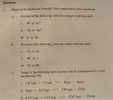 Questions I. Based on the Reduction Potential Table constructed in this experiment: For each of the following, circle the stronger oxidizing agent: i. Ht or Fe3* ii. Cl2 or Zn2 iii. 2 or Br2 a. b. For each of the following, circle the weaker reducing agent: i. Cu or H2 ii. Br or I iii. H2 or Br Predict if he following redox rescióons will be pontaneous (S), r non- spontaneous (N): i. 2H+(aq) + 21-(aq)-- H2(g) + 12(aq) ii....
a. Cl2 b. F2 c. Br2 d. I2 e. All of the halogens have equal strength...
 a.
Cl2
b.
F2
c.
Br2
d.
I2
e.
All of the halogens have equal strength as oxidizing agents.
E°(V +2.87 +1.359 +1.065 +1.23 +0.799 Table 20.1 Half Reaction F2 (8) 2e → 2F- (ag) Cl2(8) 2e → 2Cl- (aq) Br21) 2e → 2Br" (ag) 02 (elut 4H+ (ag) + 4e + 2H20 (1) Agte → Ag (5) Fe3+ (aq) → Fe2+ (aq) 12 (5) + 2e – 21 (ag) Cu2+ + 2e - Cu (s) 2H+ + 2e →...
a.
Cl2
b.
F2
c.
Br2
d.
I2
e.
All of the halogens have equal strength as oxidizing agents.
E°(V +2.87 +1.359 +1.065 +1.23 +0.799 Table 20.1 Half Reaction F2 (8) 2e → 2F- (ag) Cl2(8) 2e → 2Cl- (aq) Br21) 2e → 2Br" (ag) 02 (elut 4H+ (ag) + 4e + 2H20 (1) Agte → Ag (5) Fe3+ (aq) → Fe2+ (aq) 12 (5) + 2e – 21 (ag) Cu2+ + 2e - Cu (s) 2H+ + 2e →...
Part 1.) Using data found in Appendix E of your textbook calculate the nonstandard emf for...
Part 1.) Using data found in Appendix E of your textbook calculate the nonstandard emf for each of the following reactions if the concentration of each of the ions in these reactions is 0.0002 molar and everything else is standard (use 298 K for the temperature, R = 8.314 J/mol-K, and F = 96,485 C/mol): (a) 2 Hg2+(aq) + 1 Sn(s) --> 1 Hg22+(aq) + 1 Sn2+(aq) E = __ V (b) 1 F2(g) + 1 Mg(s) --> 2 F-(aq)...
Using data found in Appendix E of your textbook calculate the nonstandard emf for each of...
Using data found in Appendix E of your textbook calculate the nonstandard emf for each of the following reactions if the concentration of each of the ions in these reactions is 0.0007 molar and everything else is standard (use 298 K for the temperature, R = 8.314 J/mol-K, and F = 96,485 C/mol): (a) 2 Li+(aq) + 1 Sn(s) --> 2 Li(s) + 1 Sn2+(aq) (b) 1 Zn2+(aq) + 1 Ca(s) --> 1 Zn(s) + 1 Ca2+(aq) (c) 1 Mg2+(aq)...
Using data found in Appendix E of your textbook calculate the nonstandard emf for each of...
Using data found in Appendix E of your textbook calculate the nonstandard emf for each of the following reactions if the concentration of each of the ions in these reactions is 0.0006 molar and everything else is standard (use 298 K for the temperature, R = 8.314 J/mol-K, and F = 96,485 C/mol): (a) 2 H+(aq) + 2 Cu(s) --> 1 H2(g) + 2 Cu+(aq) E = V (b) 1 Ca2+(aq) + 2 K(s) --> 1 Ca(s) + 2 K+(aq) E...
For each of the following pairs of substances, determine which has the larger molar entropy at...
For each of the following pairs of substances, determine which has the larger molar entropy at 298 K: (A) Br2(l) or (B) Cl2(g) (C) Fe(s) or (D) Ni(s) (E) C2H6(g) or (F) C2H4(g) (G) CH4(g) or (H) CCl4(g) (I) MgO(s) or (J) HgO(s) (K) NaCl(aq) or (L) MgCl2(aq) Enter the six letters in order (e.g. ACEGIK, BDFHJL, etc.)
For each of the following pairs of substances, determine which has the larger molar entropy at...
For each of the following pairs of substances, determine which has the larger molar entropy at 298 K: (A) Br2(l) or (B) Cl2(g) (C) Fe(s) or (D) Ni(s) (E) C2H4(g) or (F) C2H6(g) (G) CCl4(g) or (H) CH4(g) (I) MgO(s) or (J) HgO(s) (K) NaCl(aq) or (L) MgCl2(aq) Enter the six letters in order (e.g. ACEGIK, BDFHJL, etc.)
Use data from Appendix IIB in the textbook to calculate ΔrS∘ for each of the following...
Use data from Appendix IIB in the textbook to calculate ΔrS∘ for each of the following reactions. CO(g)+2H2(g)→CH3OH(g) Express your answer using four significant figures. ΔrS∘ = JK−1mol−1
Using data found in Appendix E of your textbook calculate the nonstandard emf for each of...
 Using data found in Appendix E of your textbook calculate the
nonstandard emf for each of the following reactions if the
concentration of each of the ions in these reactions is 0.0005
molar and everything else is standard (use 298 K for the
temperature, R = 8.314 J/mol-K, and F = 96,485 C/mol):
Using data found in Appendix E of your textbook calculate the nonstandard emf for each of the following reactions if the concentration of each of the ions...
Using data found in Appendix E of your textbook calculate the
nonstandard emf for each of the following reactions if the
concentration of each of the ions in these reactions is 0.0005
molar and everything else is standard (use 298 K for the
temperature, R = 8.314 J/mol-K, and F = 96,485 C/mol):
Using data found in Appendix E of your textbook calculate the nonstandard emf for each of the following reactions if the concentration of each of the ions...
 Questions I. Based on the Reduction Potential Table constructed in this experiment: For each of the following, circle the stronger oxidizing agent: i. Ht or Fe3* ii. Cl2 or Zn2 iii. 2 or Br2 a. b. For each of the following, circle the weaker reducing agent: i. Cu or H2 ii. Br or I iii. H2 or Br Predict if he following redox rescióons will be pontaneous (S), r non- spontaneous (N): i. 2H+(aq) + 21-(aq)-- H2(g) + 12(aq) ii....
 a.
Cl2
b.
F2
c.
Br2
d.
I2
e.
All of the halogens have equal strength as oxidizing agents.
E°(V +2.87 +1.359 +1.065 +1.23 +0.799 Table 20.1 Half Reaction F2 (8) 2e → 2F- (ag) Cl2(8) 2e → 2Cl- (aq) Br21) 2e → 2Br" (ag) 02 (elut 4H+ (ag) + 4e + 2H20 (1) Agte → Ag (5) Fe3+ (aq) → Fe2+ (aq) 12 (5) + 2e – 21 (ag) Cu2+ + 2e - Cu (s) 2H+ + 2e →...
a.
Cl2
b.
F2
c.
Br2
d.
I2
e.
All of the halogens have equal strength as oxidizing agents.
E°(V +2.87 +1.359 +1.065 +1.23 +0.799 Table 20.1 Half Reaction F2 (8) 2e → 2F- (ag) Cl2(8) 2e → 2Cl- (aq) Br21) 2e → 2Br" (ag) 02 (elut 4H+ (ag) + 4e + 2H20 (1) Agte → Ag (5) Fe3+ (aq) → Fe2+ (aq) 12 (5) + 2e – 21 (ag) Cu2+ + 2e - Cu (s) 2H+ + 2e →...
 Using data found in Appendix E of your textbook calculate the
nonstandard emf for each of the following reactions if the
concentration of each of the ions in these reactions is 0.0005
molar and everything else is standard (use 298 K for the
temperature, R = 8.314 J/mol-K, and F = 96,485 C/mol):
Using data found in Appendix E of your textbook calculate the nonstandard emf for each of the following reactions if the concentration of each of the ions...
Using data found in Appendix E of your textbook calculate the
nonstandard emf for each of the following reactions if the
concentration of each of the ions in these reactions is 0.0005
molar and everything else is standard (use 298 K for the
temperature, R = 8.314 J/mol-K, and F = 96,485 C/mol):
Using data found in Appendix E of your textbook calculate the nonstandard emf for each of the following reactions if the concentration of each of the ions...
Most questions answered within 3 hours.
-
Where is the error in this code sequence?
String s1 = "Hello";
String s2 = "ello";...
asked 11 months ago -
Financial data for Joel de Paris, Inc., for last year
follow:
Joel de Paris, Inc.
Balance...
asked 11 months ago -
Consider this reaction:
Al2(SO4)3 (aq)+ BaCl3
(aq) Al2Cl6 (aq)- +
3BaSO4(s) . What is the...
asked 11 months ago -
Suppose that Savneet is considering increasing her
recent random sample from 20 car rentals to 40...
asked 11 months ago -
Trucks arrive at an unloading terminal at an average rate of 120
per hour.
Trucks arrive...
asked 11 months ago -
Why are methanol and ethanol completely soluble in water while
octanol is not very little soluble....
asked 11 months ago -
A facilities manager at a university reads in a research report
that the mean amount of...
asked 11 months ago -
When the CuSO4 is rehydrated by adding water to the anhydrous
compound, is this an endothermic...
asked 11 months ago -
A ray of sunlight is passing from diamond into crown glass; the
angle of incidence is...
asked 11 months ago -
A block of mass 0.249 kg is placed on top of a light, vertical
spring of...
asked 11 months ago -
how do the kidneys compensate in the presences of acidosis
a) trigger hyperventilate
b) reserve acid...
asked 11 months ago -
Question 501 pts
The rental rate of capital to the firm increases. Which of the
following...
asked 11 months ago