Suppose we are trying to model the probability q of winning the lottery using a geometric...
Suppose we are trying to model the probability q of winning the lottery using a geometric distribution. Suppose we have one sample, where a person wins the lottery the second time he plays.
(a) Find a likelihood function L for the parameter q.
(b) Find all critical points of L
(c) Find the maximum likelihood estimator ˆq.
(d) Compute the upper limit ph of the 95% confidence interval for q.
(e) Compute the lower limit pl of the 95% confidence interval for q.
Homework Answers


Add Answer to:
Suppose we are trying to model the probability q of winning the
lottery using a geometric...
Suppose we flip a coin 10 times and we record 8 heads, 2 tails. Let p...
Suppose we flip a coin 10 times and we record 8 heads, 2 tails. Let p be the true probability of flipping heads. (a) Given this data, a likelihood function L for the parameter p. (b) Find all the critical points of L. (c) Find the maximum likelihood estimator ˆ p.
Stion 4 (6 pt) (Ex. 8.40 on page 409 is modified): Suppose that random variable Y is an observati...
 8.40
stion 4 (6 pt) (Ex. 8.40 on page 409 is modified): Suppose that random variable Y is an observation from a normal distribution with unknown mean u and variance l Find and verify a pivotal quantity that you can use to derive confidence limits for the mean u. Find a 95% lower confidence limit for. a. b. 8.40 Suppose that the random variable Yis an observation from a normal distribution with unknown mean μ and variance 1 . Find...
8.40
stion 4 (6 pt) (Ex. 8.40 on page 409 is modified): Suppose that random variable Y is an observation from a normal distribution with unknown mean u and variance l Find and verify a pivotal quantity that you can use to derive confidence limits for the mean u. Find a 95% lower confidence limit for. a. b. 8.40 Suppose that the random variable Yis an observation from a normal distribution with unknown mean μ and variance 1 . Find...
Problem 2. Rice, Problem 7, pg. 314 (Extended)] Suppose that X1,..., Xn iid Geometric(p). a) Find...
 Problem 2. Rice, Problem 7, pg. 314 (Extended)] Suppose that X1,..., Xn iid Geometric(p). a) Find the method of moments estimator for p. (b) Find the maximum likelihood estimator for p. (c) Find the asymptotic variance of the MLE (d) Suppose that p has a uniform prior distribution on the interval [0, 1]. What is the posterior distribution of p? For part (e), assume that we obtained a random sample of size 4 with L^^^xi-.4 (e) What is the posterior...
Let X1, ..., X50 denote a random sample of size 50 from the geometric distribution f(x;...
Let X1, ..., X50 denote a random sample of size 50 from the geometric distribution f(x; θ) = θ(1 − θ) x−1 for x = 1, 2, ... and 0 < θ < 1. Suppose that after taking the observations we find that ¯x = 5. 8. a) Find the maximum likelihood estimator ˆθ of θ. b) Find E[X¯] and var(X¯). c) Use part (b) above together with the CLT and delta method to find the limiting distribution of √...
Question 5-7 2 Gamma waiting times (frequentist) Suppose we model a sample of times between arrivals...
 Question 5-7
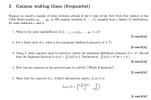
2 Gamma waiting times (frequentist) Suppose we model a sample of times between arrivals of the 1 train of the New York City subway at the 116th Street station, y1, . . . , Yn, as IID random variables Y1, ... , Yn sampled from a Gam(v, 1) distribution, for some unknown v and X. 1. What is the joint log-likelihood, In fy ...Y|0,1(91, ... , Yn | v, 4)? [5 mark(s)] 2. For a fixed value of...
Question 5-7
2 Gamma waiting times (frequentist) Suppose we model a sample of times between arrivals of the 1 train of the New York City subway at the 116th Street station, y1, . . . , Yn, as IID random variables Y1, ... , Yn sampled from a Gam(v, 1) distribution, for some unknown v and X. 1. What is the joint log-likelihood, In fy ...Y|0,1(91, ... , Yn | v, 4)? [5 mark(s)] 2. For a fixed value of...
ABayes Is the confidence Region R(a,b) symmetric around the Bayesian estimatorA , as defined earlier? Why or Why not? (...
 ABayes Is the confidence Region R(a,b) symmetric around the Bayesian estimatorA , as defined earlier? Why or Why not? (a)Yes, because by construction, confidence intervals and hence confidence regions are symmetric around any consistent of the parameter (b)Yes, because our posterior distribution is symmetric and we chose a and b such that (-o0, a) and (b,oo) have an equal 5% Probability. (c)No, because our posterior distribution is not symmetric (it is either skewed to the left or skewed to the...
Using techniques from Section 8.2, we can find a confidence interval for μd. Consider a random...
Using techniques from Section 8.2, we can find a confidence interval for μd. Consider a random sample of n matched data pairs A, B. Let d = B − A be a random variable representing the difference between the values in a matched data pair. Compute the sample mean d of the differences and the sample standard deviation sd. If d has a normal distribution or is mound-shaped, or if n ≥ 30, then a confidence interval for μd is...
we use a person's dad's height to predict how short or tall the person will be by Suppose building a regression...
 we use a person's dad's height to predict how short or tall the person will be by Suppose building a regression model to investigate if a relationship exists between the two variables. Suppose the confidence/prediction interval results are as follows: Predicted/Fitted Values of Height Lower Predicted Bound57.739 Lower Fitted Bound 66.451 Predicted Value Fitted Value 67.532 67.532 Upper Predicted Bound 77.326 Upper Fitted Bound 68.613 SE (Fitted Value) SE (Predicted Value) 0.5432 4.9212 Unusualness (Leverage) 0.0123 Percent Coverage 95 Corresponding...
Suppose observations X1, X2,.. are recorded. We assume these to be conditionally independent and exponen- tially...
 Suppose observations X1, X2,.. are recorded. We assume these to be conditionally independent and exponen- tially distributed given a parameter θ: Xi ~' Exponential(θ), for all i 1, . . . , n. The exponential distribution is controlled by one rate parameter θ > 0, and its density is for r ER+ 1. Plot the graph of p(x:0) for θ 1 in the interval x E [0,4] 2. What is the visual representation of the likelihood of individual data points?...
R CODE PROGRAM 1. Suppose we want to simulate an experiment that can take outcomes 1;...
R CODE PROGRAM 1. Suppose we want to simulate an experiment that can take outcomes 1; : : : ; n with probabilies p1; : : : ; pn. To be specic, suppose the R-vector p=c(.1,.2,.3,.35, .02, .03) gives the desired probabilities. Write R code that produces a number from 1 to 6 with the given probabilities, without using if statements. I recommend using the R command cumsum to do this, though there many possible approaches. 2. Suppose we are...
 8.40
stion 4 (6 pt) (Ex. 8.40 on page 409 is modified): Suppose that random variable Y is an observation from a normal distribution with unknown mean u and variance l Find and verify a pivotal quantity that you can use to derive confidence limits for the mean u. Find a 95% lower confidence limit for. a. b. 8.40 Suppose that the random variable Yis an observation from a normal distribution with unknown mean μ and variance 1 . Find...
8.40
stion 4 (6 pt) (Ex. 8.40 on page 409 is modified): Suppose that random variable Y is an observation from a normal distribution with unknown mean u and variance l Find and verify a pivotal quantity that you can use to derive confidence limits for the mean u. Find a 95% lower confidence limit for. a. b. 8.40 Suppose that the random variable Yis an observation from a normal distribution with unknown mean μ and variance 1 . Find...
 Problem 2. Rice, Problem 7, pg. 314 (Extended)] Suppose that X1,..., Xn iid Geometric(p). a) Find the method of moments estimator for p. (b) Find the maximum likelihood estimator for p. (c) Find the asymptotic variance of the MLE (d) Suppose that p has a uniform prior distribution on the interval [0, 1]. What is the posterior distribution of p? For part (e), assume that we obtained a random sample of size 4 with L^^^xi-.4 (e) What is the posterior...
 Question 5-7
2 Gamma waiting times (frequentist) Suppose we model a sample of times between arrivals of the 1 train of the New York City subway at the 116th Street station, y1, . . . , Yn, as IID random variables Y1, ... , Yn sampled from a Gam(v, 1) distribution, for some unknown v and X. 1. What is the joint log-likelihood, In fy ...Y|0,1(91, ... , Yn | v, 4)? [5 mark(s)] 2. For a fixed value of...
Question 5-7
2 Gamma waiting times (frequentist) Suppose we model a sample of times between arrivals of the 1 train of the New York City subway at the 116th Street station, y1, . . . , Yn, as IID random variables Y1, ... , Yn sampled from a Gam(v, 1) distribution, for some unknown v and X. 1. What is the joint log-likelihood, In fy ...Y|0,1(91, ... , Yn | v, 4)? [5 mark(s)] 2. For a fixed value of...
 ABayes Is the confidence Region R(a,b) symmetric around the Bayesian estimatorA , as defined earlier? Why or Why not? (a)Yes, because by construction, confidence intervals and hence confidence regions are symmetric around any consistent of the parameter (b)Yes, because our posterior distribution is symmetric and we chose a and b such that (-o0, a) and (b,oo) have an equal 5% Probability. (c)No, because our posterior distribution is not symmetric (it is either skewed to the left or skewed to the...
 we use a person's dad's height to predict how short or tall the person will be by Suppose building a regression model to investigate if a relationship exists between the two variables. Suppose the confidence/prediction interval results are as follows: Predicted/Fitted Values of Height Lower Predicted Bound57.739 Lower Fitted Bound 66.451 Predicted Value Fitted Value 67.532 67.532 Upper Predicted Bound 77.326 Upper Fitted Bound 68.613 SE (Fitted Value) SE (Predicted Value) 0.5432 4.9212 Unusualness (Leverage) 0.0123 Percent Coverage 95 Corresponding...
 Suppose observations X1, X2,.. are recorded. We assume these to be conditionally independent and exponen- tially distributed given a parameter θ: Xi ~' Exponential(θ), for all i 1, . . . , n. The exponential distribution is controlled by one rate parameter θ > 0, and its density is for r ER+ 1. Plot the graph of p(x:0) for θ 1 in the interval x E [0,4] 2. What is the visual representation of the likelihood of individual data points?...
Most questions answered within 3 hours.
-
Where is the error in this code sequence?
String s1 = "Hello";
String s2 = "ello";...
asked 10 months ago -
Financial data for Joel de Paris, Inc., for last year
follow:
Joel de Paris, Inc.
Balance...
asked 10 months ago -
Consider this reaction:
Al2(SO4)3 (aq)+ BaCl3
(aq) Al2Cl6 (aq)- +
3BaSO4(s) . What is the...
asked 10 months ago -
Suppose that Savneet is considering increasing her
recent random sample from 20 car rentals to 40...
asked 10 months ago -
Trucks arrive at an unloading terminal at an average rate of 120
per hour.
Trucks arrive...
asked 10 months ago -
Why are methanol and ethanol completely soluble in water while
octanol is not very little soluble....
asked 10 months ago -
A facilities manager at a university reads in a research report
that the mean amount of...
asked 10 months ago -
When the CuSO4 is rehydrated by adding water to the anhydrous
compound, is this an endothermic...
asked 10 months ago -
A ray of sunlight is passing from diamond into crown glass; the
angle of incidence is...
asked 10 months ago -
A block of mass 0.249 kg is placed on top of a light, vertical
spring of...
asked 10 months ago -
how do the kidneys compensate in the presences of acidosis
a) trigger hyperventilate
b) reserve acid...
asked 10 months ago -
Question 501 pts
The rental rate of capital to the firm increases. Which of the
following...
asked 10 months ago