NH4NO3(s)<---->N2O(g)+2H2O(g) what would be the change in the concentrations of reactants and products if 1/2 of...
NH4NO3(s)<---->N2O(g)+2H2O(g) what would be the change in the concentrations of reactants and products if 1/2 of the NH4NO3(s) was removed?
Homework Answers
According to Le chatelier principles, remove reactant then equilibrium shift to left or backward direction.
Concentration of products decreases and concentration of reactant increases after disturbing the equilibrium.
Add Answer to:
NH4NO3(s)<---->N2O(g)+2H2O(g) what would be the change in
the concentrations of reactants and products if 1/2 of...
Consider the reaction: NH4NO3(aq) ----> N2O(g) + 2H2O(l) Using standard thermodynamic data at 298K, calculate the...
Consider the reaction: NH4NO3(aq) ----> N2O(g) + 2H2O(l) Using standard thermodynamic data at 298K, calculate the entropy change for the surroundings when 1.85 moles of NH4NO3(aq) react at standard conditions. S°surroundings = _______ J/K
The decomposition of ammonium nitrate is first-order. NH4NO3 (aq) → N2O(g) + 2H2O(g) The rate constant...
The decomposition of ammonium nitrate is first-order. NH4NO3 (aq) → N2O(g) + 2H2O(g) The rate constant of this reaction is 0.110 min-1. If the initial concentration of ammonium nitrate is 0.551 M, what is the concentration after 38.5 minutes?
For which reaction does Kp = K ? NH4NO3 (8) = N2O(g) + 2H2O(9) 2Na,02()+2C02(9) =...
 For which reaction does Kp = K ? NH4NO3 (8) = N2O(g) + 2H2O(9) 2Na,02()+2C02(9) = 2Na2CO3(s) + O2(g) O Fe2O3(s) + 3CO(9) = 2Fe(s) + 3C02 (9)
What is the value of n for the reaction below? NH4NO3(s) ⇌ N2O(g) + 2 H2O(g)...
What is the value of n for the reaction below? NH4NO3(s) ⇌ N2O(g) + 2 H2O(g) Kp is related to Kc by the equation Kp = Kc(RT)Δn. A. -1 B. 0 C. -2 D. +2 E. +1
NH4NO3(aq)N2O(g) + 2H2O(l) Using the standard thermodynamic data in the tables linked above, calculate the equilibrium...
 NH4NO3(aq)N2O(g)
+ 2H2O(l)
Using the standard thermodynamic data in the tables linked above,
calculate the equilibrium constant for this reaction at
298.15K.
ANSWER:
NH4NO3(aq)N2O(g)
+ 2H2O(l)
Using the standard thermodynamic data in the tables linked above,
calculate the equilibrium constant for this reaction at
298.15K.
ANSWER:
For the reaction NH4NO3(aq) ---->. N2O(g) + 2 H2O(l) Delta G° = -183.7 kJ and Delta...
For the reaction NH4NO3(aq) ---->. N2O(g) + 2 H2O(l) Delta G° = -183.7 kJ and Delta H° = -149.6 kJ at 341 K and 1 atm. This reaction is (reactant, product)_______favored under standard conditions at 341 K. The entropy change for the reaction of 1.70 moles of NH4NO3(aq) at this temperature would be________ J/K.
Which equilibrium below is homogeneous? Which equilibrium below is homogeneous? NH4NO3(s) ⇌ N2O(g) + 2 H2O(g)...
Which equilibrium below is homogeneous? Which equilibrium below is homogeneous? NH4NO3(s) ⇌ N2O(g) + 2 H2O(g) 2 H2O2(l) ⇌ 2 H2O(l) + O2(g) BaSO4(s) ⇌ Ba2+(aq) + SO4 2-(aq) 2 CO(g) + O2(g) ⇌ 2 CO2(g)
1) At equilibrium, there is no overall change in the concentrations of reactants and products. Why,...
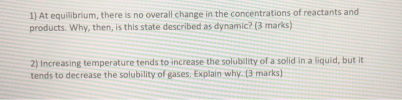 1) At equilibrium, there is no overall change in the concentrations of reactants and products. Why, then, is this state described as dynamic? (3 marks) 2) Increasing temperature tends to increase the solubility of a solid in a liquid, but it tends to decrease the solubility of gases. Explain why. (3 marks)
Consider the following reaction:2 N2O(g) → 2 N2(g)+O2(g)
Consider the following reaction:2 N2O(g) → 2 N2(g)+O2(g)Part AExpress the rate of the reaction in terms of the change in concentration of each of the reactants and products.Express the rate of the reaction in terms of the change in concentration of each of the reactants and products.Rate=12Δ[N2O]Δt=−12Δ[N2]Δt=Δ[O2]ΔtRate=Δ[N2O]Δt=12Δ[N2]Δt=−12Δ[O2]ΔtRate=−Δ[N2O]Δt=−12Δ[N2]Δt=12Δ[O2]ΔtRate=−12Δ[N2O]Δt=12Δ[N2]Δt=Δ[O2]ΔtPart BIn the first 14.0 s of the reaction, 1.9×10⁻² mol of O2 is produced in a reaction vessel with a volume of 0.460 L . What is the average rate of the reaction over this time...
Consider the following reaction: 2 N2O(g) → 2 N2(g)+O2(g) A) Express the rate of the reaction...
Consider the following reaction: 2 N2O(g) → 2 N2(g)+O2(g) A) Express the rate of the reaction in terms of the change in concentration of each of the reactants and products. ans: Rate= −1/2 Δ[N2O] / Δt= 1/2 Δ[N2] / Δt = Δ[O2] / Δt B) In the first 13.0 s of the reaction, 1.7×10⁻² mol of O2 is produced in a reaction vessel with a volume of 0.440 L . What is the average rate of the reaction over this time interval? ans:...
 For which reaction does Kp = K ? NH4NO3 (8) = N2O(g) + 2H2O(9) 2Na,02()+2C02(9) = 2Na2CO3(s) + O2(g) O Fe2O3(s) + 3CO(9) = 2Fe(s) + 3C02 (9)
 NH4NO3(aq)N2O(g)
+ 2H2O(l)
Using the standard thermodynamic data in the tables linked above,
calculate the equilibrium constant for this reaction at
298.15K.
ANSWER:
NH4NO3(aq)N2O(g)
+ 2H2O(l)
Using the standard thermodynamic data in the tables linked above,
calculate the equilibrium constant for this reaction at
298.15K.
ANSWER:
 1) At equilibrium, there is no overall change in the concentrations of reactants and products. Why, then, is this state described as dynamic? (3 marks) 2) Increasing temperature tends to increase the solubility of a solid in a liquid, but it tends to decrease the solubility of gases. Explain why. (3 marks)
Most questions answered within 3 hours.
-
Where is the error in this code sequence?
String s1 = "Hello";
String s2 = "ello";...
asked 10 months ago -
Financial data for Joel de Paris, Inc., for last year
follow:
Joel de Paris, Inc.
Balance...
asked 10 months ago -
Consider this reaction:
Al2(SO4)3 (aq)+ BaCl3
(aq) Al2Cl6 (aq)- +
3BaSO4(s) . What is the...
asked 10 months ago -
Suppose that Savneet is considering increasing her
recent random sample from 20 car rentals to 40...
asked 10 months ago -
Trucks arrive at an unloading terminal at an average rate of 120
per hour.
Trucks arrive...
asked 10 months ago -
Why are methanol and ethanol completely soluble in water while
octanol is not very little soluble....
asked 10 months ago -
A facilities manager at a university reads in a research report
that the mean amount of...
asked 10 months ago -
When the CuSO4 is rehydrated by adding water to the anhydrous
compound, is this an endothermic...
asked 10 months ago -
A ray of sunlight is passing from diamond into crown glass; the
angle of incidence is...
asked 10 months ago -
A block of mass 0.249 kg is placed on top of a light, vertical
spring of...
asked 10 months ago -
how do the kidneys compensate in the presences of acidosis
a) trigger hyperventilate
b) reserve acid...
asked 10 months ago -
Question 501 pts
The rental rate of capital to the firm increases. Which of the
following...
asked 10 months ago