A 10- kg fish swims toward and swallows a 2.5 kg fish that is at rest....
A 10- kg fish swims toward and swallows a 2.5 kg fish that is at rest. If the larger fish swims at 3 m/s, what is its velocity after dinner?
Homework Answers

Add Answer to:
A 10- kg fish swims toward and swallows a 2.5 kg fish that is at
rest....
A 6.1-kg fish swims toward and swallows a 1.6-kg fish that is at rest. If the...
A 6.1-kg fish swims toward and swallows a 1.6-kg fish that is at rest. If the larger fish swims at 0.8 m/s, what is its velocity immediately after lunch?
a 5 kg fish swimming at a speed of 1m/s swallows an absent minded 1 kg fish swimming toward it at 4 m/s
a 5 kg fish swimming at a speed of 1m/s swallows an absent minded 1 kg fish swimming toward it at 4 m/s. the speed of the larger fish after lunch is?
I need solutions that are detailed for these introductory physics questions please! Name: ID: 1. Consider...
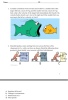 I need solutions that are detailed for these introductory
physics questions please!
Name: ID: 1. Consider a fish that swims toward and swallows a smaller fish. If the larger fish has a mass of 5kg and the smaller one has a mass of 1-kg fish, what is the velocity of the larger fish immediately after lunch if its velocity before lunch was 1 m/s to the right and if the smaller fish was moving to the left at a velocity...
I need solutions that are detailed for these introductory
physics questions please!
Name: ID: 1. Consider a fish that swims toward and swallows a smaller fish. If the larger fish has a mass of 5kg and the smaller one has a mass of 1-kg fish, what is the velocity of the larger fish immediately after lunch if its velocity before lunch was 1 m/s to the right and if the smaller fish was moving to the left at a velocity...
A 5 kg fish swims at 1 m / s when a distracted fish of 1...
A 5 kg fish swims at 1 m / s when a distracted fish of 1 kg of mass is swallowed that swims in the opposite direction and stops when swallowed. What is the speed of the distracted fish before being swallowed?
In Connecticut River a 3kg fish moving at 3m/s towards North swallows another 0.5 kg fish...
In Connecticut River a 3kg fish moving at 3m/s towards North swallows another 0.5 kg fish moving at 1.5m/s towards South. What the speed of the big fish is after swallowed the small fish?
A big fish, mbig fish=2.4kg, swimming with a speed of vbig=0.18ms swallows a smaller fish msmall...
A big fish, mbig fish=2.4kg, swimming with a speed of vbig=0.18ms swallows a smaller fish msmall fish=0.2kg initially at rest. What is the mass of the big fish, right after he ate his lunch ? Hint: Consider this is an elastic collision! A) 2.6kg; B) 1.2ms; C) 2.2kg; D) 3.9;
momentum
a 5 kg fish swimming 1 meter per second swallows an absentminded 1 kg fish swimming toward it at a velocity that brings both to a halt immediately after lunch. what isthe velocity of the smaller fish before lunch?
A fish swims at 20 m of depth from water surface. The density of water is...
 A fish swims at 20 m of depth from water surface. The density of water is 1000 kg/ m3, the acceleration due to gravity is 10 m/s2 , and the atmospheric pressure is 105 N/m2. Fluid pressure at the depth 20 *:m is N/m2
Starting at rest at the edge of a swimming pool, a 67.0 kg athlete swims along...
Starting at rest at the edge of a swimming pool, a 67.0 kg athlete swims along the surface of the water and reaches a speed of 1.20 m/s by doing the work Wnc1 = 161 J . Find the nonconservative work, Wnc2, done by the water on the athlete.
A fish swimming in a horizontal plane has velocity m/s at a point in a the...
 A fish swimming in a horizontal plane has velocity m/s at a point in a the ocean where the position relative to a certain rock is m. After the fish swims with constant acceleration for 15.0 s, its velocity is m/s. What are the components of the acceleration of the fish? What is the direction of its acceleration with respect to unit vector ? counterclockwise from the +x-axis If the fish maintains constant acceleration, where is it at t =...
 I need solutions that are detailed for these introductory
physics questions please!
Name: ID: 1. Consider a fish that swims toward and swallows a smaller fish. If the larger fish has a mass of 5kg and the smaller one has a mass of 1-kg fish, what is the velocity of the larger fish immediately after lunch if its velocity before lunch was 1 m/s to the right and if the smaller fish was moving to the left at a velocity...
I need solutions that are detailed for these introductory
physics questions please!
Name: ID: 1. Consider a fish that swims toward and swallows a smaller fish. If the larger fish has a mass of 5kg and the smaller one has a mass of 1-kg fish, what is the velocity of the larger fish immediately after lunch if its velocity before lunch was 1 m/s to the right and if the smaller fish was moving to the left at a velocity...
 A fish swims at 20 m of depth from water surface. The density of water is 1000 kg/ m3, the acceleration due to gravity is 10 m/s2 , and the atmospheric pressure is 105 N/m2. Fluid pressure at the depth 20 *:m is N/m2
 A fish swimming in a horizontal plane has velocity m/s at a point in a the ocean where the position relative to a certain rock is m. After the fish swims with constant acceleration for 15.0 s, its velocity is m/s. What are the components of the acceleration of the fish? What is the direction of its acceleration with respect to unit vector ? counterclockwise from the +x-axis If the fish maintains constant acceleration, where is it at t =...
Most questions answered within 3 hours.
-
Where is the error in this code sequence?
String s1 = "Hello";
String s2 = "ello";...
asked 11 months ago -
Financial data for Joel de Paris, Inc., for last year
follow:
Joel de Paris, Inc.
Balance...
asked 11 months ago -
Consider this reaction:
Al2(SO4)3 (aq)+ BaCl3
(aq) Al2Cl6 (aq)- +
3BaSO4(s) . What is the...
asked 11 months ago -
Suppose that Savneet is considering increasing her
recent random sample from 20 car rentals to 40...
asked 11 months ago -
Trucks arrive at an unloading terminal at an average rate of 120
per hour.
Trucks arrive...
asked 11 months ago -
Why are methanol and ethanol completely soluble in water while
octanol is not very little soluble....
asked 11 months ago -
A facilities manager at a university reads in a research report
that the mean amount of...
asked 11 months ago -
When the CuSO4 is rehydrated by adding water to the anhydrous
compound, is this an endothermic...
asked 11 months ago -
A ray of sunlight is passing from diamond into crown glass; the
angle of incidence is...
asked 11 months ago -
A block of mass 0.249 kg is placed on top of a light, vertical
spring of...
asked 11 months ago -
how do the kidneys compensate in the presences of acidosis
a) trigger hyperventilate
b) reserve acid...
asked 11 months ago -
Question 501 pts
The rental rate of capital to the firm increases. Which of the
following...
asked 11 months ago