why amines reacts with 2,4 DNP giving a false possitive result
Homework Answers

Which sample(s) gave a positive result for the 2,4-DNP test? tert-butanol formaldehyde cyclohexanone acetone
Which sample(s) gave a positive result for the 2,4-DNP test? tert-butanol formaldehyde cyclohexanone acetone
Why would benzylamine or an amine (carbonyl-less) unknown be positive in the 2,4 DNP test
Why would benzylamine or an amine (carbonyl-less) unknown be positive in the 2,4 DNP test
7. When isopentyl ethanoate reacts with DIBAH it produces an aldehyde; however, if the same ester...
 7. When isopentyl ethanoate reacts with DIBAH it produces an aldehyde; however, if the same ester reacts with LAH, it produces ethanol. Why is this? Please draw reactions/intermediates/steps to explain. (5) 7. When isopentyl ethanoate reacts with DIBAH it produces an aldehyde; however, if the same ester reacts with LAH, it produces ethanol. Why is this? Please draw reactions/intermediates/steps to explain. (5) 9. 2,4-DNP is known to form imines on reaction with any aldehyde or ketone giving a characteristic yellow...
3. What is a positive test for the 2,4-DNP test with an aliphatic ketone? (2 points)...
 3. What is a positive test for the 2,4-DNP test with an aliphatic ketone? (2 points) 4. Draw the final product you obtain by reacting acetone with 2,4-DNP. (2 points)
14. The molecule 2,4-dinitrophenol (DNP) is an uncoupling agent that breaks down the concentration gradient of...
 14. The molecule 2,4-dinitrophenol (DNP) is an uncoupling agent that breaks down the concentration gradient of protons formed during oxidative phosphorylation. DNP shuttling protons across the cell membrane, equalizing the concentration of protons on either side of the membrane. Which of the following will be true for a bacterium poisoned with DNP? a. The cell will have an increased level of NADH in the cytoplasm b. Oxygen will not be converted to water by the electron transport chain c. Glycolysis...
14. The molecule 2,4-dinitrophenol (DNP) is an uncoupling agent that breaks down the concentration gradient of...
 14. The molecule 2,4-dinitrophenol (DNP) is an uncoupling agent that breaks down the concentration gradient of protons formed during oxidative phosphorylation. DNP shuttling protons across the cell membrane, equalizing the concentration of protons on either side of the membrane. Which of the following will be true for a bacterium poisoned with DNP? a. The cell will have an increased level of NADH in the cytoplasm b. Oxygen will not be converted to water by the electron transport chain c. Glycolysis...
Regarding the qualitative analysis experiment which of the following statements is false? Ellagic acid decolorizes Br_2/CH_2Cl_2...
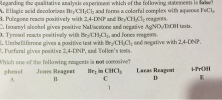 Regarding the qualitative analysis experiment which of the following statements is false? Ellagic acid decolorizes Br_2/CH_2Cl_2 and forms a colorful complex with aqueous FeCl_3. Pulegone reacts positively with 2,4-DNP and Br_2/CH_2Cl_2 reagents. Isoamyl alcohol gives positive NaI/acetone and negative AgNO_3/EtOH tests. Tyrosol reacts positively with Br_2/CH_2Cl_2, and Jones reagents. Umbelliferone gives a positive test with B Br_2/CH_2Cl_2 and negative with 2,4-DNP. Furfural gives positive 2,4-DNP, and Tollen's tests. Which one of the following reagents is not corrosive?
What are the 2,4 DNP and semicarbazone derivatives of butanal? Please show the mechanism with curvy...
What are the 2,4 DNP and semicarbazone derivatives of butanal? Please show the mechanism with curvy arrow. Thank you.
2,4-dinitrophenol (DNP) and carbonylcyanide-p-trifluoromethoxyphenylhydrazone (FCCP) are well known uncouplers that can dissipate the proton gradient across...
2,4-dinitrophenol (DNP) and carbonylcyanide-p-trifluoromethoxyphenylhydrazone (FCCP) are well known uncouplers that can dissipate the proton gradient across the inner mitochondrial membrane created by the electron-transport system. Explain how this uncoupling works, in terms of the chemical properties of DNP and FCCP.
b. Draw the product when a ketone is treated with 2,4-DNP in the presence of catalytic...
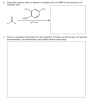 b. Draw the product when a ketone is treated with 2,4-DNP in the presence of catalytic acid O2N NO2 H2NHN HO* (cat.) R c. Draw a complete mechanism for this reaction. Include curved arrows, all reactive intermediates, and elementary step labels above each step
 7. When isopentyl ethanoate reacts with DIBAH it produces an aldehyde; however, if the same ester reacts with LAH, it produces ethanol. Why is this? Please draw reactions/intermediates/steps to explain. (5) 7. When isopentyl ethanoate reacts with DIBAH it produces an aldehyde; however, if the same ester reacts with LAH, it produces ethanol. Why is this? Please draw reactions/intermediates/steps to explain. (5) 9. 2,4-DNP is known to form imines on reaction with any aldehyde or ketone giving a characteristic yellow...
 3. What is a positive test for the 2,4-DNP test with an aliphatic ketone? (2 points) 4. Draw the final product you obtain by reacting acetone with 2,4-DNP. (2 points)
 14. The molecule 2,4-dinitrophenol (DNP) is an uncoupling agent that breaks down the concentration gradient of protons formed during oxidative phosphorylation. DNP shuttling protons across the cell membrane, equalizing the concentration of protons on either side of the membrane. Which of the following will be true for a bacterium poisoned with DNP? a. The cell will have an increased level of NADH in the cytoplasm b. Oxygen will not be converted to water by the electron transport chain c. Glycolysis...
 14. The molecule 2,4-dinitrophenol (DNP) is an uncoupling agent that breaks down the concentration gradient of protons formed during oxidative phosphorylation. DNP shuttling protons across the cell membrane, equalizing the concentration of protons on either side of the membrane. Which of the following will be true for a bacterium poisoned with DNP? a. The cell will have an increased level of NADH in the cytoplasm b. Oxygen will not be converted to water by the electron transport chain c. Glycolysis...
 Regarding the qualitative analysis experiment which of the following statements is false? Ellagic acid decolorizes Br_2/CH_2Cl_2 and forms a colorful complex with aqueous FeCl_3. Pulegone reacts positively with 2,4-DNP and Br_2/CH_2Cl_2 reagents. Isoamyl alcohol gives positive NaI/acetone and negative AgNO_3/EtOH tests. Tyrosol reacts positively with Br_2/CH_2Cl_2, and Jones reagents. Umbelliferone gives a positive test with B Br_2/CH_2Cl_2 and negative with 2,4-DNP. Furfural gives positive 2,4-DNP, and Tollen's tests. Which one of the following reagents is not corrosive?
 b. Draw the product when a ketone is treated with 2,4-DNP in the presence of catalytic acid O2N NO2 H2NHN HO* (cat.) R c. Draw a complete mechanism for this reaction. Include curved arrows, all reactive intermediates, and elementary step labels above each step
Most questions answered within 3 hours.
-
Where is the error in this code sequence?
String s1 = "Hello";
String s2 = "ello";...
asked 10 months ago -
Financial data for Joel de Paris, Inc., for last year
follow:
Joel de Paris, Inc.
Balance...
asked 10 months ago -
Consider this reaction:
Al2(SO4)3 (aq)+ BaCl3
(aq) Al2Cl6 (aq)- +
3BaSO4(s) . What is the...
asked 10 months ago -
Suppose that Savneet is considering increasing her
recent random sample from 20 car rentals to 40...
asked 10 months ago -
Trucks arrive at an unloading terminal at an average rate of 120
per hour.
Trucks arrive...
asked 10 months ago -
Why are methanol and ethanol completely soluble in water while
octanol is not very little soluble....
asked 10 months ago -
A facilities manager at a university reads in a research report
that the mean amount of...
asked 10 months ago -
When the CuSO4 is rehydrated by adding water to the anhydrous
compound, is this an endothermic...
asked 10 months ago -
A ray of sunlight is passing from diamond into crown glass; the
angle of incidence is...
asked 10 months ago -
A block of mass 0.249 kg is placed on top of a light, vertical
spring of...
asked 10 months ago -
how do the kidneys compensate in the presences of acidosis
a) trigger hyperventilate
b) reserve acid...
asked 10 months ago -
Question 501 pts
The rental rate of capital to the firm increases. Which of the
following...
asked 10 months ago