Let {?1,?2} be two error events and we are interested in P(?1∪?2), the probability of the...
Let {?1,?2} be two error events and we are interested in
P(?1∪?2), the probability of the union of two events. Explain what
the union (upper) bound is and state when t he equality of this
upper bound holds.
Homework Answers
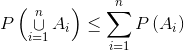
Boole’s inequality is used to find the upper bound of union of events:
If  are n events then the upper bound of union of events is the sum of
the probabilities of n events:
are n events then the upper bound of union of events is the sum of
the probabilities of n events:
Given Information:
 are
two given error events.
are
two given error events.
The upper bound of union of two given error events is calculated using Boole’s inequality and is given by:

Hence, the upper bound of union of
two given error events is  .
.
If the two given error events are mutually exclusive then
 .
.
Using the addition rule of probability:
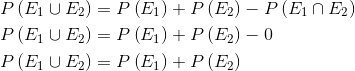
The equality of this upper bound holds when the two given error events are mutually exclusive.
Add Answer to:
Let {?1,?2} be two error events and we are interested in
P(?1∪?2), the probability of the...
1. If two events are independent how do we calculate the and probability, P(E and F),...
1. If two events are independent how do we calculate the and probability, P(E and F), of the two events? (As a side note: this "and" probability, P(E and F), is called the joint probability of Events E and F. Likewise, the probability of an individual event, like P(E), is called the marginal probability of Event E.) 2. One way to interpret conditional probability is that the sample space for the conditional probability is the "conditioning" event. If Event A...
1. (2 pts) If A and B are events, where P(B) > 0, then show that P(A' |B) 1- P(A | B) Hint: Use the definition o...
 1. (2 pts) If A and B are events, where P(B) > 0, then show that P(A' |B) 1- P(A | B) Hint: Use the definition of conditional probability to show that P(A | B) P(A' | B) 1. derived the Law of Total Probability (the simple case) Take a look at how we 4. (2 pts) At the beginning of the week, George made seven sandwiches: three turkey sandwiches two ham sandwiches, and two roast beef sandwiches. Each day,...
Suppose that we have two events E and F such that their union is the entire...
Suppose that we have two events E and F such that their union is the entire sample space and P(E)=1/3 and P(F)=2/3. Are they independent? Explain.
1) Let A, B and C be three events with P(A) = 94%, P(B) = 11%,...
 1) Let A, B and C be three events with P(A) = 94%, P(B) = 11%, and P(C) = 4%. Answer the following questions if B and C are disjoint and P(ANC) = 3%, and P(ANB) = 8%. a. Fill the Venn diagram with probabilities of each area. Find the probability that event C does not happen on its own? (That is, either C does not happen, or it happens with other events.) c. Find the probability that at least...
2. a) Let A and B be two events such that P(A) 4, P(B) .5 and...
 2. a) Let A and B be two events such that P(A) 4, P(B) .5 and P(AnB) 3 Find P(AUB). b) Let A and B be two events such that P(A)-5, P(B) 3 and P(AUB) .6. Find P(An B)
Since t is difficult to evaluate the integral e dx exactly, we will approximate t using Maclaurınn polynomials 2 (a) De...
 Since t is difficult to evaluate the integral e dx exactly, we will approximate t using Maclaurınn polynomials 2 (a) Determine P4(x), the 4th degree Maclaurin polynomial of the integrand e" (b) Obtain an upper bound on the error in the integrand for r in the range 0S S 1/2 (c) Find an approximation to the original integral by integrating P4(x) (d) Obtain an upper bound on the error in the integration in (c) 2, when the integrand is approximated...
2. Let C and D be two events exhaustively defining a sample space, we know that...
 2. Let C and D be two events exhaustively defining a sample space, we know that P(C) = 0.3, P(D) = 0.4, and P(c n D) = 0.2. what is P(C" n D)?
Let A,B be two events given on a probability space (Ω, F, P). Find E(1A|1B).
Let A,B be two events given on a probability space (Ω, F, P). Find E(1A|1B).
4. Let (2, P) be a finite probability space. Recall that if A 2 is an...
 4. Let (2, P) be a finite probability space. Recall that if A 2 is an event, then the probability of A is P(A)-〉 P(w). WEA Let A be the compliment of A. Show that a) P(Ac)1- P(A) b) Let Ņ є Z+ be an arbitrarily large integer. If Ai, A2, . . . , AN are a set of events, then prove k-1 k-1
Let X and Y be two independent and identically distributed random variables with expected value 1...
Let X and Y be two independent and identically distributed random variables with expected value 1 and variance 2.56. First, find a non-trivial upper bound for P(|X + Y − 2| ≥ 1). Now suppose that X and Y are independent and identically distributed N(1,2.56) random variables. What is P(|X + Y − 2| ≥ 1) exactly? Why is the upper bound first obtained so different from the exact probability obtained?
 1. (2 pts) If A and B are events, where P(B) > 0, then show that P(A' |B) 1- P(A | B) Hint: Use the definition of conditional probability to show that P(A | B) P(A' | B) 1. derived the Law of Total Probability (the simple case) Take a look at how we 4. (2 pts) At the beginning of the week, George made seven sandwiches: three turkey sandwiches two ham sandwiches, and two roast beef sandwiches. Each day,...
 1) Let A, B and C be three events with P(A) = 94%, P(B) = 11%, and P(C) = 4%. Answer the following questions if B and C are disjoint and P(ANC) = 3%, and P(ANB) = 8%. a. Fill the Venn diagram with probabilities of each area. Find the probability that event C does not happen on its own? (That is, either C does not happen, or it happens with other events.) c. Find the probability that at least...
 2. a) Let A and B be two events such that P(A) 4, P(B) .5 and P(AnB) 3 Find P(AUB). b) Let A and B be two events such that P(A)-5, P(B) 3 and P(AUB) .6. Find P(An B)
 Since t is difficult to evaluate the integral e dx exactly, we will approximate t using Maclaurınn polynomials 2 (a) Determine P4(x), the 4th degree Maclaurin polynomial of the integrand e" (b) Obtain an upper bound on the error in the integrand for r in the range 0S S 1/2 (c) Find an approximation to the original integral by integrating P4(x) (d) Obtain an upper bound on the error in the integration in (c) 2, when the integrand is approximated...
 2. Let C and D be two events exhaustively defining a sample space, we know that P(C) = 0.3, P(D) = 0.4, and P(c n D) = 0.2. what is P(C" n D)?
 4. Let (2, P) be a finite probability space. Recall that if A 2 is an event, then the probability of A is P(A)-〉 P(w). WEA Let A be the compliment of A. Show that a) P(Ac)1- P(A) b) Let Ņ є Z+ be an arbitrarily large integer. If Ai, A2, . . . , AN are a set of events, then prove k-1 k-1
Most questions answered within 3 hours.
-
Where is the error in this code sequence?
String s1 = "Hello";
String s2 = "ello";...
asked 10 months ago -
Financial data for Joel de Paris, Inc., for last year
follow:
Joel de Paris, Inc.
Balance...
asked 10 months ago -
Consider this reaction:
Al2(SO4)3 (aq)+ BaCl3
(aq) Al2Cl6 (aq)- +
3BaSO4(s) . What is the...
asked 10 months ago -
Suppose that Savneet is considering increasing her
recent random sample from 20 car rentals to 40...
asked 10 months ago -
Trucks arrive at an unloading terminal at an average rate of 120
per hour.
Trucks arrive...
asked 10 months ago -
Why are methanol and ethanol completely soluble in water while
octanol is not very little soluble....
asked 10 months ago -
A facilities manager at a university reads in a research report
that the mean amount of...
asked 10 months ago -
When the CuSO4 is rehydrated by adding water to the anhydrous
compound, is this an endothermic...
asked 10 months ago -
A ray of sunlight is passing from diamond into crown glass; the
angle of incidence is...
asked 10 months ago -
A block of mass 0.249 kg is placed on top of a light, vertical
spring of...
asked 10 months ago -
how do the kidneys compensate in the presences of acidosis
a) trigger hyperventilate
b) reserve acid...
asked 10 months ago -
Question 501 pts
The rental rate of capital to the firm increases. Which of the
following...
asked 10 months ago