Consider the BF3 molecule. There are SALCs from the F valence orbitals which transform as A2”...
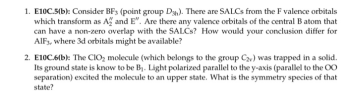
Consider the BF3 molecule. There are SALCs from the F valence orbitals which transform as A2” and E”. Are there any valence orbitals of the central B atom that can have a non-zero overlap with these SALCs? How would your conclusion differ for AlF3 where 3d orbitals might be available?
Homework Answers
Request Answer!
We need at least 10 more requests to produce the answer.
0 / 10 have requested this problem solution
The more requests, the faster the answer.
Add Answer to:
Consider the BF3 molecule. There are SALCs from the F valence
orbitals which transform as A2”...
please explain and answer both questions very confused and not sure where to start. Thank You! 1. E10C.5(b): Consid...
 please explain and answer both questions very confused and not sure
where to start. Thank You!
1. E10C.5(b): Consider BF3 (point group D3h). There are SALCs from the F valence orbitals which transform as A" and E". Are there any valence orbitals of the central B atom that can have a non-zero overlap with the SALCs? How would your conclusion differ for AlF3, where 3d orbitals might be available? 2. E10C.6(b): The ClO2 molecule (which belongs to the group C2v)...
please explain and answer both questions very confused and not sure
where to start. Thank You!
1. E10C.5(b): Consider BF3 (point group D3h). There are SALCs from the F valence orbitals which transform as A" and E". Are there any valence orbitals of the central B atom that can have a non-zero overlap with the SALCs? How would your conclusion differ for AlF3, where 3d orbitals might be available? 2. E10C.6(b): The ClO2 molecule (which belongs to the group C2v)...
BF3 (4 Pts) B) total number of valence electrons___________ B) Draw the Lewis Structure C) Steric...
BF3 (4 Pts) B) total number of valence electrons___________ B) Draw the Lewis Structure C) Steric number (SN) of central atom __________ D) Electron pair geometry________________________ G) Sketch 3D geometry E) Molecular geometry___________________________ F) Is molecule polar______________________________ H) Hybridization_________________________
Sho Consider the following molecule. Draw the Lewis Structure and use that to fill in the following chart: AlCl 24 Number of Valence e (Whole Structure) Areas of e Density Around Central Atom: El...
 Sho Consider the following molecule. Draw the Lewis Structure and use that to fill in the following chart: AlCl 24 Number of Valence e (Whole Structure) Areas of e Density Around Central Atom: Electronic Geometry: Trigonal Planar # Bonding Areas (Central Atom): # Non-Bonding Areas (Central Atom): Molecular Geometry Select an answer Bond Angles (Central Atom) Select an answer Select an answer Polar Bonds? Polar Molecule? Select an answer Any Pi (Double/Triple) Bonds? Select an answer
Sho Consider the following...
Sho Consider the following molecule. Draw the Lewis Structure and use that to fill in the following chart: AlCl 24 Number of Valence e (Whole Structure) Areas of e Density Around Central Atom: Electronic Geometry: Trigonal Planar # Bonding Areas (Central Atom): # Non-Bonding Areas (Central Atom): Molecular Geometry Select an answer Bond Angles (Central Atom) Select an answer Select an answer Polar Bonds? Polar Molecule? Select an answer Any Pi (Double/Triple) Bonds? Select an answer
Sho Consider the following...
1. The chromium-chromium bonding in a molecule uses the 3d orbitals of the chromium atoms. a....
1. The chromium-chromium bonding in a molecule uses the 3d orbitals of the chromium atoms. a. Draw the 3d orbitals of a chromium atom being sure to label the x, y and z axes. Standard convention is that the z-axis is parallel to the internuclear axis. b. Draw the MO energy diagram for an isolated [Cr2]2+ fragment (no ligands!) assuming the interactions of only the 3d orbitals. Assume that the z-axis is parallel to the internuclear axis c. Next to...
4. On the basis of molecular orbitals and molecular orbital diagrams, predict which molecule in each...
 4. On the basis of molecular orbitals and molecular orbital diagrams, predict which molecule in each series will have the longest bond. Be sure to provide a brief explanation a. B2, B2 b. 02*, 0,- c. HHe", Hz 5. Consider the hydroxide ion, OH and do the following: a. Prepare a molecular orbital diagram and fill with electrons given the following atomic orbital potential energies: O(2s) = -32.3 eV, O(2p) = -15.8 eV, H(s) -13.6 eV. Be sure to label...
Show In Consider the following molecule. Draw the Lewis Structure and use that to fill in...
 Show In Consider the following molecule. Draw the Lewis Structure and use that to fill in the following chart SbCl5 Number of Valence e (Whole Structure) Areas of e Density Around Central Atom: Electronic Geometry: # Bonding Areas (Central Atom): # Non-Bonding Areas (Central Atom): Molecular Geometry Bond Angles (Central Atom) Polar Bonds? Polar Molecule? Any Pi (Double/Triple) Bonds? Select an answer Select an answer Select an answer Select an answer Select an answer Select an answer 6
Consider the following molecule. Draw the Lewis Structure and use that to fll ln the following chart PFs Number of...
 Consider the following molecule. Draw the Lewis Structure and use that to fll ln the following chart PFs Number of Valence e (Whole Structure) Areas of e Density Around Central Atom Electronic Geometry Select an answer # Bonding Areas (Central Atom): # Non-Bonding Areas (Central Atom) Molecular Geometry Select an answer Bond Angles (Central Atom) Select an answer Y Polar Bonds? Select an answer Polar Molecule? Select an answer Any Pi (Double/Triple) Bonds? Select an answer Points possible: 1 Unlimited...
Consider the following molecule. Draw the Lewis Structure and use that to fill in the following...
 Consider the following molecule. Draw the Lewis Structure and use that to fill in the following chart: NF3 Number of Valence e (Whole Structure Areas of e Density Around Central Atom: Electronic Geometry Select an answer # Bonding Areas (Central Atom): # Non-Bonding Areas (Central Atom): Molecular Geometry Select an answer Select an answer Select an answer Bond Angles (Central Atom) Polar Bonds? Polar Molecule? Select an answer Any Pi (Double/Triple) Bonds? Select an answer " Points possible: 1 Unlimited...
Consider the molecule AX5, where the central atom A has no lone pairs. X represents the...
Consider the molecule AX5, where the central atom A has no lone pairs. X represents the outer atoms, all identical to each other. How many of the following statements are correct? A. The central atom A utilizes its outermost ns orbital, all three of its outermost np orbitals, and two of its (n – 1)d orbitals for bonding. B. The A-X equatorial bond length is shorter than the A-X axial bond length. C. Suppose in AX5 a lone pair was...
I need help with questions 1-8 POST-LAB: LABORATORY 11 Complete on a separate sheet of paper. 1. Indicate whether the molecule is an ion. Then, indicate whether the molecule is polar m. I n. H...
 I need help with questions 1-8
POST-LAB: LABORATORY 11 Complete on a separate sheet of paper. 1. Indicate whether the molecule is an ion. Then, indicate whether the molecule is polar m. I n. H,PO o. BrO, p. IF q CO2 a. HCN b. H,SO c. HNO, d. BF H,CO, i. SF j. BeCl k. PO, 1. SO, e. XeF f H,O Calculate the number of valence electrons in each structure in question 1 2. Draw a correct Lewis dot...
I need help with questions 1-8
POST-LAB: LABORATORY 11 Complete on a separate sheet of paper. 1. Indicate whether the molecule is an ion. Then, indicate whether the molecule is polar m. I n. H,PO o. BrO, p. IF q CO2 a. HCN b. H,SO c. HNO, d. BF H,CO, i. SF j. BeCl k. PO, 1. SO, e. XeF f H,O Calculate the number of valence electrons in each structure in question 1 2. Draw a correct Lewis dot...
 please explain and answer both questions very confused and not sure
where to start. Thank You!
1. E10C.5(b): Consider BF3 (point group D3h). There are SALCs from the F valence orbitals which transform as A" and E". Are there any valence orbitals of the central B atom that can have a non-zero overlap with the SALCs? How would your conclusion differ for AlF3, where 3d orbitals might be available? 2. E10C.6(b): The ClO2 molecule (which belongs to the group C2v)...
please explain and answer both questions very confused and not sure
where to start. Thank You!
1. E10C.5(b): Consider BF3 (point group D3h). There are SALCs from the F valence orbitals which transform as A" and E". Are there any valence orbitals of the central B atom that can have a non-zero overlap with the SALCs? How would your conclusion differ for AlF3, where 3d orbitals might be available? 2. E10C.6(b): The ClO2 molecule (which belongs to the group C2v)...
 Sho Consider the following molecule. Draw the Lewis Structure and use that to fill in the following chart: AlCl 24 Number of Valence e (Whole Structure) Areas of e Density Around Central Atom: Electronic Geometry: Trigonal Planar # Bonding Areas (Central Atom): # Non-Bonding Areas (Central Atom): Molecular Geometry Select an answer Bond Angles (Central Atom) Select an answer Select an answer Polar Bonds? Polar Molecule? Select an answer Any Pi (Double/Triple) Bonds? Select an answer
Sho Consider the following...
Sho Consider the following molecule. Draw the Lewis Structure and use that to fill in the following chart: AlCl 24 Number of Valence e (Whole Structure) Areas of e Density Around Central Atom: Electronic Geometry: Trigonal Planar # Bonding Areas (Central Atom): # Non-Bonding Areas (Central Atom): Molecular Geometry Select an answer Bond Angles (Central Atom) Select an answer Select an answer Polar Bonds? Polar Molecule? Select an answer Any Pi (Double/Triple) Bonds? Select an answer
Sho Consider the following...
 4. On the basis of molecular orbitals and molecular orbital diagrams, predict which molecule in each series will have the longest bond. Be sure to provide a brief explanation a. B2, B2 b. 02*, 0,- c. HHe", Hz 5. Consider the hydroxide ion, OH and do the following: a. Prepare a molecular orbital diagram and fill with electrons given the following atomic orbital potential energies: O(2s) = -32.3 eV, O(2p) = -15.8 eV, H(s) -13.6 eV. Be sure to label...
 Show In Consider the following molecule. Draw the Lewis Structure and use that to fill in the following chart SbCl5 Number of Valence e (Whole Structure) Areas of e Density Around Central Atom: Electronic Geometry: # Bonding Areas (Central Atom): # Non-Bonding Areas (Central Atom): Molecular Geometry Bond Angles (Central Atom) Polar Bonds? Polar Molecule? Any Pi (Double/Triple) Bonds? Select an answer Select an answer Select an answer Select an answer Select an answer Select an answer 6
 Consider the following molecule. Draw the Lewis Structure and use that to fll ln the following chart PFs Number of Valence e (Whole Structure) Areas of e Density Around Central Atom Electronic Geometry Select an answer # Bonding Areas (Central Atom): # Non-Bonding Areas (Central Atom) Molecular Geometry Select an answer Bond Angles (Central Atom) Select an answer Y Polar Bonds? Select an answer Polar Molecule? Select an answer Any Pi (Double/Triple) Bonds? Select an answer Points possible: 1 Unlimited...
 Consider the following molecule. Draw the Lewis Structure and use that to fill in the following chart: NF3 Number of Valence e (Whole Structure Areas of e Density Around Central Atom: Electronic Geometry Select an answer # Bonding Areas (Central Atom): # Non-Bonding Areas (Central Atom): Molecular Geometry Select an answer Select an answer Select an answer Bond Angles (Central Atom) Polar Bonds? Polar Molecule? Select an answer Any Pi (Double/Triple) Bonds? Select an answer " Points possible: 1 Unlimited...
 I need help with questions 1-8
POST-LAB: LABORATORY 11 Complete on a separate sheet of paper. 1. Indicate whether the molecule is an ion. Then, indicate whether the molecule is polar m. I n. H,PO o. BrO, p. IF q CO2 a. HCN b. H,SO c. HNO, d. BF H,CO, i. SF j. BeCl k. PO, 1. SO, e. XeF f H,O Calculate the number of valence electrons in each structure in question 1 2. Draw a correct Lewis dot...
I need help with questions 1-8
POST-LAB: LABORATORY 11 Complete on a separate sheet of paper. 1. Indicate whether the molecule is an ion. Then, indicate whether the molecule is polar m. I n. H,PO o. BrO, p. IF q CO2 a. HCN b. H,SO c. HNO, d. BF H,CO, i. SF j. BeCl k. PO, 1. SO, e. XeF f H,O Calculate the number of valence electrons in each structure in question 1 2. Draw a correct Lewis dot...
Most questions answered within 3 hours.
-
Where is the error in this code sequence?
String s1 = "Hello";
String s2 = "ello";...
asked 10 months ago -
Financial data for Joel de Paris, Inc., for last year
follow:
Joel de Paris, Inc.
Balance...
asked 10 months ago -
Consider this reaction:
Al2(SO4)3 (aq)+ BaCl3
(aq) Al2Cl6 (aq)- +
3BaSO4(s) . What is the...
asked 10 months ago -
Suppose that Savneet is considering increasing her
recent random sample from 20 car rentals to 40...
asked 10 months ago -
Trucks arrive at an unloading terminal at an average rate of 120
per hour.
Trucks arrive...
asked 10 months ago -
Why are methanol and ethanol completely soluble in water while
octanol is not very little soluble....
asked 10 months ago -
A facilities manager at a university reads in a research report
that the mean amount of...
asked 10 months ago -
When the CuSO4 is rehydrated by adding water to the anhydrous
compound, is this an endothermic...
asked 10 months ago -
A ray of sunlight is passing from diamond into crown glass; the
angle of incidence is...
asked 10 months ago -
A block of mass 0.249 kg is placed on top of a light, vertical
spring of...
asked 10 months ago -
how do the kidneys compensate in the presences of acidosis
a) trigger hyperventilate
b) reserve acid...
asked 10 months ago -
Question 501 pts
The rental rate of capital to the firm increases. Which of the
following...
asked 10 months ago