1)Given a singly linked list contains four nodes and simply show as 4->3->2->1, where the head...
1)Given a singly linked list contains four nodes and simply show as 4->3->2->1, where the head reference refers to the first node contains an Integer with value 4. If Node curr = head; curr= curr.next; are applied to this list, what is the number you can find in the first node?
2)
Given a singly linked list contains 6 nodes, which is simply shown as 1->2->3->4->5->6. Assume head refers to the first node (contains 1) on the list. How many nodes remain on the list if the following statements are applied?
Node curr = head.next;
while(curr!=null)
{
if(curr. element % 2==0) curr = curr.next;
else curr.element++;
}
head = curr;
3)
Given a singly linked list contains 5 nodes, which simply shows as 5->4->3->2->1, what is the value that you can find in the second node of the remaining list if the following statements are applied? Assume head reference refers the first node of the list.
Node prev = head;
Node curr = head. next;
while(curr.next!=null)
{
if(prev.element > 3)
{
prev = curr;
curr = curr.next;
}
else break;
}
head = prev.next;
Homework Answers
1)Given a singly linked list contains four nodes and simply show as 4->3->2->1, where the head reference refers to the first node contains an Integer with value 4. If Node curr = head; curr= curr.next; are applied to this list, what is the number you can find in the first node?
Ans:
let start node address is 100, and the next node address is 200, and so on.
4->3->2->1
4 is address 100, 3 at address 200, 2 at address 300.
head=100
curr=head //100
curr=curr.next //200
here we have changed the curr to the next location. but the head is not changed.
so head points to 1st node that is 4, and curr points to second node that is 3.
============================================================================================
2)
Given a singly linked list contains 6 nodes, which is simply shown as 1->2->3->4->5->6. Assume head refers to the first node (contains 1) on the list. How many nodes remain on the list if the following statements are applied?
Node curr = head.next;
while(curr!=null)
{
if(curr. element % 2==0) curr = curr.next;
else curr.element++;
}
head = curr;
Ans:
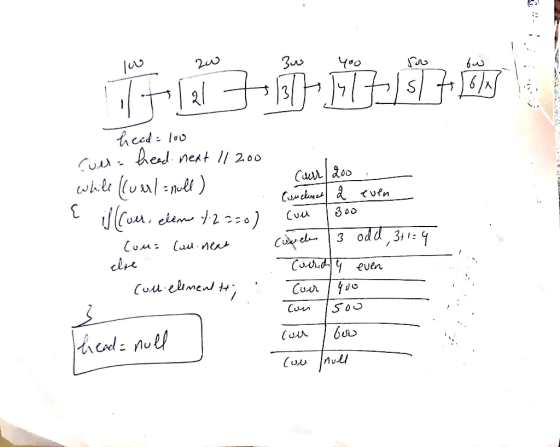
so head=null
there will be node in the list.
============================================================================================
3)
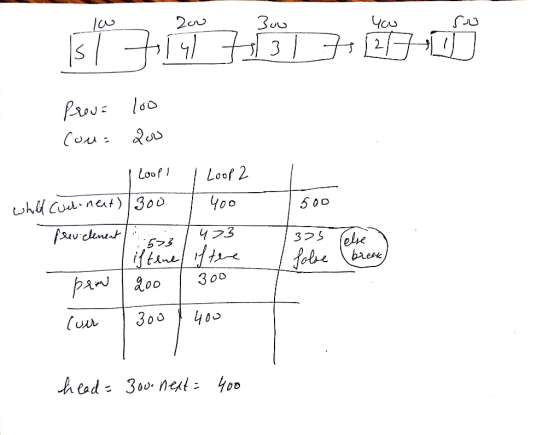
Given a singly linked list contains 5 nodes, which simply shows as 5->4->3->2->1, what is the value that you can find in the second node of the remaining list if the following statements are applied? Assume head reference refers the first node of the list.
Node prev = head;
Node curr = head. next;
while(curr.next!=null)
{
if(prev.element > 3)
{
prev = curr;
curr = curr.next;
}
else break;
}
head = prev.next;
Ans:
Add Answer to:
1)Given a singly linked list contains four nodes and simply show
as 4->3->2->1, where the head...
Given a singly linked list contains 5 nodes, which simply shows as 5->4->3->2->1, what is the...
Given a singly linked list contains 5 nodes, which simply shows as 5->4->3->2->1, what is the value that you can find in the second node of the remaining list if the following statements are applied? Assume head reference refers the first node of the list. Node prev = head; Node curr = head. next; while(curr.next!=null) { if(prev.element > 3) { prev = curr; curr = curr.next; } else break; } head = prev.next; Question 3 options: 3 2 4 1...
Question 2 (3 points) Given the following singly linked list (a list with four nodes), what...
 Question 2 (3 points) Given the following singly linked list (a list with four nodes), what will be the value stored at the last node when the following operations are executed? head->1111-151->11011->1211 Node curr = head; while(curr next !=null) { curr.item = curritem-head. item; curr = cur next; اسرة Node newNode = new Node(8): curr.next = newNode: 23 O 12 OS O21 Question 3 (3 points) Given a recursive method as shown below, what is the return value for P(5)...
True False Question 2 (3 points) Given a singly linked list with more than two nodes,...
 True False Question 2 (3 points) Given a singly linked list with more than two nodes, to remove the second node from a linked list with only head reference, assume curr - head, next, you do Set curr.next to head.next Oset head. next to curr.next Set head, next to curr Oset head to curr.next TL th Question 3 (3 points) Given the following singly linked list (a list with four nodes), what will be the value stored at the last...
C++: I need implement this code using Double Linked List using the cosiderations 1. head point...
C++: I need implement this code using Double Linked List using the cosiderations 1. head point to null in an empty list 2. There is not need of a tail pointer /*This class implements the singly linked list using templates Each list has two attributes: -head: first node in the list -tail: last node in the list #include "circDLLNode.h" template class { public: //Default constructor: creates an empty list (); //Destructor: deallocate memory ~(); ...
Question 13 (6 points) Assume the singly linked list is defined as a head reference variable...
 Question 13 (6 points) Assume the singly linked list is defined as a head reference variable refers to the first node and a size reference variable refers to the number of nodes (similar like your L.AB4). Provide a method named count that used to count and return the occurrences of the head item (item stored at the head node) in the list. If the list is empty, return - 1. provide the appropriate method signature and implementation. Format BIU In...
Data Structures - Singly Linked Lists You will add a method swapNodes to SinglyLinkedList class (below). This method should swap two nodes node1 and node2 (and not just their contents) given reference...
Data Structures - Singly Linked Lists You will add a method swapNodes to SinglyLinkedList class (below). This method should swap two nodes node1 and node2 (and not just their contents) given references only to node1 and node2. The new method should check if node1 and node2 are the same node, etc. Write the main method to test the swapNodes method. You may need to traverse the list. package linkedlists; public class SinglyLinkedList<E> implements Cloneable { // ---------------- nested Node class...
Question: SWAPPING NODES IN A SINGULARLY LINKED LIST: I am attempting to create a program that...
Question: SWAPPING NODES IN A SINGULARLY LINKED LIST: I am attempting to create a program that swaps 2 nodes (no matter where they are in the list) and am having some difficulty. I can't seem to figure out why this swap method is throwing an error. Code: (SWAPPING METHOD AND TEST LINE BOLDED) package linkedlists; public class SinglyLinkedList<E> implements Cloneable { //---------------- nested Node class ---------------- /** * Node of a singly linked list, which stores a reference to its...
14) Create a singly linked list using only two variables: head and current. Traverse through the...
14) Create a singly linked list using only two variables: head and current. Traverse through the list void addToEnd (struct node *&head, int data){ //create node //if head==NULL //else } int main (){ node * head=NULL; addToEnd(head,1); addToEnd(head,2); addToEnd(head,3); //Traverse using current }
Answer all questions 1- in circular singly linked list, previous pointer of the first node points...
 Answer all questions
1- in circular singly linked list, previous pointer of the first node points to which node A. First node B. Itself C. null D. Last node 2- Which of the following is NOT an applications of linked lists? A. Implementation of stacks and queues B. Dynamic memory allocation C. Manipulation of polynomials D. Keeping people at home during epidemics like corona virus 3- In a circular singly linked list? A. Components are all linked together in some...
Answer all questions
1- in circular singly linked list, previous pointer of the first node points to which node A. First node B. Itself C. null D. Last node 2- Which of the following is NOT an applications of linked lists? A. Implementation of stacks and queues B. Dynamic memory allocation C. Manipulation of polynomials D. Keeping people at home during epidemics like corona virus 3- In a circular singly linked list? A. Components are all linked together in some...
C++ You're given the pointer to the head nodes of two linked lists. Compare the data...
 C++
You're given the pointer to the head nodes of two linked lists. Compare the data in the nodes of the linked lists to check if they are equal. The lists are equal only if they have the same number of nodes and corresponding nodes contain the same data. Either head pointer given may be null meaning that the corresponding list is empty. Input Format You have to complete the int CompareLists (Node headA, Node* head B) method which takes...
C++
You're given the pointer to the head nodes of two linked lists. Compare the data in the nodes of the linked lists to check if they are equal. The lists are equal only if they have the same number of nodes and corresponding nodes contain the same data. Either head pointer given may be null meaning that the corresponding list is empty. Input Format You have to complete the int CompareLists (Node headA, Node* head B) method which takes...
 Question 2 (3 points) Given the following singly linked list (a list with four nodes), what will be the value stored at the last node when the following operations are executed? head->1111-151->11011->1211 Node curr = head; while(curr next !=null) { curr.item = curritem-head. item; curr = cur next; اسرة Node newNode = new Node(8): curr.next = newNode: 23 O 12 OS O21 Question 3 (3 points) Given a recursive method as shown below, what is the return value for P(5)...
 True False Question 2 (3 points) Given a singly linked list with more than two nodes, to remove the second node from a linked list with only head reference, assume curr - head, next, you do Set curr.next to head.next Oset head. next to curr.next Set head, next to curr Oset head to curr.next TL th Question 3 (3 points) Given the following singly linked list (a list with four nodes), what will be the value stored at the last...
 Question 13 (6 points) Assume the singly linked list is defined as a head reference variable refers to the first node and a size reference variable refers to the number of nodes (similar like your L.AB4). Provide a method named count that used to count and return the occurrences of the head item (item stored at the head node) in the list. If the list is empty, return - 1. provide the appropriate method signature and implementation. Format BIU In...
 Answer all questions
1- in circular singly linked list, previous pointer of the first node points to which node A. First node B. Itself C. null D. Last node 2- Which of the following is NOT an applications of linked lists? A. Implementation of stacks and queues B. Dynamic memory allocation C. Manipulation of polynomials D. Keeping people at home during epidemics like corona virus 3- In a circular singly linked list? A. Components are all linked together in some...
Answer all questions
1- in circular singly linked list, previous pointer of the first node points to which node A. First node B. Itself C. null D. Last node 2- Which of the following is NOT an applications of linked lists? A. Implementation of stacks and queues B. Dynamic memory allocation C. Manipulation of polynomials D. Keeping people at home during epidemics like corona virus 3- In a circular singly linked list? A. Components are all linked together in some...
 C++
You're given the pointer to the head nodes of two linked lists. Compare the data in the nodes of the linked lists to check if they are equal. The lists are equal only if they have the same number of nodes and corresponding nodes contain the same data. Either head pointer given may be null meaning that the corresponding list is empty. Input Format You have to complete the int CompareLists (Node headA, Node* head B) method which takes...
C++
You're given the pointer to the head nodes of two linked lists. Compare the data in the nodes of the linked lists to check if they are equal. The lists are equal only if they have the same number of nodes and corresponding nodes contain the same data. Either head pointer given may be null meaning that the corresponding list is empty. Input Format You have to complete the int CompareLists (Node headA, Node* head B) method which takes...
Most questions answered within 3 hours.
-
Where is the error in this code sequence?
String s1 = "Hello";
String s2 = "ello";...
asked 10 months ago -
Financial data for Joel de Paris, Inc., for last year
follow:
Joel de Paris, Inc.
Balance...
asked 10 months ago -
Consider this reaction:
Al2(SO4)3 (aq)+ BaCl3
(aq) Al2Cl6 (aq)- +
3BaSO4(s) . What is the...
asked 10 months ago -
Suppose that Savneet is considering increasing her
recent random sample from 20 car rentals to 40...
asked 10 months ago -
Trucks arrive at an unloading terminal at an average rate of 120
per hour.
Trucks arrive...
asked 10 months ago -
Why are methanol and ethanol completely soluble in water while
octanol is not very little soluble....
asked 10 months ago -
A facilities manager at a university reads in a research report
that the mean amount of...
asked 10 months ago -
When the CuSO4 is rehydrated by adding water to the anhydrous
compound, is this an endothermic...
asked 10 months ago -
A ray of sunlight is passing from diamond into crown glass; the
angle of incidence is...
asked 10 months ago -
A block of mass 0.249 kg is placed on top of a light, vertical
spring of...
asked 10 months ago -
how do the kidneys compensate in the presences of acidosis
a) trigger hyperventilate
b) reserve acid...
asked 10 months ago -
Question 501 pts
The rental rate of capital to the firm increases. Which of the
following...
asked 10 months ago