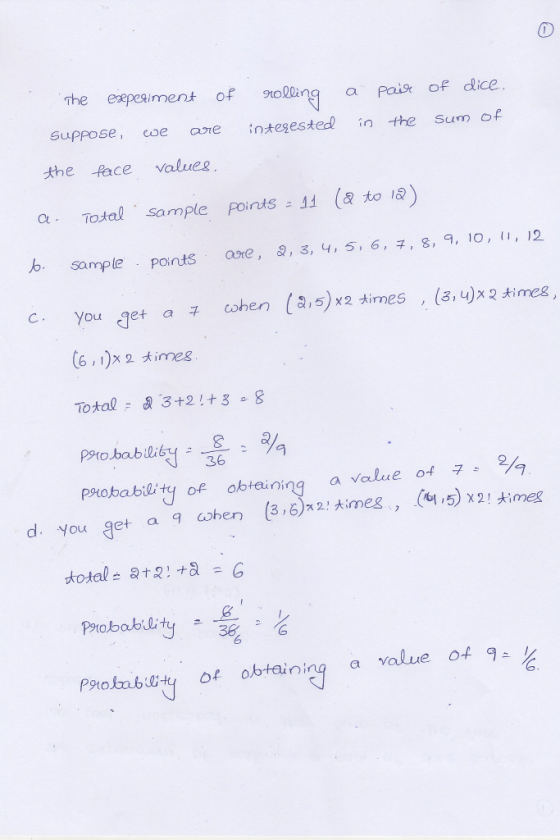
Consider the experiment of rolling a pair of dice. Suppose that we are interested in the...
Consider the experiment of rolling a pair of dice.
Suppose that we are interested in the sum of the face values
showing on the dice.
a. How many sample points are possible? (Use the counting rule for
multiple-step experimwnts.)
b. List the sample points.
c. What is the probability of obtaining a value of 7?
d. What is the probability of obtaining a value of 9 or
greater?
Homework Answers
ANSWER:
PROBABILITY: Probability is the measure of the likelihood that an event will occur in a Random Experiment. Probability is quantified as a number between 0 and 1, where, loosely speaking, 0 indicates impossibility and 1 indicates certainty. The higher the probability of an event, the more likely it is that the event will occur.
Add Answer to:
Consider the experiment of rolling a pair of dice.
Suppose that we are interested in the...
13. - 18 points ASWSBE13 4.E.016, My Notes Ask Your Teacher Consider the experiment of rolling...
 13. - 18 points ASWSBE13 4.E.016, My Notes Ask Your Teacher Consider the experiment of rolling a pair of dice. Suppose that we are interested in the sum of the face values showing on the dice. (w) How many sample points are possible? (Hint: use the counting rule for multiple-step experiments.) (b) List the sample points. There Select to sum the face values of a pair of dice to 2. There-Sec to sum the face values of a pair of...
1. Consider the experiment of rolling a pair of dice values showing on the dice. experiment...
 1. Consider the experiment of rolling a pair of dice values showing on the dice. experiment of rolling a pair of dice. Suppose we are interested in the sum of face a. How many simple events are possible? b. List the sample space. c. What is the probability of obtaining a 7? d. What is the probability of obtaining a value of 9 or more? Because each roll has six possible even values (2.4,6,8,10,12) and five possible odd values (3,5,7,9,11),...
Consider the experiment of rolling two dice. a) What is the probability of obtaining a sum...
Consider the experiment of rolling two dice. a) What is the probability of obtaining a sum of five? b) What is the probability of obtaining a sum of four or less? c) What is the probability of obtaining a sum of eight or more? a) The probability of obtaining a sum of five? . (Type an integer or a simplified fraction.)
Rolling Dice 2. A pair of dice is rolled. Here is the sample space (all of...
 Rolling Dice 2. A pair of dice is rolled. Here is the sample space (all of the possible outcomes) of rolling a pair of dice. First Die a) In how many different ways can we roll a 7 (as the sum of the two dice)? What is the probability of rolling a 7? 2 3 4 5 6 7 3 4 5 6 7 8 b) In how many ways can we roll a sum that is divisible by 3?...
Please work this out so I can make sure I solved it right. Chapter 4 8)...
 Please work this out so I can make sure I solved it
right.
Chapter 4 8) Consider the experiment of rolling a pair of dice a) How many sample points are there? What is the probability of obtaining a value of 7? What is the probability of obtaining a value of 9 or greater? Because each roll has six possible even values (2, 4, 6, 8, 10, 12) and only five possible odd values (3, 5, 7, 9, and 11),...
Please work this out so I can make sure I solved it
right.
Chapter 4 8) Consider the experiment of rolling a pair of dice a) How many sample points are there? What is the probability of obtaining a value of 7? What is the probability of obtaining a value of 9 or greater? Because each roll has six possible even values (2, 4, 6, 8, 10, 12) and only five possible odd values (3, 5, 7, 9, and 11),...
help please Consider the probability experiment of rolling two 6-sided dice, and the associated random variable...
 help please
Consider the probability experiment of rolling two 6-sided dice, and the associated random variable X = sum of the two dice. () (3 points) See the OpenLab poet which includes the sample space for this experiment, and gives part of the proba bility distribution of Complete the exercise by filling in this table to get the full probability distribution of X Sum of the two dice, Outcomes in the event (X=;} Probability PCX-23) 1/36 = 0.0278 3 {(1,2),...
help please
Consider the probability experiment of rolling two 6-sided dice, and the associated random variable X = sum of the two dice. () (3 points) See the OpenLab poet which includes the sample space for this experiment, and gives part of the proba bility distribution of Complete the exercise by filling in this table to get the full probability distribution of X Sum of the two dice, Outcomes in the event (X=;} Probability PCX-23) 1/36 = 0.0278 3 {(1,2),...
Please answer the question clearly 6. Suppose that we roll a pair of balanced dice. Let...
 Please answer the question clearly
6. Suppose that we roll a pair of balanced dice. Let X be the number of dice that show 1 and Y be the number of dice that show either 4, 5, or 6. (a) Draw a diagram like Figure 3.1 on page 62 showing the values of the pair (X, Y) associated with each of the 36 equally likely points of the sample space. (b) Construct a table showing the values of the joint...
Please answer the question clearly
6. Suppose that we roll a pair of balanced dice. Let X be the number of dice that show 1 and Y be the number of dice that show either 4, 5, or 6. (a) Draw a diagram like Figure 3.1 on page 62 showing the values of the pair (X, Y) associated with each of the 36 equally likely points of the sample space. (b) Construct a table showing the values of the joint...
An experiment consists of rolling two dice, let E1= “The sum of the numbers is greater...
An experiment consists of rolling two dice, let E1= “The sum of the numbers is greater than 7” and E3= “The numbers on the two dice are equal”. a. Are E1 and E3 mutually exclusive? b. What are the odds of rolling a pair with the same number on the faces?
A standard pair of six-sided dice is rolled. What is the probability of rolling a sum...
 A standard pair of six-sided dice is rolled. What is the probability of rolling a sum greater than 117 Express your answer as a fraction or a decimal number rounded to four decimal places. Answer/How to Enter) 2 Points Key Keyboard Shor I
11 Suppose that we are rolling a pair of fair dice till getting a sum of...
 11 Suppose that we are rolling a pair of fair dice till getting a sum of 4 or less. Let X be a random variable representing the number of rolls that we need to make. Calculate P(X> 3) a) 0.5787 b) 0.6944 c) 0.0046 3) None of these
 13. - 18 points ASWSBE13 4.E.016, My Notes Ask Your Teacher Consider the experiment of rolling a pair of dice. Suppose that we are interested in the sum of the face values showing on the dice. (w) How many sample points are possible? (Hint: use the counting rule for multiple-step experiments.) (b) List the sample points. There Select to sum the face values of a pair of dice to 2. There-Sec to sum the face values of a pair of...
 1. Consider the experiment of rolling a pair of dice values showing on the dice. experiment of rolling a pair of dice. Suppose we are interested in the sum of face a. How many simple events are possible? b. List the sample space. c. What is the probability of obtaining a 7? d. What is the probability of obtaining a value of 9 or more? Because each roll has six possible even values (2.4,6,8,10,12) and five possible odd values (3,5,7,9,11),...
 Rolling Dice 2. A pair of dice is rolled. Here is the sample space (all of the possible outcomes) of rolling a pair of dice. First Die a) In how many different ways can we roll a 7 (as the sum of the two dice)? What is the probability of rolling a 7? 2 3 4 5 6 7 3 4 5 6 7 8 b) In how many ways can we roll a sum that is divisible by 3?...
 Please work this out so I can make sure I solved it
right.
Chapter 4 8) Consider the experiment of rolling a pair of dice a) How many sample points are there? What is the probability of obtaining a value of 7? What is the probability of obtaining a value of 9 or greater? Because each roll has six possible even values (2, 4, 6, 8, 10, 12) and only five possible odd values (3, 5, 7, 9, and 11),...
Please work this out so I can make sure I solved it
right.
Chapter 4 8) Consider the experiment of rolling a pair of dice a) How many sample points are there? What is the probability of obtaining a value of 7? What is the probability of obtaining a value of 9 or greater? Because each roll has six possible even values (2, 4, 6, 8, 10, 12) and only five possible odd values (3, 5, 7, 9, and 11),...
 help please
Consider the probability experiment of rolling two 6-sided dice, and the associated random variable X = sum of the two dice. () (3 points) See the OpenLab poet which includes the sample space for this experiment, and gives part of the proba bility distribution of Complete the exercise by filling in this table to get the full probability distribution of X Sum of the two dice, Outcomes in the event (X=;} Probability PCX-23) 1/36 = 0.0278 3 {(1,2),...
help please
Consider the probability experiment of rolling two 6-sided dice, and the associated random variable X = sum of the two dice. () (3 points) See the OpenLab poet which includes the sample space for this experiment, and gives part of the proba bility distribution of Complete the exercise by filling in this table to get the full probability distribution of X Sum of the two dice, Outcomes in the event (X=;} Probability PCX-23) 1/36 = 0.0278 3 {(1,2),...
 Please answer the question clearly
6. Suppose that we roll a pair of balanced dice. Let X be the number of dice that show 1 and Y be the number of dice that show either 4, 5, or 6. (a) Draw a diagram like Figure 3.1 on page 62 showing the values of the pair (X, Y) associated with each of the 36 equally likely points of the sample space. (b) Construct a table showing the values of the joint...
Please answer the question clearly
6. Suppose that we roll a pair of balanced dice. Let X be the number of dice that show 1 and Y be the number of dice that show either 4, 5, or 6. (a) Draw a diagram like Figure 3.1 on page 62 showing the values of the pair (X, Y) associated with each of the 36 equally likely points of the sample space. (b) Construct a table showing the values of the joint...
 A standard pair of six-sided dice is rolled. What is the probability of rolling a sum greater than 117 Express your answer as a fraction or a decimal number rounded to four decimal places. Answer/How to Enter) 2 Points Key Keyboard Shor I
 11 Suppose that we are rolling a pair of fair dice till getting a sum of 4 or less. Let X be a random variable representing the number of rolls that we need to make. Calculate P(X> 3) a) 0.5787 b) 0.6944 c) 0.0046 3) None of these
Most questions answered within 3 hours.
-
Where is the error in this code sequence?
String s1 = "Hello";
String s2 = "ello";...
asked 11 months ago -
Financial data for Joel de Paris, Inc., for last year
follow:
Joel de Paris, Inc.
Balance...
asked 11 months ago -
Consider this reaction:
Al2(SO4)3 (aq)+ BaCl3
(aq) Al2Cl6 (aq)- +
3BaSO4(s) . What is the...
asked 11 months ago -
Suppose that Savneet is considering increasing her
recent random sample from 20 car rentals to 40...
asked 11 months ago -
Trucks arrive at an unloading terminal at an average rate of 120
per hour.
Trucks arrive...
asked 11 months ago -
Why are methanol and ethanol completely soluble in water while
octanol is not very little soluble....
asked 11 months ago -
A facilities manager at a university reads in a research report
that the mean amount of...
asked 11 months ago -
When the CuSO4 is rehydrated by adding water to the anhydrous
compound, is this an endothermic...
asked 11 months ago -
A ray of sunlight is passing from diamond into crown glass; the
angle of incidence is...
asked 11 months ago -
A block of mass 0.249 kg is placed on top of a light, vertical
spring of...
asked 11 months ago -
how do the kidneys compensate in the presences of acidosis
a) trigger hyperventilate
b) reserve acid...
asked 11 months ago -
Question 501 pts
The rental rate of capital to the firm increases. Which of the
following...
asked 11 months ago