If Purchasing power parity (PPP) holds, a. the real exchange rate increases b. the real exchange...
If Purchasing power parity (PPP) holds,
a. the real exchange rate increases
b. the real exchange rate decreases
c. the real exchange rate does not change
d. prices in the foreign country will increase
Homework Answers
Answer
Option c
the real exchange rate does not change
the real exchange rate and the PPP is the same as the real exchange rate means the costs of the goods same in any currency as the PPP do.
Add Answer to:
If Purchasing power parity (PPP) holds,
a. the real exchange rate increases
b. the real exchange...
The International Fisher Effect (IFE), Purchasing Power Parity (PPP) and Interest Rate Parity (IRP) are three...
 The International Fisher Effect (IFE), Purchasing Power Parity (PPP) and Interest Rate Parity (IRP) are three very important theories in international finance, each with its own predictions and implication. Which of the following is correct? IRP suggests that a change in interest rate differential will not change the currency's forward premium/discount. According to purchasing power parity (PPP), if a foreign country's inflation rate is below the inflation rate at home, home country consumers will increase their imports from the foreign...
According to the absolute purchasing power parity (PPP) hypothesis, a. the real exchange rate, ϵ =...
According to the absolute purchasing power parity (PPP) hypothesis, a. the real exchange rate, ϵ = eP/P*, between the currencies of two trading countries must always be equal to one. b. the real exchange rate, ϵ = eP/P*, between the currencies of two trading countries must be constant, but not necessarily equal to one. c. the ratio of the real GDPs of two trading countries must be equal to one when measured with a common set of prices. d. the...
Briefly explain exchange rate theories: Interest Rate Parity (IRP) and Purchasing Power Parity (PPP) and the...
Briefly explain exchange rate theories: Interest Rate Parity (IRP) and Purchasing Power Parity (PPP) and the International Fisher Effect (IFE). How do these work?
ulate the Implied Purchasing Power Parity (PPP) exchange rate for each of the below! countries and...
 ulate the Implied Purchasing Power Parity (PPP) exchange rate for each of the below! countries and explain which currencies are over-or undervalued. Actual Exchange Rate Country U.S. Japan China India Egypt Donut Price in U.S. Dollar 1.40 1.10 2.20 2.70 2.25 5.8 | 1.55 4.30 0.8
Calculate the Implied Purchasing Power Parity (PPP) exchange rate for each of the below countries and explain which...
 Calculate the Implied Purchasing Power Parity (PPP) exchange rate for each of the below countries and explain which currencies are over-or undervalued. Actual Exchange Rate Country U.S. Japan China India Egypt Donut Price in U.S. Dollar 1.40 1.10 2.20 2.70 0.8 2.25 5.8 1.55 4.30
Assuming the PPP (Purchasing Power Parity) holds, what is the cost in the UK of a...
Assuming the PPP (Purchasing Power Parity) holds, what is the cost in the UK of a Lasko Beer if the price in Croatia is HRK 20? Why might the beer actually sell at a different price in the UK?
If purchasing power parity prevails absolutely in a two country world, the real exchange rate between...
If purchasing power parity prevails absolutely in a two country world, the real exchange rate between the two countries should be...
Assuming the theory of purchasing power parity holds, what is the exchange rate between the United...
Assuming the theory of purchasing power parity holds, what is the exchange rate between the United States and Mexico if the price of an Under Armour shirt costs $25 in the United States and 350 pesos in Mexico? (The shirts are identical in each country.) a. 1.43 pesos per dollar b. 1.14 pesos per dollar c. 0.07 pesos per dollar d. 14.00 pesos per dollar e. 7.14 pesos per dollar
28. In-1 (%) PPP Line . Increased Purchasing Power of Foreign Goods % in the Foreign...
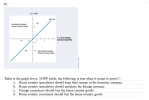 28. In-1 (%) PPP Line . Increased Purchasing Power of Foreign Goods % in the Foreign Currency's Spot Rate .D Decreased Purchasing Power of Foreign Goods Refer to the graph above. If PPP holds, the following is true when it comes to point C: a. Home country speculators should keep their money in the domestic currency. b. Home country speculators should purchase the foreign currency. c. Foreign consumers should buy the home country goods. d. Home country consumers should buy...
PPP - Purchasing Power Parity Suppose that the current Swiss franc to U.S. dollar spot exchange...
PPP - Purchasing Power Parity Suppose that the current Swiss franc to U.S. dollar spot exchange rate is $:SFr = 1.60 (i.e., 1.60 SFr per U.S. dollar or 1.60 SFr/$). The expected inflation over the coming year is 2% in Switzerland and 5% in the US. According to the purchasing power parity, what is the expected value of the Swiss franc to U.S. dollar spot exchange rate a year from now?
 The International Fisher Effect (IFE), Purchasing Power Parity (PPP) and Interest Rate Parity (IRP) are three very important theories in international finance, each with its own predictions and implication. Which of the following is correct? IRP suggests that a change in interest rate differential will not change the currency's forward premium/discount. According to purchasing power parity (PPP), if a foreign country's inflation rate is below the inflation rate at home, home country consumers will increase their imports from the foreign...
 ulate the Implied Purchasing Power Parity (PPP) exchange rate for each of the below! countries and explain which currencies are over-or undervalued. Actual Exchange Rate Country U.S. Japan China India Egypt Donut Price in U.S. Dollar 1.40 1.10 2.20 2.70 2.25 5.8 | 1.55 4.30 0.8
 Calculate the Implied Purchasing Power Parity (PPP) exchange rate for each of the below countries and explain which currencies are over-or undervalued. Actual Exchange Rate Country U.S. Japan China India Egypt Donut Price in U.S. Dollar 1.40 1.10 2.20 2.70 0.8 2.25 5.8 1.55 4.30
 28. In-1 (%) PPP Line . Increased Purchasing Power of Foreign Goods % in the Foreign Currency's Spot Rate .D Decreased Purchasing Power of Foreign Goods Refer to the graph above. If PPP holds, the following is true when it comes to point C: a. Home country speculators should keep their money in the domestic currency. b. Home country speculators should purchase the foreign currency. c. Foreign consumers should buy the home country goods. d. Home country consumers should buy...
Most questions answered within 3 hours.
-
Where is the error in this code sequence?
String s1 = "Hello";
String s2 = "ello";...
asked 10 months ago -
Financial data for Joel de Paris, Inc., for last year
follow:
Joel de Paris, Inc.
Balance...
asked 10 months ago -
Consider this reaction:
Al2(SO4)3 (aq)+ BaCl3
(aq) Al2Cl6 (aq)- +
3BaSO4(s) . What is the...
asked 10 months ago -
Suppose that Savneet is considering increasing her
recent random sample from 20 car rentals to 40...
asked 10 months ago -
Trucks arrive at an unloading terminal at an average rate of 120
per hour.
Trucks arrive...
asked 10 months ago -
Why are methanol and ethanol completely soluble in water while
octanol is not very little soluble....
asked 10 months ago -
A facilities manager at a university reads in a research report
that the mean amount of...
asked 10 months ago -
When the CuSO4 is rehydrated by adding water to the anhydrous
compound, is this an endothermic...
asked 10 months ago -
A ray of sunlight is passing from diamond into crown glass; the
angle of incidence is...
asked 10 months ago -
A block of mass 0.249 kg is placed on top of a light, vertical
spring of...
asked 10 months ago -
how do the kidneys compensate in the presences of acidosis
a) trigger hyperventilate
b) reserve acid...
asked 10 months ago -
Question 501 pts
The rental rate of capital to the firm increases. Which of the
following...
asked 10 months ago