The water solubilities of oxalic acid and sodium oxalate at room temp are 10g/100ml and 3.7g/100ml...
The water solubilities of oxalic acid and sodium oxalate at room temp are 10g/100ml and 3.7g/100ml respectively. Could you prepare oxalic acid by adding HCl to a solution of sodium oxalate, cooling it to room temp, and filtering the resulting mixture? Explain why or why not.
Homework Answers
No, Oxalic acid can't be prepared in filter paper this way.
Explanation:
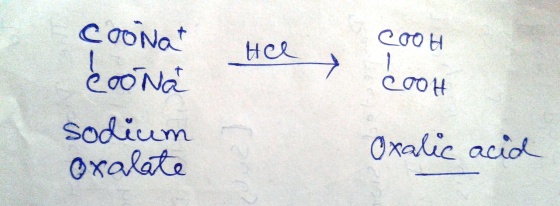
Sodium oxalate is the sodium salt of oxalic acid and by simple acidification oxalic acid can be recovered in solution. But the problem is when sodium oxalate converted to oxalic acid its solubility increases at room temperature. So at room temperature oxalic acid will be in the solution not in solid precipitate that's why there will be nothing to filtrate.
Add Answer to:
The water solubilities of oxalic acid and sodium oxalate at room
temp are 10g/100ml and 3.7g/100ml...
The water solubilities of oxalic acid and sodium oxalate at room temperature are 10g/100ml and 3.7...
The water solubilities of oxalic acid and sodium oxalate at room temperature are 10g/100ml and 3.7 g/100ml, respectively. Could you prepare oxalic acid by adding HCl to a solution of sodium oxalate, cooling it to room temperature and then filtering the resulting mixture? Explain why or why not.
1. Why did you dissolve Oxalate (sodium oxalate or your sample) in sulfuric acid rather than...
1. Why did you dissolve Oxalate (sodium oxalate or your sample) in sulfuric acid rather than in water? 2. Why did you heat solution (oxalate and sulfuric acid mixture) before titration with KMnO4?
Sodium carbonate, Na2CO3, reacts with hydrochloric acid, HCl, to produce sodium chloride, carbon dioxide and water....
 Sodium carbonate, Na2CO3, reacts with hydrochloric acid, HCl, to produce sodium chloride, carbon dioxide and water. Refer to slide 7.18 for a summary of formulae relevant to the calculations below. 2HCl(aq) + Na.CO3(aq) + NaCl(aq) + H2O(l) + CO2(g) 1. Use this reaction to explain what is meant by the terms "acid", "conjugate base" and "salt" 2. Balance the equation for this reaction. 3. A solution was prepared by dissolving 5.00 g of Na2CO3 in water and adding water to...
A solution is prepared by dissolving 0.5892 g oxalic acid (H2C2O4) in enough water to make...
A solution is prepared by dissolving 0.5892 g oxalic acid (H2C2O4) in enough water to make 100.0 mL of solution. A 10.00-mL aliquot (portion) of this solution is then diluted to a final volume of 250.0 mL. What is the final molarity of the diluted oxalic acid solution? I do not know if the answer of 0.00187 or 1.87 x 10^ -3 is correct. It is incorrect in my perspective, so i do not expect that answer, if you think...
ould you help me with all three, please 8) If the solubility limit of sodium acetate (Molar mass-82 g/mol) at room temp is 76 grams per 100 grams of water, would a solution where 355 grams of sod...
 ould you help me with all three, please 8) If the solubility limit of sodium acetate (Molar mass-82 g/mol) at room temp is 76 grams per 100 grams of water, would a solution where 355 grams of sodium acetate is dissolved in 465 mi of water be considered supersaturated7 Show all your work, and asume 1 mi water-1gram 9) if the s Am isotope emits an alpha particle, what would be the atomic namber of the 243 resulting daughter atom?...
Sodium carbonate, Na2COs, reacts with hydrochloric acid, HCl, to produce sodium chloride, carbon dioxide and water....
 Sodium carbonate, Na2COs, reacts with hydrochloric acid, HCl, to produce sodium chloride, carbon dioxide and water. Refer to slide 7.18 for a summary of formulae relevant to the calculations below. 2HCI(aq) Na,cO3(aq) NaCl(aq) H2O(I) CO2(g) 1. Use this reaction to explain what is meant by the terms "acid", "conjugate base" and "salt". (6 marks) 2 Balance the equation for this reaction. (2 marks) A solution was prepared by dissolving 5.00 g of Na,CO3 in water and adding water to give...
Acid buffer described in Problem 21, you discover that your m ion? laboratory is out of sodium ac...
 number 23
acid buffer described in Problem 21, you discover that your m ion? laboratory is out of sodium acetate, but you do have sodium hydroxide. How much (in moles and grams) acetic acid and til the pH on of the sodium hydroxide do you need to make the buffer? f th ola . Another alternative. Your friend from another labora- ory was out of acetic acid, so tries to prepare the buffer in Problem 21 by dissolving 41.02 g...
number 23
acid buffer described in Problem 21, you discover that your m ion? laboratory is out of sodium acetate, but you do have sodium hydroxide. How much (in moles and grams) acetic acid and til the pH on of the sodium hydroxide do you need to make the buffer? f th ola . Another alternative. Your friend from another labora- ory was out of acetic acid, so tries to prepare the buffer in Problem 21 by dissolving 41.02 g...
1. 1x10^-9 moles of strong acid HCl are added to of water (total volume is 1L)....
1. 1x10^-9 moles of strong acid HCl are added to of water (total volume is 1L). the pH of the resulting solution is... a)9 b)8 c)7 d)5 e)2 I got 9 but got the answer incorrect, so i would like to know how to solve this properly and what is the final answer. 2. the pKa of acetic acid is 4.76. if the pH=4.76 and the concentration of sodium acetate is 0.1M, what is the concentration of acetic acid? a)0.05...
Preparation of Phosphate Buffer Rxn: Purpose: The purpose of lab this week is to prepare a...
Preparation of Phosphate Buffer Rxn: Purpose: The purpose of lab this week is to prepare a 0.05M sodium phosphate buffer, use a pH meter to adjust the pH of this buffer, and to calculate theoretical pH changes upon addition of acid/ base. Your theory will then be correlated against your actual observational pH changes. Solutions to be made Molecular Weight Table Solution Volume 1.0M HCL 10ML 1.0 M NaOH 20ml 0.05M Sodium Phosphate: *?g NaH2PO4 H2O + *?g Na2HPO4 7H2O,...
The Na,Co, solution described above was used to analyse a hydrochloric acid solution of unknown concentration....
 The Na,Co, solution described above was used to analyse a hydrochloric acid solution of unknown concentration. It was found that 24.30 mL of the Na,Co, solution was required to neutralise a 20.00 mL sample of the hydrochloric acid solution. 4. Using your answer to part 3 above, calculate the amount of Na,Co, present in 24.30 mL of the Na,Co, solution. (2 marks) 5. Using your answer to part 2 above, deduce the amount of HCl that was present in the...
 Sodium carbonate, Na2CO3, reacts with hydrochloric acid, HCl, to produce sodium chloride, carbon dioxide and water. Refer to slide 7.18 for a summary of formulae relevant to the calculations below. 2HCl(aq) + Na.CO3(aq) + NaCl(aq) + H2O(l) + CO2(g) 1. Use this reaction to explain what is meant by the terms "acid", "conjugate base" and "salt" 2. Balance the equation for this reaction. 3. A solution was prepared by dissolving 5.00 g of Na2CO3 in water and adding water to...
 ould you help me with all three, please 8) If the solubility limit of sodium acetate (Molar mass-82 g/mol) at room temp is 76 grams per 100 grams of water, would a solution where 355 grams of sodium acetate is dissolved in 465 mi of water be considered supersaturated7 Show all your work, and asume 1 mi water-1gram 9) if the s Am isotope emits an alpha particle, what would be the atomic namber of the 243 resulting daughter atom?...
 Sodium carbonate, Na2COs, reacts with hydrochloric acid, HCl, to produce sodium chloride, carbon dioxide and water. Refer to slide 7.18 for a summary of formulae relevant to the calculations below. 2HCI(aq) Na,cO3(aq) NaCl(aq) H2O(I) CO2(g) 1. Use this reaction to explain what is meant by the terms "acid", "conjugate base" and "salt". (6 marks) 2 Balance the equation for this reaction. (2 marks) A solution was prepared by dissolving 5.00 g of Na,CO3 in water and adding water to give...
 number 23
acid buffer described in Problem 21, you discover that your m ion? laboratory is out of sodium acetate, but you do have sodium hydroxide. How much (in moles and grams) acetic acid and til the pH on of the sodium hydroxide do you need to make the buffer? f th ola . Another alternative. Your friend from another labora- ory was out of acetic acid, so tries to prepare the buffer in Problem 21 by dissolving 41.02 g...
number 23
acid buffer described in Problem 21, you discover that your m ion? laboratory is out of sodium acetate, but you do have sodium hydroxide. How much (in moles and grams) acetic acid and til the pH on of the sodium hydroxide do you need to make the buffer? f th ola . Another alternative. Your friend from another labora- ory was out of acetic acid, so tries to prepare the buffer in Problem 21 by dissolving 41.02 g...
 The Na,Co, solution described above was used to analyse a hydrochloric acid solution of unknown concentration. It was found that 24.30 mL of the Na,Co, solution was required to neutralise a 20.00 mL sample of the hydrochloric acid solution. 4. Using your answer to part 3 above, calculate the amount of Na,Co, present in 24.30 mL of the Na,Co, solution. (2 marks) 5. Using your answer to part 2 above, deduce the amount of HCl that was present in the...
Most questions answered within 3 hours.
-
Where is the error in this code sequence?
String s1 = "Hello";
String s2 = "ello";...
asked 11 months ago -
Financial data for Joel de Paris, Inc., for last year
follow:
Joel de Paris, Inc.
Balance...
asked 11 months ago -
Consider this reaction:
Al2(SO4)3 (aq)+ BaCl3
(aq) Al2Cl6 (aq)- +
3BaSO4(s) . What is the...
asked 11 months ago -
Suppose that Savneet is considering increasing her
recent random sample from 20 car rentals to 40...
asked 11 months ago -
Trucks arrive at an unloading terminal at an average rate of 120
per hour.
Trucks arrive...
asked 11 months ago -
Why are methanol and ethanol completely soluble in water while
octanol is not very little soluble....
asked 11 months ago -
A facilities manager at a university reads in a research report
that the mean amount of...
asked 11 months ago -
When the CuSO4 is rehydrated by adding water to the anhydrous
compound, is this an endothermic...
asked 11 months ago -
A ray of sunlight is passing from diamond into crown glass; the
angle of incidence is...
asked 11 months ago -
A block of mass 0.249 kg is placed on top of a light, vertical
spring of...
asked 11 months ago -
how do the kidneys compensate in the presences of acidosis
a) trigger hyperventilate
b) reserve acid...
asked 11 months ago -
Question 501 pts
The rental rate of capital to the firm increases. Which of the
following...
asked 11 months ago