The time to failure of a mechanical component (in a vehicle) is normally distributed with a...
The time to failure of a mechanical component (in a vehicle) is normally distributed with a MTTF = 20,000 miles and a standard deviation of 5,000 miles. Since installing this component, it has not failed in the first 20,000 miles. What is the probability that it does not fail in the next 10,000 miles?
Homework Answers

Add Answer to:
The time to failure of a mechanical component (in a vehicle) is
normally distributed with a...
A DC battery has a time to failure that is normally distributed with a mean of...
A DC battery has a time to failure that is normally distributed with a mean of 30 hours and a standard deviation of 4 hours. (a) What is the 25 hour reliability? (b) When should a battery be replaced to ensure that there is not more than a 5% change of failure prior to replacement? (c) Two batteries are connected in parallel to power a light. Assuming that the light does not fail, what is the 35 hour reliability for...
A company makes car shocks. The distance traveled before the shocks fail is normally distributed with...
A company makes car shocks. The distance traveled before the shocks fail is normally distributed with a mean of 75,000 miles and a standard deviation of 10,000 miles. At about what number of miles is there a 80% chance that the shock will have failed?
7 - 22 (page 365). Spacescope Inc. has an electronic component that has a failure rate...
 7 - 22 (page 365). Spacescope Inc. has an electronic component that has a failure rate of 0.0000165 units/hour. Find the mean time to failure (MTTF). What is the probability (assume an exponential distribution) that the component wil not have failed after 15,000 hours of operation? Calculate your answer using the appropriate mathematical formula, and verify your results using Excel.
Calculate mean time to failure, standard deviation, and design life for a continuously run, mechanical system:...
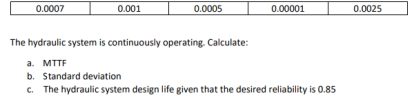 Calculate mean time to failure, standard deviation, and design
life for a continuously run, mechanical system:
The failure rates are given per day as:
0.0007 0.001 0.0005 0.00001 0.0025 The hydraulic system is continuously operating. Calculate: a. MTTF b. Standard deviation C. The hydraulic system design life given that the desired reliability is 0.85
Calculate mean time to failure, standard deviation, and design
life for a continuously run, mechanical system:
The failure rates are given per day as:
0.0007 0.001 0.0005 0.00001 0.0025 The hydraulic system is continuously operating. Calculate: a. MTTF b. Standard deviation C. The hydraulic system design life given that the desired reliability is 0.85
2. If assume collection of modules have exponentially distributed lifetimes (age of component doesn't matter in...
2. If assume collection of modules have exponentially distributed lifetimes (age of component doesn't matter in failure probability) and modules fail independently, overall failure rate of collection is sum of failure rates of modules. Calculate MTTF of a disk subsystem with • 10 disks, each rated at 1,000,000 hour MTTF • 1 SCSI controller, 500,000 hour MTTF • 1 power supply, 200,000 hour MTTF • 1 fan, 200,000 MTTF • 1 SCSI cable, 1,000,000 hour MTTF 1) Failure Rate? 2)...
A mechanical device has a wearout time distributed normally with a mean of 1100 hours and...
A mechanical device has a wearout time distributed normally with a mean of 1100 hours and a standard deviation of 50 hours. Find the values that constitute the central 95% of the wearout times.
The time it takes to assemble a component on a factory assemble line is normally distributed...
 The time it takes to assemble a component on a factory assemble line is normally distributed with a man of 3.1 minutes and a standard deviation of 0.6 minutes. Find the probability that a randomly selected employee will take between 2.0 and 2.3 minutes? Answer In a Sentence Question 7: The following data gives the information of the number of children that could complete an activity in the specified time. Construct a histogram with probabilities. Time No. of Children 30...
The time to failure T of a component is assumed to be uniformly distributed over (a,...
 The time to failure T of a component is assumed to be uniformly distributed over (a, b]. The probability density is thus for a<t< b Derive the corresponding survivor function R(t) and failure rate function z(t). Draw a sketch of z(t).
2.27 The time to failure T of a component is assumed to be uniformly distributed over...
 2.27 The time to failure T of a component is assumed to be uniformly distributed over (a, b. The probability density is thus (1)for a<isb b-a Derive the corresponding survivor function R(t) and failure rate function z(). Draw a sketch of z()
The time required to assemble an electronic component is normally distributed, with a mean of 12...
The time required to assemble an electronic component is normally distributed, with a mean of 12 minutes and a standard deviation of 1.5 minutes. Find the probability that a particular assembly take less than 10 minutes. a. 0.6542 b. 0.0918 c. 0.8164 d. 0.9082 e. 0.4541
 7 - 22 (page 365). Spacescope Inc. has an electronic component that has a failure rate of 0.0000165 units/hour. Find the mean time to failure (MTTF). What is the probability (assume an exponential distribution) that the component wil not have failed after 15,000 hours of operation? Calculate your answer using the appropriate mathematical formula, and verify your results using Excel.
 Calculate mean time to failure, standard deviation, and design
life for a continuously run, mechanical system:
The failure rates are given per day as:
0.0007 0.001 0.0005 0.00001 0.0025 The hydraulic system is continuously operating. Calculate: a. MTTF b. Standard deviation C. The hydraulic system design life given that the desired reliability is 0.85
Calculate mean time to failure, standard deviation, and design
life for a continuously run, mechanical system:
The failure rates are given per day as:
0.0007 0.001 0.0005 0.00001 0.0025 The hydraulic system is continuously operating. Calculate: a. MTTF b. Standard deviation C. The hydraulic system design life given that the desired reliability is 0.85
 The time it takes to assemble a component on a factory assemble line is normally distributed with a man of 3.1 minutes and a standard deviation of 0.6 minutes. Find the probability that a randomly selected employee will take between 2.0 and 2.3 minutes? Answer In a Sentence Question 7: The following data gives the information of the number of children that could complete an activity in the specified time. Construct a histogram with probabilities. Time No. of Children 30...
 The time to failure T of a component is assumed to be uniformly distributed over (a, b]. The probability density is thus for a<t< b Derive the corresponding survivor function R(t) and failure rate function z(t). Draw a sketch of z(t).
 2.27 The time to failure T of a component is assumed to be uniformly distributed over (a, b. The probability density is thus (1)for a<isb b-a Derive the corresponding survivor function R(t) and failure rate function z(). Draw a sketch of z()
Most questions answered within 3 hours.
-
Where is the error in this code sequence?
String s1 = "Hello";
String s2 = "ello";...
asked 10 months ago -
Financial data for Joel de Paris, Inc., for last year
follow:
Joel de Paris, Inc.
Balance...
asked 10 months ago -
Consider this reaction:
Al2(SO4)3 (aq)+ BaCl3
(aq) Al2Cl6 (aq)- +
3BaSO4(s) . What is the...
asked 10 months ago -
Suppose that Savneet is considering increasing her
recent random sample from 20 car rentals to 40...
asked 10 months ago -
Trucks arrive at an unloading terminal at an average rate of 120
per hour.
Trucks arrive...
asked 10 months ago -
Why are methanol and ethanol completely soluble in water while
octanol is not very little soluble....
asked 10 months ago -
A facilities manager at a university reads in a research report
that the mean amount of...
asked 10 months ago -
When the CuSO4 is rehydrated by adding water to the anhydrous
compound, is this an endothermic...
asked 10 months ago -
A ray of sunlight is passing from diamond into crown glass; the
angle of incidence is...
asked 10 months ago -
A block of mass 0.249 kg is placed on top of a light, vertical
spring of...
asked 10 months ago -
how do the kidneys compensate in the presences of acidosis
a) trigger hyperventilate
b) reserve acid...
asked 10 months ago -
Question 501 pts
The rental rate of capital to the firm increases. Which of the
following...
asked 10 months ago